

READ

Life in the Qfly Red Zone

While it gives the neighbourhood a slightly Stranger Things vibe, DPIRD’s Qfly eradication program isn’t that scary – and is actually quite important.
Rockwell McGellin
Rockwell McGellin
STEM Content Creator
Life in the Qfly Red Zone

Welcome to the Red Zone.

Cars from The Department patrol the streets. Agents in high-vis go door to door, looking for invaders hiding in plain sight. 

Cryptic surveillance devices appear across the neighbourhood. Posters and leaflets urge citizens to be vigilant and to play their part in the Eradication Project.

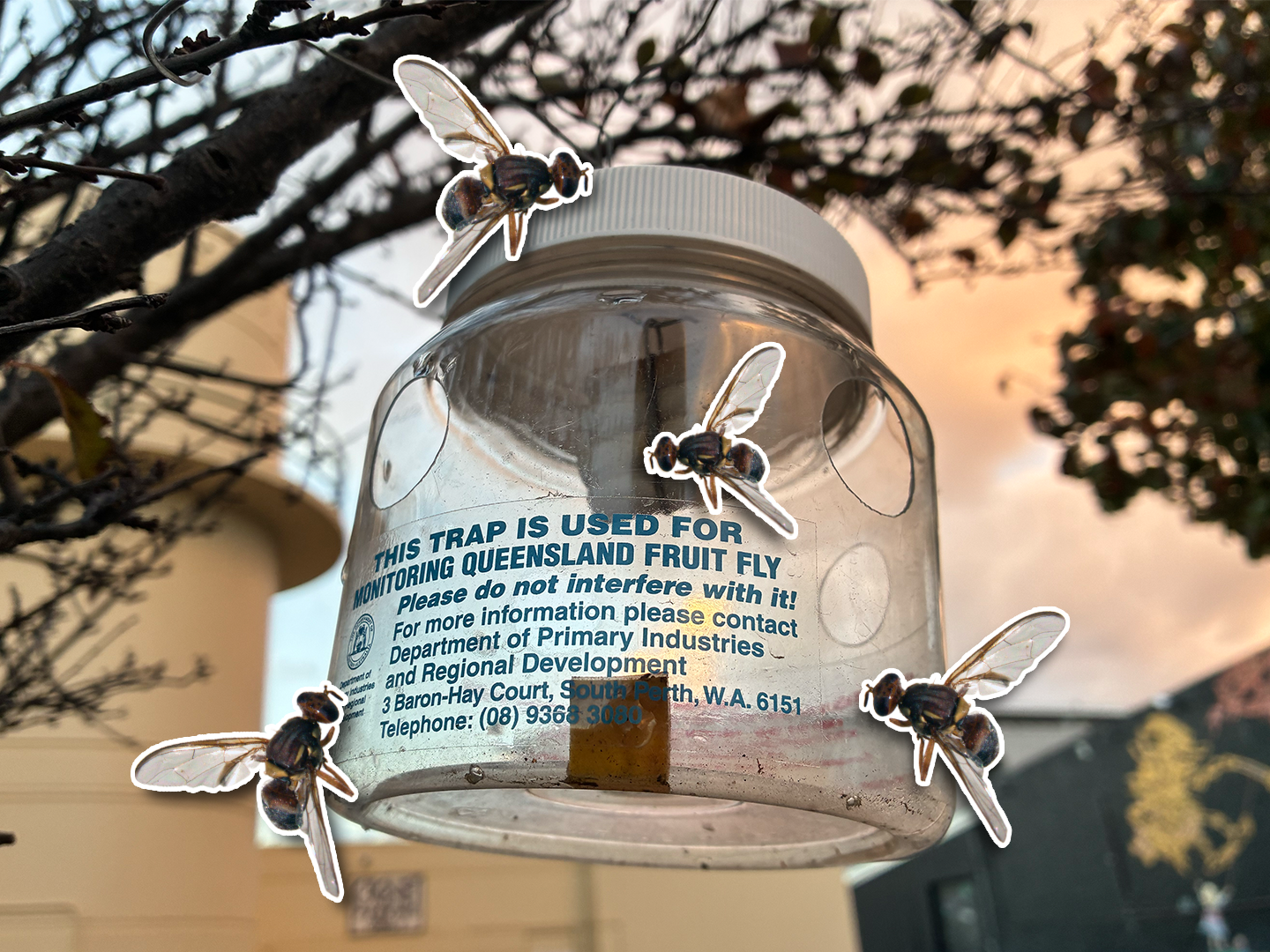
Because they are among us. And a single, undetectable puncture will leave you with thousands of them bursting out of your skin.
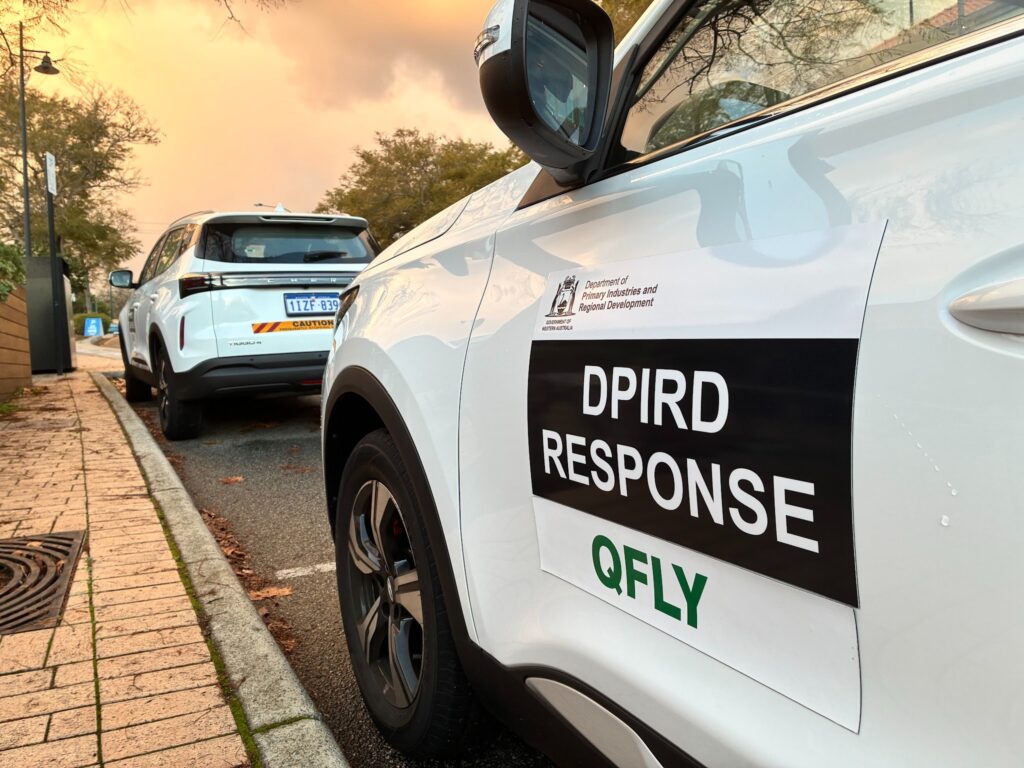
Caption: You may have seen these cars orbiting your streets – but why?
Credit: Rockwell McGellin

If you’re a lemon, that is. 

Or any of the other 300 plant species susceptible to Qfly – the Queensland fruit fly.

Qfly don’t bother me

For humans, life in the Red Zone – also known as South Perth – goes on as normal with a couple of changes under the eye of the Department of Primary Industries and Regional Development (DPIRD).

Queensland fruit fly is an insect that hops from fruit to soil and back as part of its life cycle. So far, despite some close calls, it hasn’t established a foothold in WA. But in April 2026, a network of surveillance devices detected an infestation on the southern shore of the Derbal Yerrigan/Swan River.
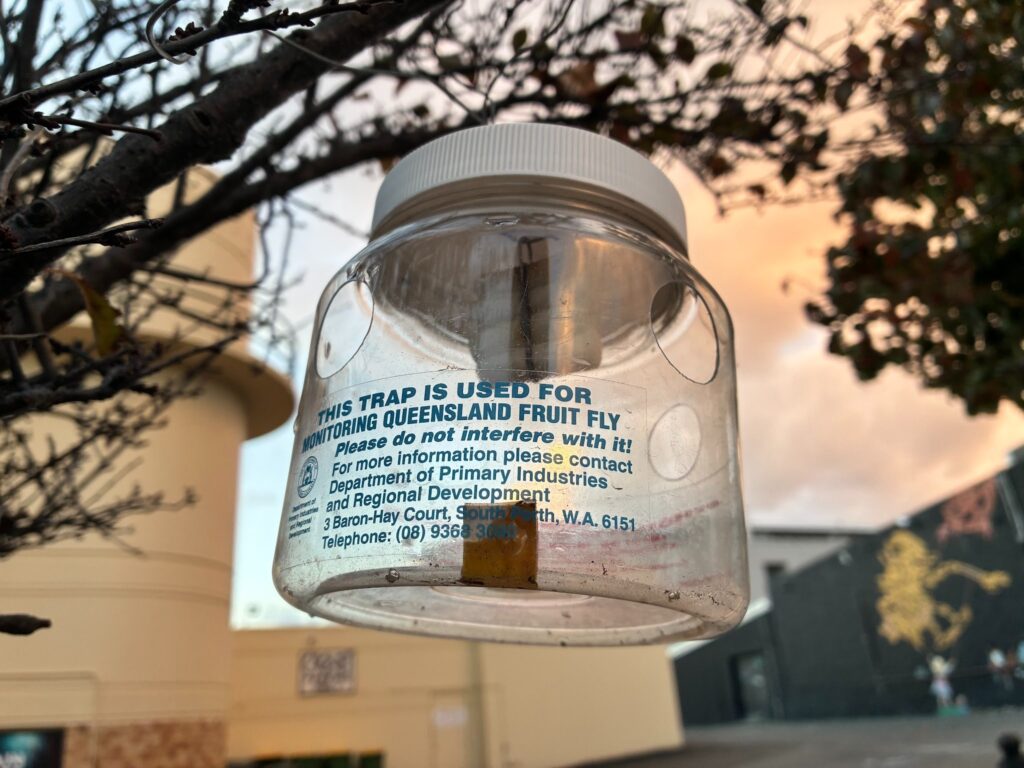
Caption: A key part of the surveillance network. 
Credit: Rockwell McGellin

That network is mostly jars hanging from trees, loaded with bait that’s irresistible to fruit flies. Since then, quarantine workers have been checking backyard trees, from verges to backyards. 

If you’re lucky, your tree will get a pretty ribbon – and be squirted with a brown goop combining an irresistible sugar syrup with a chemical from a soil bacterium that only kills fruit flies.

Qfly and A

According to its latest update, DPIRD has deployed 5,743 lures and 2,522 litres of brown goop and made 17,610 home visits since April. 

It’s a huge effort spread over hundreds of streets and thousands of homes.
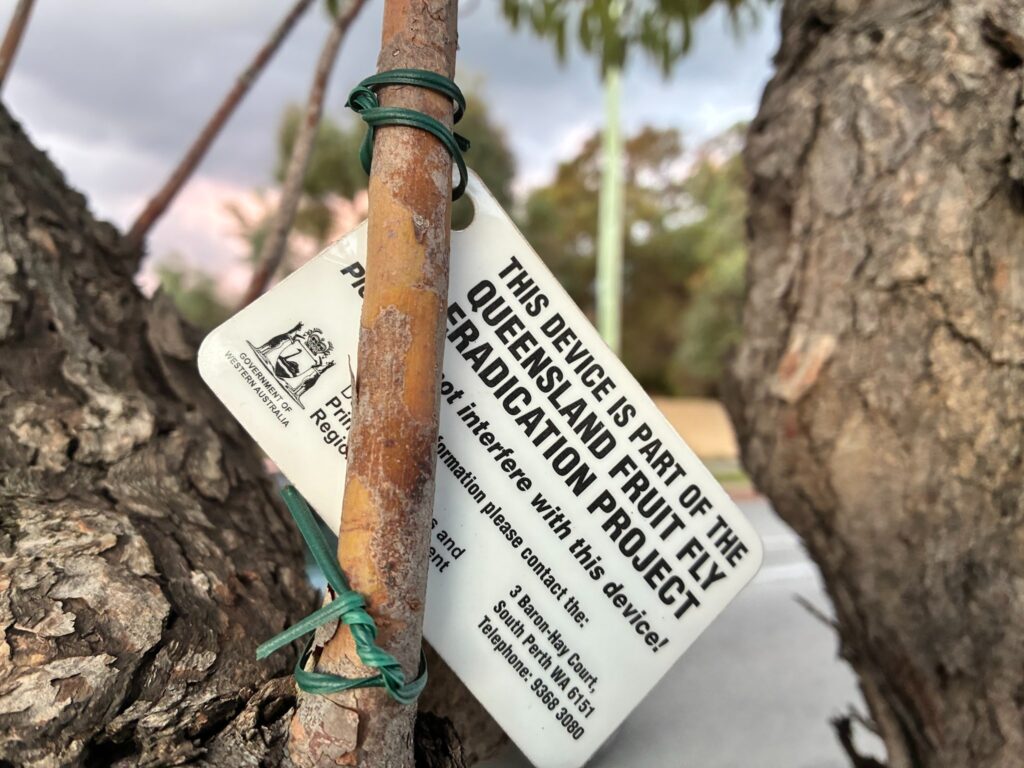
Caption: Devices can be anything from jars to sticky paper.
Credit: Rockwell McGellin

Without community awareness, the job gets a lot harder. If curiosity about the slightly ominous cars doing laps of the neighbourhood gets locals searching for Qfly facts, maybe that’s a good thing.

It seems to be working. DPIRD successfully repelled 10 invasion attempts since 1989, and since the latest eradication project started in April, the Red Zone has been confined to south of the river.

Until a better option comes along, goop, jars and flyers are the best tools we have.
Rockwell McGellin
About the author
Rockwell McGellin
Rockwell is a jack of all trades with a Masters in science communication. He likes space, beer, and sciencey t-shirts. Yes, Rocky is fine for short.
View articles
Rockwell is a jack of all trades with a Masters in science communication. He likes space, beer, and sciencey t-shirts. Yes, Rocky is fine for short.
View articles

NEXT ARTICLE

We've got chemistry, let's take it to the next level!

Get the latest WA science news delivered to your inbox, every fortnight.

This field is for validation purposes and should be left unchanged.

Republish

Creative Commons Logo

Republishing our content

We want our stories to be shared and seen by as many people as possible.

Therefore, unless it says otherwise, copyright on the stories on Particle belongs to Scitech and they are published under a Creative Commons Attribution-NoDerivatives 4.0 International License.

This allows you to republish our articles online or in print for free. You just need to credit us and link to us, and you can’t edit our material or sell it separately.

Using the ‘republish’ button on our website is the easiest way to meet our guidelines.

Guidelines

You cannot edit the article.

When republishing, you have to credit our authors, ideally in the byline. You have to credit Particle with a link back to the original publication on Particle.

If you’re republishing online, you must use our pageview counter, link to us and include links from our story. Our page view counter is a small pixel-ping (invisible to the eye) that allows us to know when our content is republished. It’s a condition of our guidelines that you include our counter. If you use the ‘republish’ then you’ll capture our page counter.

If you’re republishing in print, please email us to let us so we know about it (we get very proud to see our work republished) and you must include the Particle logo next to the credits. Download logo here.

If you wish to republish all our stories, please contact us directly to discuss this opportunity.

Images

Most of the images used on Particle are copyright of the photographer who made them.

It is your responsibility to confirm that you’re licensed to republish images in our articles.

Video

All Particle videos can be accessed through YouTube under the Standard YouTube Licence.

The Standard YouTube licence

  1. This licence is ‘All Rights Reserved’, granting provisions for YouTube to display the content, and YouTube’s visitors to stream the content. This means that the content may be streamed from YouTube but specifically forbids downloading, adaptation, and redistribution, except where otherwise licensed. When uploading your content to YouTube it will automatically use the Standard YouTube licence. You can check this by clicking on Advanced Settings and looking at the dropdown box ‘License and rights ownership’.
  2. When a user is uploading a video he has license options that he can choose from. The first option is “standard YouTube License” which means that you grant the broadcasting rights to YouTube. This essentially means that your video can only be accessed from YouTube for watching purpose and cannot be reproduced or distributed in any other form without your consent.

Contact

For more information about using our content, email us: particle@scitech.org.au

Copy this HTML into your CMS
Press Ctrl+C to copy