


READ

Particle 101: Condoms

How did they come to be?
Zaya Altangerel
Zaya Altangerel
Freelance Writer
Particle 101: Condoms

Condom prices are rumoured to rise by 20–30% in coming months due to supply chain disruptions. 

The production of condoms relies on numerous materials, including latex, polyurethane, polyisoprene, nitrile, aluminium foil and silicone oil. After they’re manufactured, condoms need to be shipped out. 

Unfortunately, both ends of this process are being affected by the blockades in the Strait of Hormuz

But condoms weren’t always this globalised or complicated. 

The journey to latex 

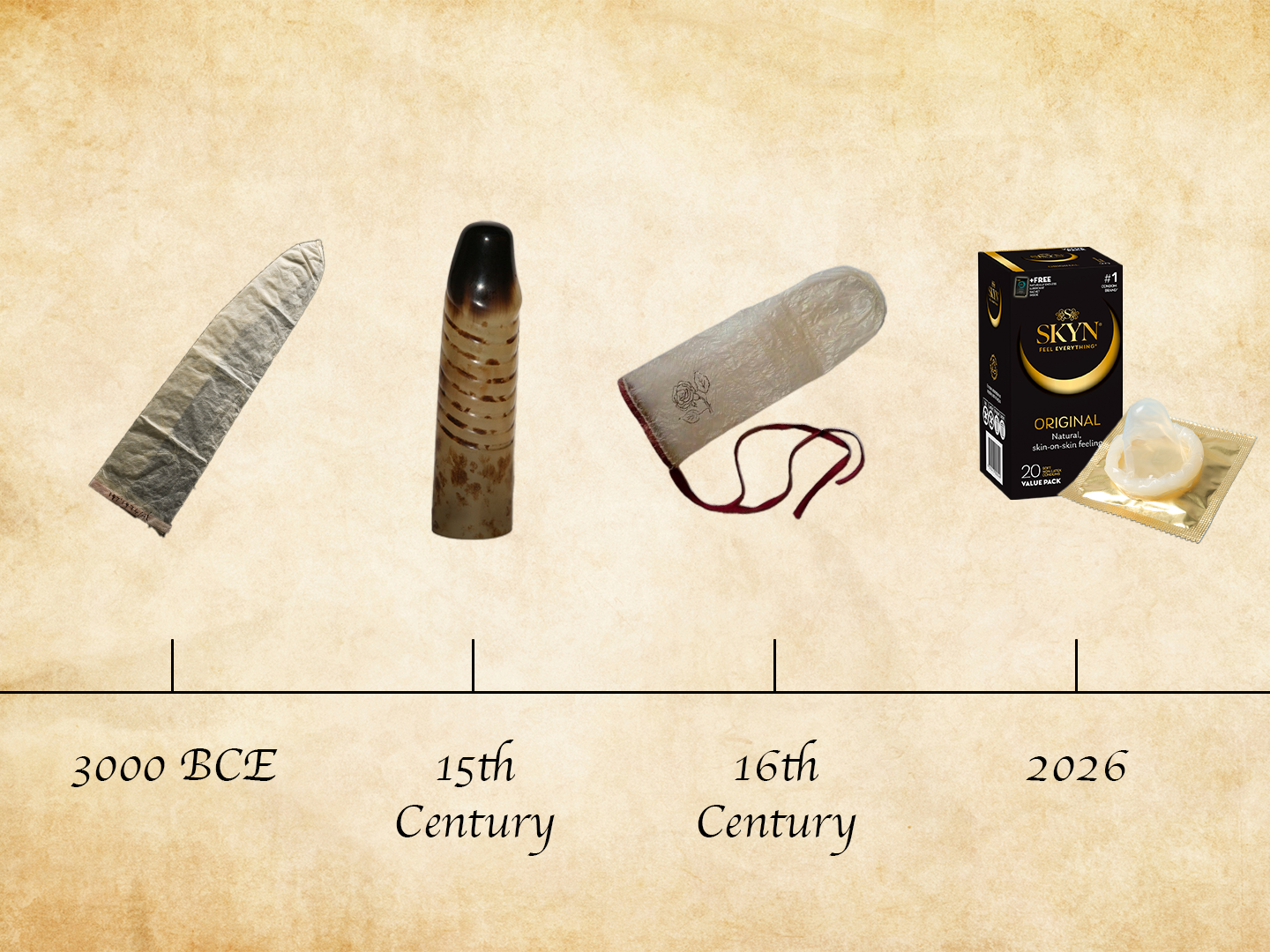
The oldest documented mention of a condom is around 3000 BCE in the legend of King Minos of Crete. He was cursed to have ‘serpents and scorpions’ in his semen, so his wife used a goat bladder as a form of physical barrier during intercourse. 

In the real world, different cultures used a variety of materials such as linen, silk paper and lamb intestines to create a ‘sheath’ that covered the penis. 

One of the most striking methods was the use of tortoise shells to cover the head of the penis, in Japan around the 15th century. 

The concept of condoms being more than a physical contraceptive was first suggested by Italian anatomist Gabriele Falloppio. 

In a book about syphilis, he suggested people use a linen sheath, secured with a ribbon, to reduce the contraction of syphilis between partners. 

Prior to the rise of syphilis in 15th century Europe and Falloppio’s work, people were mostly concerned about avoiding pregnancy – not STIs. 

The next development in condom design came at the end of the 19th century when Charles Goodyear made the first rubber condom

These first iterations are said to have been almost as thick as the inner tube of bicycles.

In the 1920s, Merle Youngs – founder of Trojan condoms – created the first latex condom. The company spent the following years making the condoms thinner and stronger. 

A new wave 

When the HIV/AIDS epidemic swept the world in the 1980s, condoms became a crucial public health tool. The invention of the female condom in 1984 also came about to reduce the spread of HIV.

A decade later, the first polyurethane condoms (plastic) entered the market. This was a game changer for people with a latex allergy. 

Until then, the only non-latex alternative was made of animal intestines. These didn’t protect against STIs due to the micropores found in the material

Fast forward to 2026 and there are three main materials used to make condoms – latex, animal intestines and plastic. 

But a new condom is about to enter its final round of clinical trials

Professor Robert Gorkin and his team at the University of Wollongong have been working on the ‘Geldom’ since 2014.

Their idea is to make condoms out of hydrogel, which has the potential to be infused with antiviral agents. This could reduce the risk of contracting sexually transmitted viruses like HIV, herpes and HPV.

However, hydrogel condoms need to be approved by regulatory bodies like Australia’s Therapeutic Goods Administration. 

After all, condoms are considered a medical device. Even if they were once made out of tortoise shells. 

Zaya Altangerel
About the author
Zaya Altangerel
Zaya is a writer with a question for everyone and everything, but she's especially interested in music, food and science.
View articles
Zaya is a writer with a question for everyone and everything, but she's especially interested in music, food and science.
View articles

NEXT ARTICLE

We've got chemistry, let's take it to the next level!

Get the latest WA science news delivered to your inbox, every fortnight.

This field is for validation purposes and should be left unchanged.

Republish

Creative Commons Logo

Republishing our content

We want our stories to be shared and seen by as many people as possible.

Therefore, unless it says otherwise, copyright on the stories on Particle belongs to Scitech and they are published under a Creative Commons Attribution-NoDerivatives 4.0 International License.

This allows you to republish our articles online or in print for free. You just need to credit us and link to us, and you can’t edit our material or sell it separately.

Using the ‘republish’ button on our website is the easiest way to meet our guidelines.

Guidelines

You cannot edit the article.

When republishing, you have to credit our authors, ideally in the byline. You have to credit Particle with a link back to the original publication on Particle.

If you’re republishing online, you must use our pageview counter, link to us and include links from our story. Our page view counter is a small pixel-ping (invisible to the eye) that allows us to know when our content is republished. It’s a condition of our guidelines that you include our counter. If you use the ‘republish’ then you’ll capture our page counter.

If you’re republishing in print, please email us to let us so we know about it (we get very proud to see our work republished) and you must include the Particle logo next to the credits. Download logo here.

If you wish to republish all our stories, please contact us directly to discuss this opportunity.

Images

Most of the images used on Particle are copyright of the photographer who made them.

It is your responsibility to confirm that you’re licensed to republish images in our articles.

Video

All Particle videos can be accessed through YouTube under the Standard YouTube Licence.

The Standard YouTube licence

  1. This licence is ‘All Rights Reserved’, granting provisions for YouTube to display the content, and YouTube’s visitors to stream the content. This means that the content may be streamed from YouTube but specifically forbids downloading, adaptation, and redistribution, except where otherwise licensed. When uploading your content to YouTube it will automatically use the Standard YouTube licence. You can check this by clicking on Advanced Settings and looking at the dropdown box ‘License and rights ownership’.
  2. When a user is uploading a video he has license options that he can choose from. The first option is “standard YouTube License” which means that you grant the broadcasting rights to YouTube. This essentially means that your video can only be accessed from YouTube for watching purpose and cannot be reproduced or distributed in any other form without your consent.

Contact

For more information about using our content, email us: particle@scitech.org.au

Copy this HTML into your CMS
Press Ctrl+C to copy