


You might be interested



The scenes are biblical.
Tens of thousands of rodents scattering across canola fields, behind sheds, into machinery. River fish with bellies full of mice. Carcasses littering the street, the sidewalk, outside your home. In supermarkets, the inescapable stench of dead and dying mice.
These are the undeniable signs of a mouse plague.
In March, the most recent mouse forecast issued by the Grains Research and Development Corporation and CSIRO reported concerns over projected high mouse numbers across Western Australia and South Australia.
By April, the plague arrived. Nothing could stop the mice.
Morawa, a regional community 90 minutes west of Geraldton, knows the sights, sounds and smell of death well. Since February, it has battled a mouse plague and become the very public face of its impacts.
The plague is not only a regional issue. Perth residents have started to see an increase in mice. Anecdotal evidence suggests the rodents are entering the suburbs as they flee the countryside.
Daniel Bremer, from Perth pest control service Swatapest, says there’s been a 125% increase in rodent enquiries since March.
“We are predicting that, by the end of this year, every house in Perth will have had a rodent visit,” says Daniel.
Mouse plagues are very difficult to predict, and once they get going, they’re very hard to stop. But there may be solutions on the horizon – tricks that utilise misinformation or rapidly advancing gene-editing technologies.
NOT A NEW PHENOMENON
Australia has experienced mice plagues for more than a century. Grain-growing regions experience plagues roughly every 3–5 years, typically following dry spells accompanied by huge rains.
In 2021, NSW experienced a mouse plague that caused more than $1 billion in damage.
Oddly, Australia and China are the only countries that experience these irruptions that can overrun entire towns.
While scientists haven’t figured out exactly why they happen, it’s likely linked to human activity and farming practices, changing environmental conditions and food supply.
Farmers and residents in plague centres typically jerry-rig their own bucket traps to cull the mice – sundried tomatoes and peanut butter (smooth, not crunchy!) seem to work as lures.
What science-backed solutions exist to tackle this biblical problem?

Credit: Nigel Harris/Getty Images
PLAGUE PROPORTIONS
Mice typically scurry around throughout the year, sneaking away seeds in regions where canola or other grains are sown.
But mice have a kind of superpower. When the going’s good – when there’s a lot of food around – they can rapidly reproduce. They are “the ultimate breeding machine”, CSIRO says.
When mice numbers exceed 800 individuals per 10,000 square metres, you have a plague. Farmers suggest there may be more than 3,000 mice in that area, based on how many they’re catching, during the current outbreak.
This is a huge problem for freshly sown crops because little slows down mice from reproducing and seeking out food. As they do so, they tear up planted seeds and can cause whole plots to be lost.
Unless you trick the mice.
MOUSE-INFORMATION
Peter Banks is a conservation scientist at the University of Sydney. Peter’s team is interested in ways to prevent the devastating impacts invasive species have on the environment without necessarily exterminating them.
A recently completed field trial in South Australia used a technique readers are likely familiar with: misinformation.
Not in the form of fake health advice on TikTok or poorly worded science articles. This misinformation is based on how mice use smell to detect delicious seeds.
Peter noticed mice can pinpoint exactly where to dig up freshly sown cereal grain seeds and suspected they must be sniffing them out.
His team sprayed the scent of wheat germ – oily stuff in the wheat seed that mice love the smell of – across plots of freshly sown crops during a pilot in Wagga Wagga, NSW. The flood of misinformation overwhelmed the ability for mice to sniff out the seeds and eventually, they gave up. The study was published in 2023.
“We showed we can reduce the damage by 70%, which is quite significant,” says Peter.
In South Australia, Peter is trying to determine just how much wheat germ misinformation farmers need to spread to confuse mice and if it’s economically viable.
“Sometimes it only takes a relatively small amount of misinformation for animals to change their mind and pursue something else,” says Peter.
There is currently no knockout punch for tackling an in-progress mouse plague. Baiting remains a crucial tool for reducing numbers, but it isn’t perfect. Standard baits may not always contain a lethal dose, particularly when mice can find lots of other food in the system, Peter says.
In May, the Australian Pesticides and Veterinary Medicines Authority, which regulates chemical use, allowed sale of a “double strength” bait to tackle plague numbers, but the threat remains high. What would a more permanent solution look like?
THE DRIVER’S SEAT
Invasive rodent populations have wreaked havoc across the world. They might not reach plague level, but on islands, they can devastate native wildlife by preying on vulnerable species and gobbling up invertebrates.
Many eradication efforts on islands have used toxic baits to drive numbers down. Of the more than 50 islands where mouse eradication has been attempted, 28 have been successful.
One technique that has attracted attention to bolster eradication efforts on islands is the idea of a gene drive, but they also may have applications for mouse plagues.
A gene drive is a way to break the rules of inheritance. Typically, when two organisms mate, they hand one gene each to their offspring – every gene has a 50% chance of being passed down. In short, a drive ensures specific genes will be inherited.
This is a powerful tool, using the revolutionary CRISPR technology, which allows scientists to make precise edits to an organism’s genes.
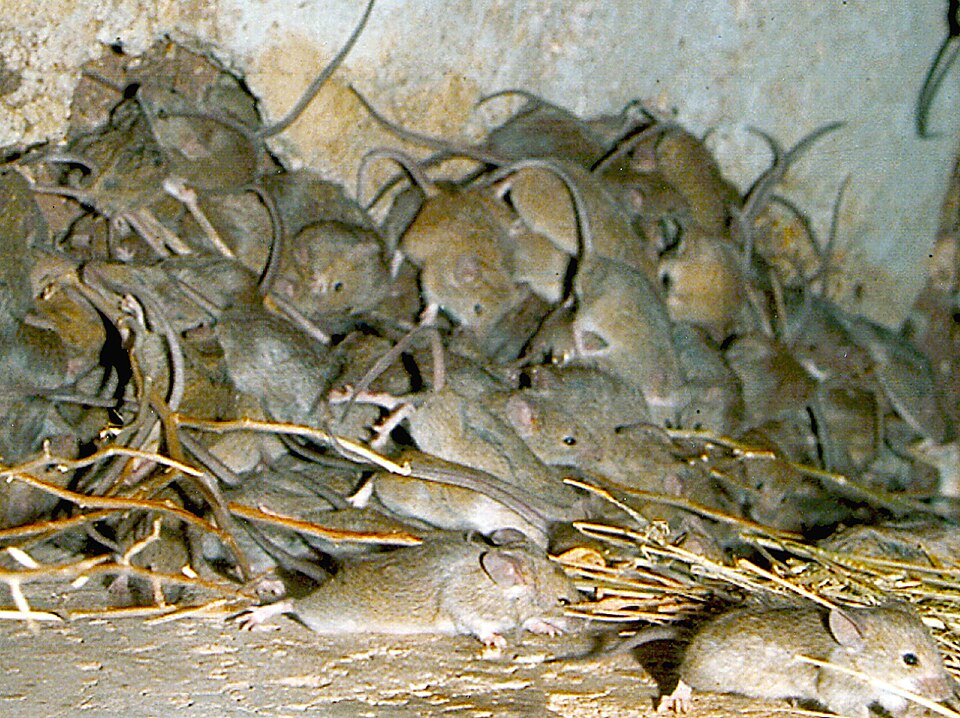
Credit: CSIRO (CC 3.0)/Wikimedia Commons
TAKING CONTROL
A gene drive uses CRISPR to cut out and replace one of the parent’s genes, which means the trait you want to pass down will almost always be inherited by offspring.
The technology was initially developed to control mosquito populations, ensuring all mosquitoes would be born male or females would be born sterile.
A similar idea may be possible in mice: release a horde of critters with a gene drive into plague-prone regions and they’ll mate with wild mice. But their offspring can’t mate, so the population starts to crash. While wild mice continue to mate with each other, it’s not an immediate eradication, but over generations, every female will be infertile.
These gene drives have been difficult to develop in mammals because inheritance isn’t quite as simple as with invertebrates. However, there are promising signs.
Computer models from the University of Adelaide show a specific type of mouse gene drive, known as tCRISPR (it works slightly different to the mosquito technology), could control rodent populations on islands over a couple of decades.
For plagues, the situation is less clear and can only be answered theoretically, says Aysegul Birand, an evolutionary biologist at Adelaide University. The same method appears to be useful for plagues if the gene drive is released 3 years before a plague begins. However, if you release the genetically modified mice when a plague has begun, it has no discernible effect on mouse populations.
“They suggest gene drives could help reduce the impact of plagues, but the benefit would be long term rather than immediate,” says Aysegul.
DISASTER WORK
Solutions to mouse plagues often focus on how to bring mice numbers back down. But the key is preparedness.
“Prevention is better than cure,” says Walter Okelo, a research scientist at CSIRO working on biosecurity economics. “Investments in early detection and quick response are therefore important, similar to other disasters such COVID and wild bushfires.”
Natural disasters are pertinent points of comparison. Some researchers have likened the impacts of mouse plague to natural disasters and global pandemics because of the speed at which they spread and their widespread impacts.
Those impacts can be felt long after plague numbers have declined. A recent study of the psychosocial impacts of a mouse plague and psychological stress by CSIRO researchers found that “mental wellbeing can be persistently affected”.
In another study, researchers identified the desire in plague-stricken communities to mitigate future plagues. Residents identified both better monitoring and biotechnological interventions as priorities – and post-outbreak, there’s a need to respond to the communities with the same kind of support you might see when recovering from a natural disaster.
While we might confuse mice with misinformation and could possibly put an end to mouse plagues by wiping out the species entirely (Australia is, after all, a big island), there’s a strong need to better understand plagues. For crops and for humans.
“We still don’t know enough about what they do, why they do it and how they do it,” says Peter. “These mice just keep throwing up new problems to address.”