
READ

MAKING WAVES

New Australian research could be a game-changer for predicting waves and weather.
Michelle Aitken
Michelle Aitken
Content Creator
MAKING WAVES

New research from the University of Melbourne has deepened our understanding of where waves originate, how they decay and just how far they can travel across oceans.

The work improves the reliability and quality of wave forecasts used by the Bureau of Meteorology as well as industries such as shipping and urban design.

The innovative method tracked ocean swell across the Pacific using more than 300 GPS-enabled buoys. It heralds a shift towards data-driven models, which could revolutionise the way waves and weather are predicted.

WAVING FROM A DISTANCE

Professor Ian Young is an expert in ocean physics and wind-generated waves and the lead author of the study. 

He says most waves originate near the polar regions, particularly near Antarctica where intense ocean storms can rotate all the way around the Earth without hitting land.

“Once they’re generated, those waves propagate off across the oceans,” says Ian.

“Just like if you throw a pebble in a pond, then the waves radiate away from that pebble.”

Waves that have propagated from where they originated are called swell.

Some of these waves can travel across oceans for 17 days, reaching shores up to 12,000 kilometres away.

FEELING SWELL

Understanding how waves travel can help us plan for future climate change and sea-level rise. 

Waves are getting larger as a result of more intense and frequent storms, especially in the Southern Ocean. This can impact coastal erosion and put coastal infrastructure at risk. 

The ocean already plays an important role in mitigating climate change because carbon dioxide from the atmosphere is sequestered in the deep ocean. 

“If you’ve got waves breaking on the surface of the ocean, they’re much more efficient at actually taking carbon dioxide and pushing it down into the ocean,” says Ian.

Better prediction models can help us understand the complex ways the ocean influences and is shaped by our changing climate.

OH BUOY

While weather prediction has improved drastically over the past 15 years, Ian says swell propagation models are lagging.

Previously, physicists have used data from satellites taking aerial images of the ocean as they pass overhead.

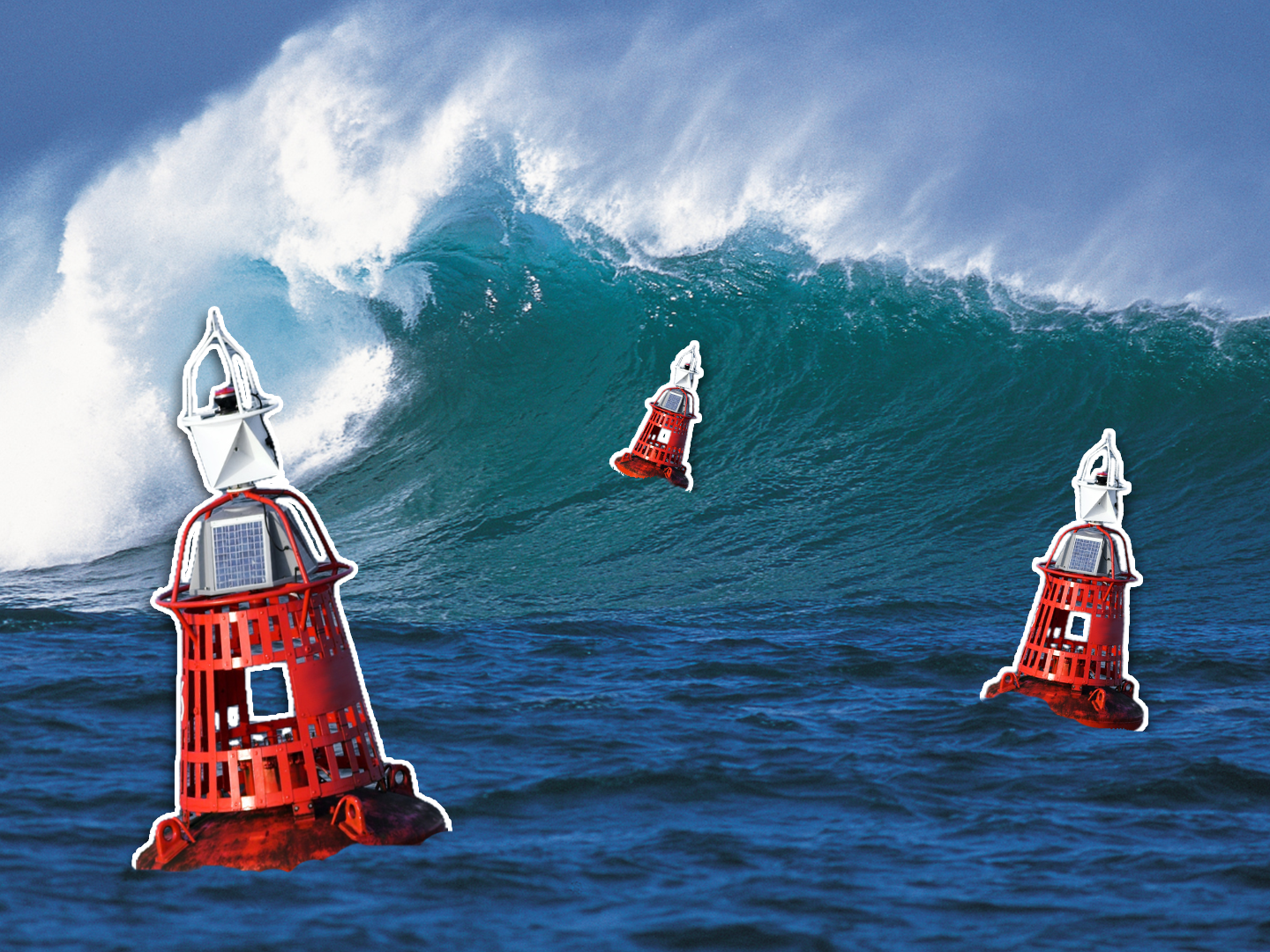
The new study used data from an array of low-cost GPS-enabled buoys floating freely in the Pacific Ocean.

The buoys report their position in three-dimensional space and the direction they’re travelling in. This data allowed the team to visualise how waves were moving across the ocean.

Ian says the buoys have opened up new possibilities. 

“It’s the first time we’ve ever been able to get that sort of data and to understand some of these really quite interesting elements of wave physics,” he says.

WAVE HELLO TO ARTIFICIAL INTELLIGENCE

These floating buoys are contributing to rapid change in the field of wave prediction.

“Ocean science is moving from a time when we complained that we didn’t have enough data to a period where we’re swamped with the data,” says Ian.

Weather predictions are currently made based on complex physics modelling, but researchers are looking to artificial intelligence to turn the influx of information into data-driven models.

Ian is optimistic about what can be achieved in an area of research he describes as “difficult”.

“[The AI models] take only a fraction of the time to run … and produce very, very good results,” he says. 

While AI is not as good as traditional models yet, we can expect big changes over the next few years in the way that waves are predicted. 

Michelle Aitken
About the author
Michelle Aitken
Michelle is interested in the relationships between science, culture, and policy. She has a background in performing arts and hospitality, and is a MEAA member.
View articles
Michelle is interested in the relationships between science, culture, and policy. She has a background in performing arts and hospitality, and is a MEAA member.
View articles

NEXT ARTICLE

We've got chemistry, let's take it to the next level!

Get the latest WA science news delivered to your inbox, every fortnight.

This field is for validation purposes and should be left unchanged.

Republish

Creative Commons Logo

Republishing our content

We want our stories to be shared and seen by as many people as possible.

Therefore, unless it says otherwise, copyright on the stories on Particle belongs to Scitech and they are published under a Creative Commons Attribution-NoDerivatives 4.0 International License.

This allows you to republish our articles online or in print for free. You just need to credit us and link to us, and you can’t edit our material or sell it separately.

Using the ‘republish’ button on our website is the easiest way to meet our guidelines.

Guidelines

You cannot edit the article.

When republishing, you have to credit our authors, ideally in the byline. You have to credit Particle with a link back to the original publication on Particle.

If you’re republishing online, you must use our pageview counter, link to us and include links from our story. Our page view counter is a small pixel-ping (invisible to the eye) that allows us to know when our content is republished. It’s a condition of our guidelines that you include our counter. If you use the ‘republish’ then you’ll capture our page counter.

If you’re republishing in print, please email us to let us so we know about it (we get very proud to see our work republished) and you must include the Particle logo next to the credits. Download logo here.

If you wish to republish all our stories, please contact us directly to discuss this opportunity.

Images

Most of the images used on Particle are copyright of the photographer who made them.

It is your responsibility to confirm that you’re licensed to republish images in our articles.

Video

All Particle videos can be accessed through YouTube under the Standard YouTube Licence.

The Standard YouTube licence

  1. This licence is ‘All Rights Reserved’, granting provisions for YouTube to display the content, and YouTube’s visitors to stream the content. This means that the content may be streamed from YouTube but specifically forbids downloading, adaptation, and redistribution, except where otherwise licensed. When uploading your content to YouTube it will automatically use the Standard YouTube licence. You can check this by clicking on Advanced Settings and looking at the dropdown box ‘License and rights ownership’.
  2. When a user is uploading a video he has license options that he can choose from. The first option is “standard YouTube License” which means that you grant the broadcasting rights to YouTube. This essentially means that your video can only be accessed from YouTube for watching purpose and cannot be reproduced or distributed in any other form without your consent.

Contact

For more information about using our content, email us: particle@scitech.org.au

Copy this HTML into your CMS
Press Ctrl+C to copy