
You might be interested



Imagine you’re 6 years old and in the back seat of your parents’ car on a road trip.
Your mum decides to stop for breakfast food at lunchtime and pulls into a quiet roadhouse where other travellers eat apple pie and drink cola with a scoop of vanilla ice cream on top.
In your adulthood, you recall this experience to your parents and remark on the deliciousness of the pancakes you ate there and the strange animatronic koala clinging to a shelf behind the counter.
But your parents remember it all differently.
How does that happen?
How do memories ‘work’?
Understanding how memory works is key to forgiving your parents for their totally incorrect recollection of this formative childhood experience.
“Memory isn’t like saving a file to a hard drive,” says cognitive scientist Professor Ullrich Ecker.
“An experience contains many facets, all of which are processed somewhat separately.
“When we encode an experience, patterns of activity across networks of neurons change the strength of connections between them.”
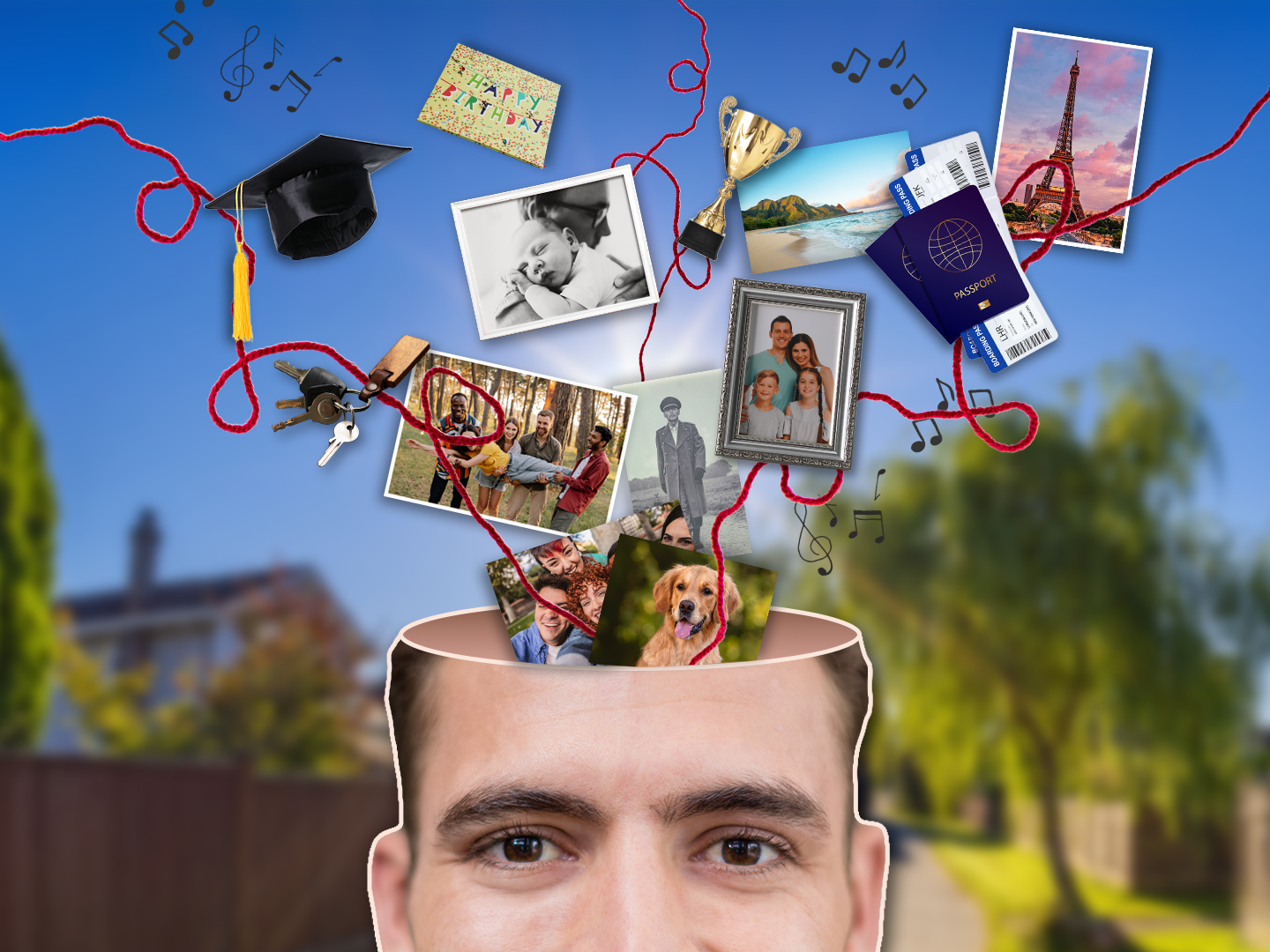
This means our memories exist as fragments – scattered across different parts of the brain – with sights, sounds, emotions and context all stored in specialised, interconnected regions.
If memories are tucked away in pieces – the koala’s face, the smell of cooking butter, the sound of the highway – how do we put them back together?
(Re)making a Memory
Retelling the story of a road trip is more neurologically complicated than you might assume.
“Memories are fundamentally reconstructive,” says Ullrich.
“When we retrieve a memory, we don’t pull out a fixed record – we reconstruct the event by reactivating those patterns, which is a bit like putting a jigsaw puzzle together.”
But not all of the pieces fare equally well in this neural network. Some fall away.
This is where our own biases, beliefs or ‘schemas’ – our mental frameworks – can influence how a memory comes back to us.
“Sometimes we can’t find a specific piece, or we make a piece fit that doesn’t actually belong – so it’s a somewhat error-prone process,” says Ullrich.
For example, if one parent forbade you from a morning-time cola, you might remember it was the stricter parent, even if the empirical truth is actually long-gone from your mind.
“Repetition increases familiarity, and familiar information tends to feel more believable, regardless of accuracy,” explains Ullrich.
“This makes memory susceptible to being shaped by repeated misinformation.”
This insidious little beast is known as the ‘illusory truth effect’ – a cognitive bias where repeated exposure to a statement increases the belief that it is true, regardless of its actual veracity.
But if memory is so easily shaped by what we believe or what we encounter repeatedly, it stands to reason that we could begin to ‘remember’ something that didn’t happen at all.
Memory, Misinformation and Democracy
While our own memories can feel like a personal archive, unfortunately we live in a society. This means that, when misinformation runs amok in our memories, there can be social and political implications.
“At a societal level, memory underpins our shared understanding of events,” says Ullrich.
“If different groups are exposed to different information or remember events differently, you can end up with polarised beliefs or even competing versions of reality.
“That makes it harder to agree on basic facts, which in turn complicates reasoning.”
In other words, memory doesn’t just hold our personal histories. Our collective memories influence how communities understand the past, how societies interpret the present and how easily we can agree on what is actually happening at all.
Together, In the Moonlight
But it’s not all doom and gloom.
“Memory’s imperfections are actually part of its strength,” says Ullrich.
“A system that simply recorded everything verbatim would be less useful than one that extracts meaning and supports flexible thinking.”
The goal isn’t perfect recall or total social harmony with our recollections of the past.
Instead, we can all aim for more awareness – noticing when something ‘feels true’ simply because it’s familiar, checking sources and being willing to question our own biases.
And sometimes it’s OK to remember things differently.
You can disagree about the specifics of the road trip. Maybe you can’t remember what songs you were all singing in the car, or how old exactly any of you were, or who left the snack bag on the side of the road.
But you can remember how it all felt, which is often enough for personal memory – even if it’s not always enough for collective truth.