


You might be interested

Colorectal or bowel cancer is one of the most commonly diagnosed cancers, affecting approximately 1 in 20 Australians.
Associate Professor of Gastroenterology and Bowel Cancer Australia spokesperson Dr John Ding has dedicated most of his career to fighting colorectal cancers.
Bowel cancer patients can generally be divided into those over and under 50 years old, says John.
Thanks to preventive measures by the National Bowel Cancer Screening Program to detect early signs of the disease, bowel cancer in the over 50s has dropped in the last 20 years.
Unfortunately, the trend is the opposite for young people, with Australia having the highest rate of bowel cancer in under 50s in the world.
So why are our rates so high, and what can be done about it?
HOW BAD IS IT, DOC?
It’s important to understand the value of an early diagnosis.
Cancer diagnoses are divided into four stages. While stages 1 and 2 are generally more positive, stages 3 and 4 have worse prognoses.
“The good news story about bowel cancer is that, if you catch it early enough, you can cure it in about 99% of people,” says John.
“This is achieved through effective colonoscopies … and surgery.”
A tumour identified during stage 1 can be removed before it begins to spread.
“That stage 3 to stage 4 category is a later-stage disease,” says John. “[It] tends not to be curable.”
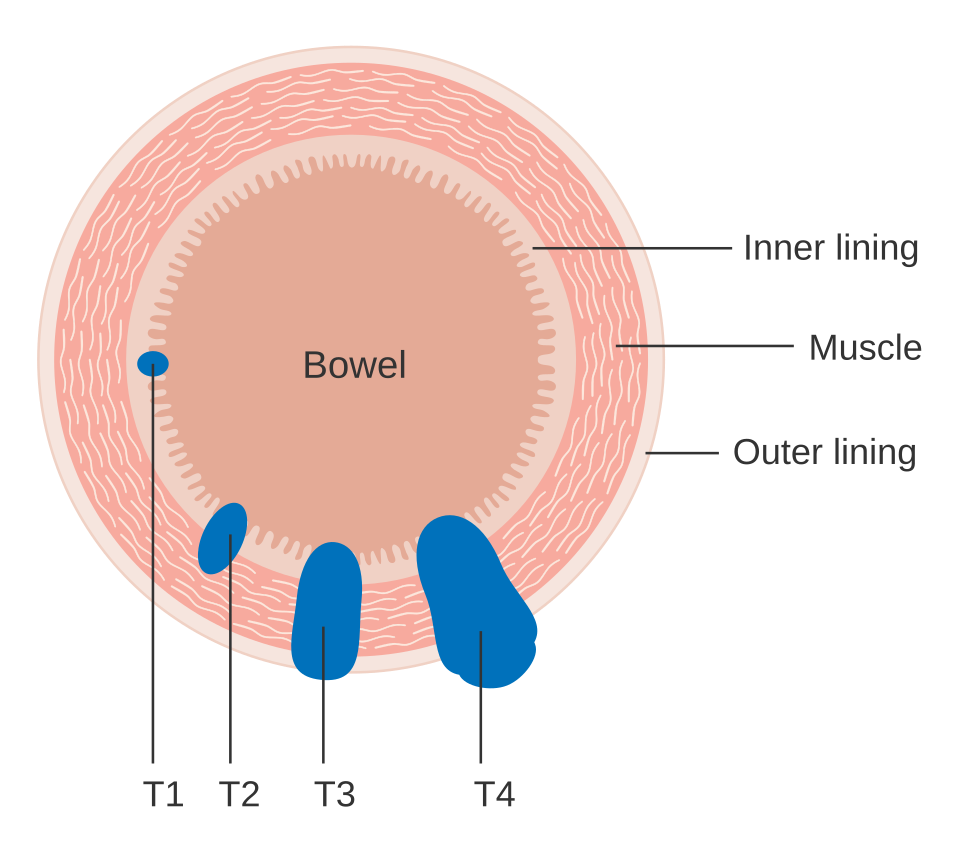
Credit: Cancer Research UK (CC BY-SA 4.0)/Wikimedia Commons
WHAT CAUSES IT?
Like most cancers, the exact causes can be unclear.
“There are genes – syndromes – that account for early-onset bowel cancer,” says John.
“But that only accounts for about a quarter of cases.
“The big risk factors recently identified in studies are not things you would say are groundbreaking.”
These risk factors include excess weight, high alcohol intake, smoking, sedentary lifestyles and excess consumption of red meat and highly processed foods.
GO WITH YOUR GUT
“As a gastroenterologist, I talk to patients all the time about how they can improve their gut health,” says John.
“Ultra-processed foods have a huge part to play in gut health and therefore increased rates of bowel cancer.”
More specifically, the preservatives that increase the shelf-life of ultra-processed foods have been shown to damage the gut microbiome.
“That biome begins to change when we eat all these delicious – but bad for us – foods,” says John.
The defensive mucus layer can be destroyed and become less protective of our cells.
WHAT MORE CAN WE DO?
It’s difficult to perform a colonoscopy on yourself. Please don’t shove your phone up there.
Before 2024, the National Bowel Cancer Screening Program was only available to those over 50.
Due to the rise in early-onset rates, that age has been lowered to 45, and some experts are calling for it to include everyone over 40.
“Often people with early-onset bowel cancer are delaying presentation,” says John. “They are often misdiagnosed as having things like irritable bowel syndrome.”
SIGNS TO LOOK FOR
The three classic symptoms of early-onset bowel cancer are blood in the stool (poo), a significant and persistent change in poo-related habits and unexplained stomach pain.
“We need to make sure that people who have those signs and symptoms go see the GP, who will then send them along to get a colonoscopy with a specialist,” says John.
Lifestyle changes can also have a huge impact. Increasing exercise, reducing ultra-processed foods and adding more fibre to your diet can help.
But the most effective prevention is screening.
People of all ages can be screened for bowel cancer – you’re not too young.
People with family histories or high-risk lifestyles in particular are encouraged to talk to their GP and start getting tested regularly.
YOU HAD BETTER BOWELIEVE IT
Outside of tests and lifestyle changes, it’s crucial to challenge the stigma associated with bowel cancer.
“As kindy kids, we all spoke about it openly, but at a certain age, we’re told, ‘No you can’t talk about that’,” says John.
“Even King Charles poos … The most richest, the most poshest people go to the bathroom.”

Credit: HM Government, OGL 3/Wikimedia Commons
Screening is easy – a small dipstick into a poo sample, placed into a tube and sent off for testing.
It’s barely different to wiping your arse. And hopefully, we all already do that.
Unfortunately, only 40% of the tests sent out as a part of the screening program are returned, with 60% wasted, says John.
These tests are the most effective way Australians can increase the detection and treatment of early-onset bowel cancer.
Everybody poos – why not make it worth it?