
READ

TRACK ME IF YOU CAN

We’re diving into the world of marine biologgers.
Cody Robinson
Cody Robinson
Freelance Writer
TRACK ME IF YOU CAN

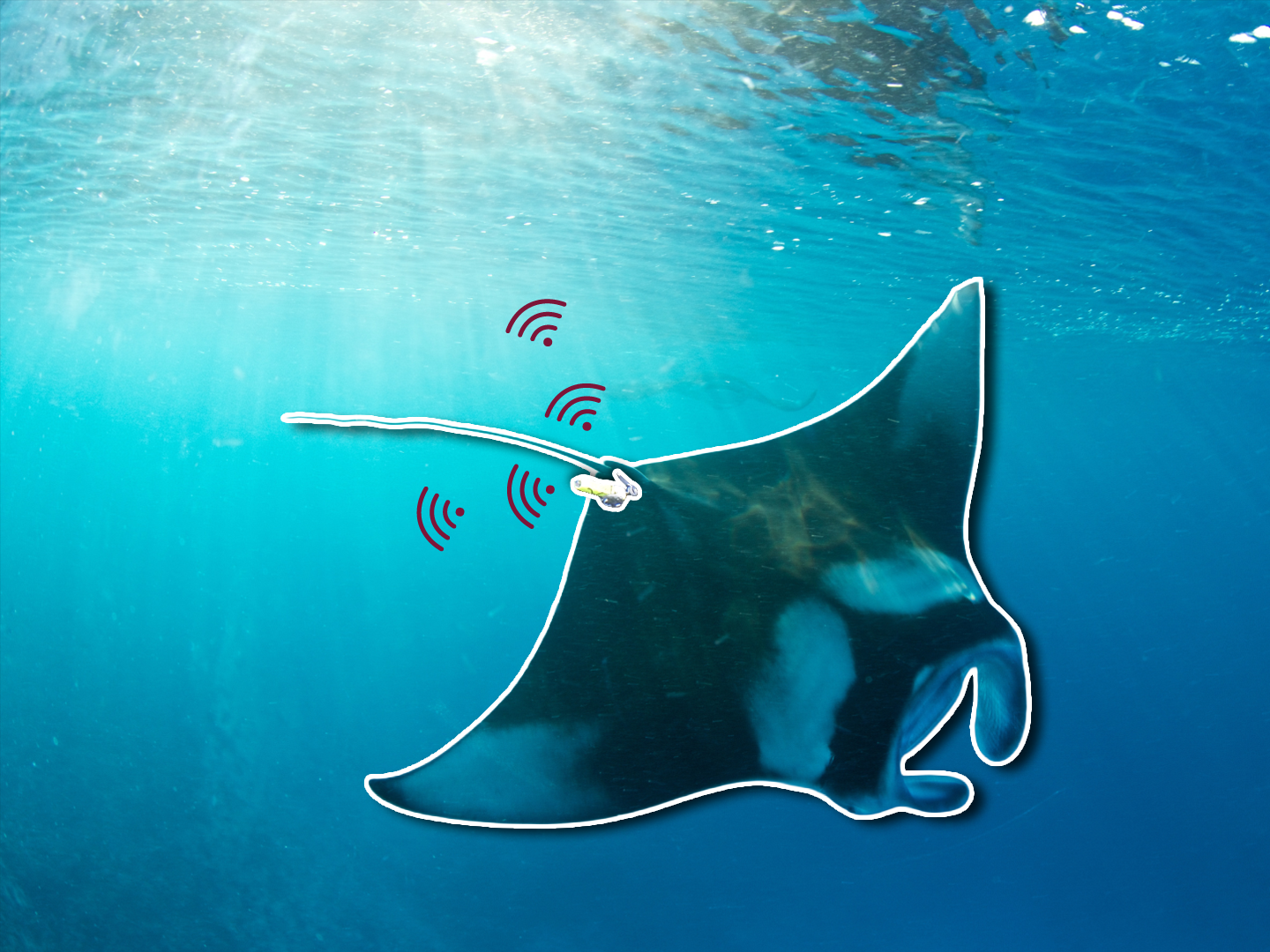
As a large female manta ray glides through pristine tropical waters, Rachel Newsome swims down and carefully and quickly clamps a device onto its dorsal fin before it swims away. 

Rachel is a Forest Scholar and PhD candidate at Murdoch University, working with the Save Our Seas Foundation.

Rachel’s device is essentially a manta ray Fitbit, allowing us to better understand marine megafauna.

Soon, every beat of the ray’s wing-like fins, every turn and dive, every reaction to its environment will be recorded.

GONNA BE GOLDEN

For Dr Ben D’Antonio – a research scientist at the Shark Research Foundation and UWA Oceans Institute – we’re in the “golden age” of animal tracking. 

“There’s been this real plethora of technologies that’s come out with human wearables such as smart watches and phones,” says Ben.

“We can essentially put that same technology on animals to track them across ocean basins, thousands of kilometres and also to thousands of metres deep into the ocean.”

This technology is used to create small devices called biologgers. They provide scientists with information on an animal’s movement, energy consumption and responses to environmental change. 
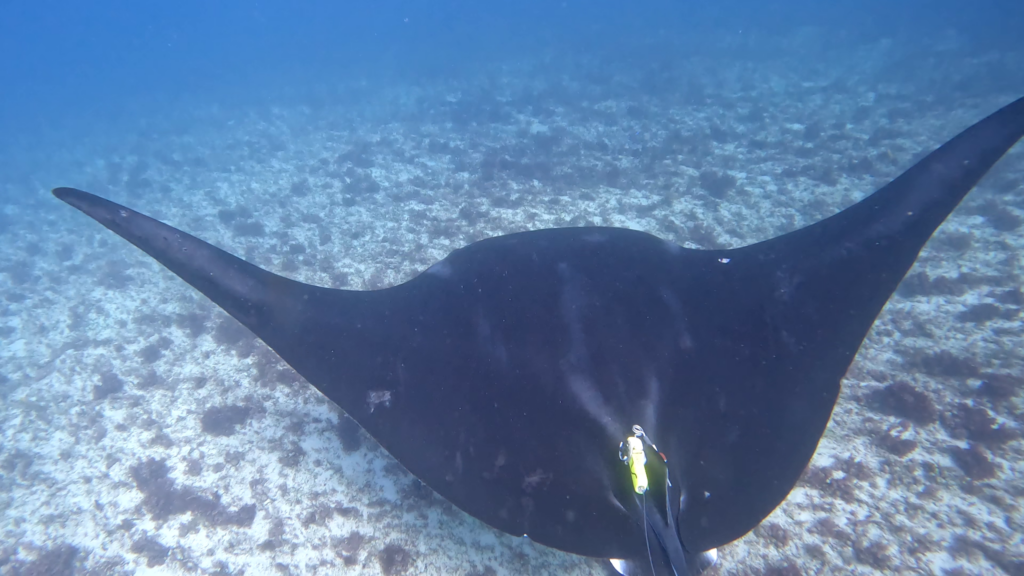
Caption: A manta ray swimming with one of Rachel’s biologger devices attached to its dorsal fin.
Credit: Supplied by Rachel Newsome

Older tracking technologies such as satellite or acoustic tags map animal movement but offer limited insights on other factors.

“Previously with manta rays, we’ve only been able to put satellite tags and acoustic tags on them, which limits your capacity to study an animal,” says Rachel.

GOING HIGH-TECH

Newer biologgers, including Rachel’s, are highly customisable and can carry an array of sensors. They might include sensors for speed, rotation, light or temperature – some even have cameras. 

When used together, these sensors allow scientists to reconstruct an animal’s movement in three dimensions by capturing data on orientation, speed and rhythm of each fin stroke.

“They basically can fully recreate the entire three dimensional picture of the animal in space and time,” says Rachel.

This means marine megafauna can be studied in unprecedented detail. 

These insights are critical in a rapidly changing ocean. Environmental shifts such as rising temperatures or declining food sources can alter how animals behave and how much energy they need to survive. Understanding these limits may help predict how species will respond to future change.

While Rachel’s work focuses on just one species, it reflects a broader transformation in marine science.

UNLOCKING SECRETS

Ben says the information gathered by marine biologgers not only reveals animal behaviours but can help scientists better understand the ocean itself.

“Animals are actually allowing us to better understand the oceans by kind of acting as these, like, evolutionary informed oceanographers,” says Ben.

By carrying temperature and other environmental sensors, tagged animals can collect valuable data from regions that are otherwise difficult to study.
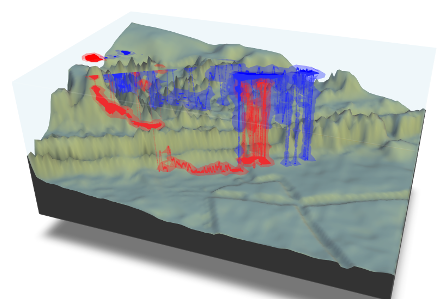
Caption: A biologger tracked a whale shark off the coast of Ningaloo Reef, with red showing its daytime movement and blue showing movement at night. 
Credit: Supplied by Ben D’Antonio

OVERCOMING CHALLENGES

Despite these advances, challenges remain.

Attaching tags to wild animals requires careful handling to minimise stress and avoid disrupting natural behaviour. 

Devices can fail or detach early, and high-resolution sensors generate vast datasets that can take months to process. There’s also the high cost for each sensor and the risk of losing it.

“There’s always an importance between ensuring animal welfare through as little human interactions as possible, while still attempting to collect data,” says Rachel.

Even so, the potential of these technologies continues to grow. 

Emerging developments, including AI-enabled tags that can process data in real time, promise to extend tracking over longer periods and greater distances.

For now, every beat of the manta ray’s fins will become a new row of data, giving researchers the keys to understanding their secrets.


Cody Robinson
About the author
Cody Robinson
Cody is a freelance writer with a degree in marine science and science communication. He’s passionate about the ocean and its conservation. In his free time, Cody enjoys the outdoors, nature photography, and Judo.
View articles
Cody is a freelance writer with a degree in marine science and science communication. He’s passionate about the ocean and its conservation. In his free time, Cody enjoys the outdoors, nature photography, and Judo.
View articles

NEXT ARTICLE

We've got chemistry, let's take it to the next level!

Get the latest WA science news delivered to your inbox, every fortnight.

This field is for validation purposes and should be left unchanged.

Republish

Creative Commons Logo

Republishing our content

We want our stories to be shared and seen by as many people as possible.

Therefore, unless it says otherwise, copyright on the stories on Particle belongs to Scitech and they are published under a Creative Commons Attribution-NoDerivatives 4.0 International License.

This allows you to republish our articles online or in print for free. You just need to credit us and link to us, and you can’t edit our material or sell it separately.

Using the ‘republish’ button on our website is the easiest way to meet our guidelines.

Guidelines

You cannot edit the article.

When republishing, you have to credit our authors, ideally in the byline. You have to credit Particle with a link back to the original publication on Particle.

If you’re republishing online, you must use our pageview counter, link to us and include links from our story. Our page view counter is a small pixel-ping (invisible to the eye) that allows us to know when our content is republished. It’s a condition of our guidelines that you include our counter. If you use the ‘republish’ then you’ll capture our page counter.

If you’re republishing in print, please email us to let us so we know about it (we get very proud to see our work republished) and you must include the Particle logo next to the credits. Download logo here.

If you wish to republish all our stories, please contact us directly to discuss this opportunity.

Images

Most of the images used on Particle are copyright of the photographer who made them.

It is your responsibility to confirm that you’re licensed to republish images in our articles.

Video

All Particle videos can be accessed through YouTube under the Standard YouTube Licence.

The Standard YouTube licence

  1. This licence is ‘All Rights Reserved’, granting provisions for YouTube to display the content, and YouTube’s visitors to stream the content. This means that the content may be streamed from YouTube but specifically forbids downloading, adaptation, and redistribution, except where otherwise licensed. When uploading your content to YouTube it will automatically use the Standard YouTube licence. You can check this by clicking on Advanced Settings and looking at the dropdown box ‘License and rights ownership’.
  2. When a user is uploading a video he has license options that he can choose from. The first option is “standard YouTube License” which means that you grant the broadcasting rights to YouTube. This essentially means that your video can only be accessed from YouTube for watching purpose and cannot be reproduced or distributed in any other form without your consent.

Contact

For more information about using our content, email us: particle@scitech.org.au

Copy this HTML into your CMS
Press Ctrl+C to copy