

READ

Particle 101: Sand Nourishment

Protecting sandy beaches from erosion.
Melanie Julien-Martial
Freelance writer
Particle 101: Sand Nourishment

Sandy beaches are beautiful spots to lay out a towel for a tan, pop up that controversial CoolCabana or enjoy a swim in the ocean.

They also offer a buffer to the coast against waves, offer habitats and feeding grounds to invertebrates and protect nesting turtles and shorebirds.

But they are increasingly eroding with more extreme weather events and rising sea levels.

FEEDING BEACHES

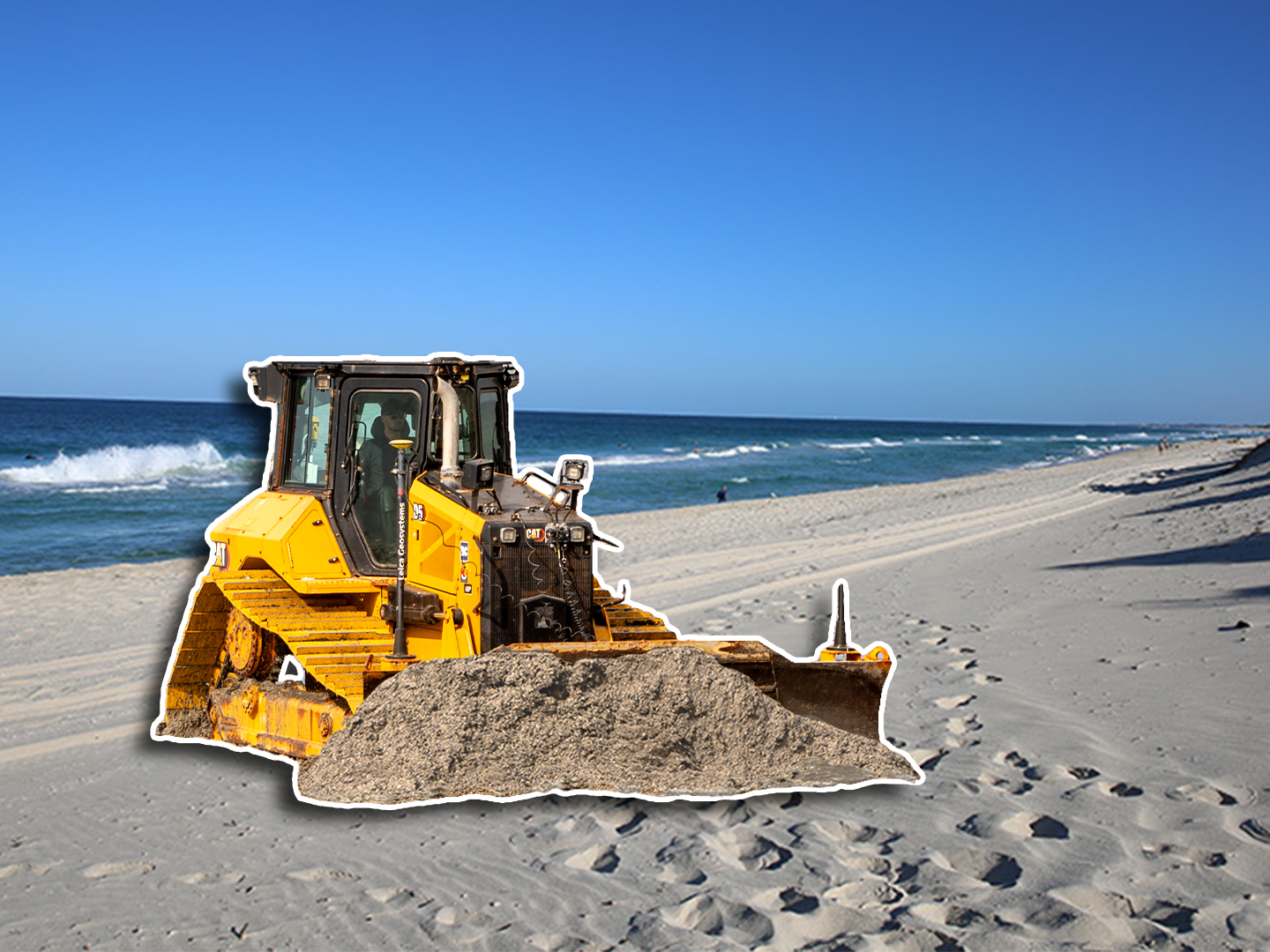
In late March, the City of Stirling undertook sand nourishment on one of Perth’s beloved beaches, Mettams Pool. 

Sand (or beach) nourishment is a process in which sand is relocated from another beach, quarry or dredged offshore to replenish eroded sand from beaches.

This protects sand and structures from further erosion, creating a barrier to the existing coastline.

An excess 5,000 cubic metres of sand at Trigg Beach was trucked to Mettams Pool to protect the coast ahead of anticipated winter storms.

LOW IMPACT, HIGH REWARD

Sand nourishment is considered a short-term and low-impact solution to coastal erosion.

It is a soft engineering method to combat erosion, without the need for permanent structures like sea walls or groynes. 

It’s a short-term solution – or can be made long term if paired with other erosion solutions.

THE CATCH

Although sand nourishment is generally seen to have more benefits than downfalls, there are negative impacts to consider.

In particular, the question of whether long-term solutions may be more economical looms over sand nourishment practices.

The impact of sand nourishment on macroinvertebrates – minute creatures living between sand granules on beaches – can be profoundly negative. 

Macroinvertebrates are essential to marine ecosystems and play a role in cleaning oceans.

They can get crushed as a result of sand nourishment – under the weight of the new sand or the machinery used to truck in the sand.

Macroinvertebrates living in the transported sand may also not adapt to their new environment.

FUTURE THINKING

Off the back of the sand nourishment at Mettams Pool in March, the City of Stirling is also in process of considering a new coastal environment management plan

For the City of Stirling, sand nourishment exists as part of a holistic bigger picture – as it should always be.

Melanie Julien-Martial
About the author
Melanie Julien-Martial
Melanie is a lover of all things nature, art, and science. They are interested in the relationships between art and the natural world, and how each can elevate the other.
View articles
Melanie is a lover of all things nature, art, and science. They are interested in the relationships between art and the natural world, and how each can elevate the other.
View articles

NEXT ARTICLE

We've got chemistry, let's take it to the next level!

Get the latest WA science news delivered to your inbox, every fortnight.

This field is for validation purposes and should be left unchanged.

Republish

Creative Commons Logo

Republishing our content

We want our stories to be shared and seen by as many people as possible.

Therefore, unless it says otherwise, copyright on the stories on Particle belongs to Scitech and they are published under a Creative Commons Attribution-NoDerivatives 4.0 International License.

This allows you to republish our articles online or in print for free. You just need to credit us and link to us, and you can’t edit our material or sell it separately.

Using the ‘republish’ button on our website is the easiest way to meet our guidelines.

Guidelines

You cannot edit the article.

When republishing, you have to credit our authors, ideally in the byline. You have to credit Particle with a link back to the original publication on Particle.

If you’re republishing online, you must use our pageview counter, link to us and include links from our story. Our page view counter is a small pixel-ping (invisible to the eye) that allows us to know when our content is republished. It’s a condition of our guidelines that you include our counter. If you use the ‘republish’ then you’ll capture our page counter.

If you’re republishing in print, please email us to let us so we know about it (we get very proud to see our work republished) and you must include the Particle logo next to the credits. Download logo here.

If you wish to republish all our stories, please contact us directly to discuss this opportunity.

Images

Most of the images used on Particle are copyright of the photographer who made them.

It is your responsibility to confirm that you’re licensed to republish images in our articles.

Video

All Particle videos can be accessed through YouTube under the Standard YouTube Licence.

The Standard YouTube licence

  1. This licence is ‘All Rights Reserved’, granting provisions for YouTube to display the content, and YouTube’s visitors to stream the content. This means that the content may be streamed from YouTube but specifically forbids downloading, adaptation, and redistribution, except where otherwise licensed. When uploading your content to YouTube it will automatically use the Standard YouTube licence. You can check this by clicking on Advanced Settings and looking at the dropdown box ‘License and rights ownership’.
  2. When a user is uploading a video he has license options that he can choose from. The first option is “standard YouTube License” which means that you grant the broadcasting rights to YouTube. This essentially means that your video can only be accessed from YouTube for watching purpose and cannot be reproduced or distributed in any other form without your consent.

Contact

For more information about using our content, email us: particle@scitech.org.au

Copy this HTML into your CMS
Press Ctrl+C to copy