
You might be interested
It’s a common misconception that rainforests are the lungs of the Earth.
Our oceans produce most of the oxygen we consume and are more effective at storing carbon.
Carbon stored in the ocean is called ‘blue carbon’ and is considered the secret weapon in the fight against climate change.
What is it and how can we protect it?
BURIED UNDER THE DEEP BLUE
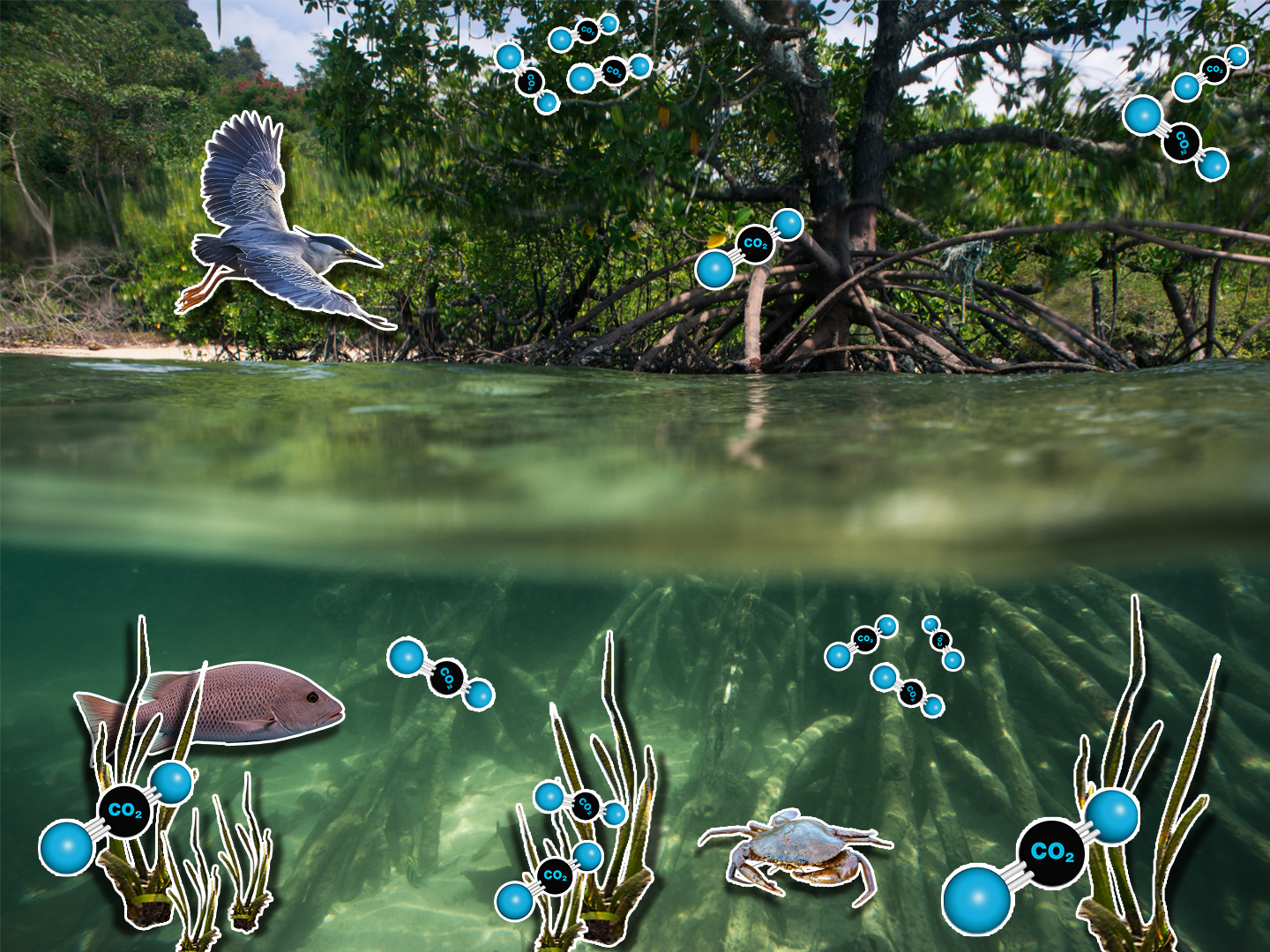
Blue carbon is trapped by the ocean and coastal ecosystems in a process known as carbon sequestration.
It begins with photosynthesis, when plants capture and absorb carbon dioxide from the atmosphere and turn it into oxygen and energy.
Chris Fulton is Principal Research Scientist at the Australian Institute of Marine Science.
He focuses on how blue carbon is stored in WA’s marine ecosystems.
“[Blue carbon] is sequestered somewhere in the ocean systems,” says Chris.
“Leaf litter, bits of algae, seagrass and timber … will get stranded, and through other processes like cyclones, storms or floods, they get buried in layers like a lasagna.
“That’s the process of carbon sequestration.”
UNDER THREAT
Reservoirs of stored carbon are known as carbon pools.
“There’s a really diverse pool of carbon, particularly the coastal wetlands,” says Chris. “That includes mangrove forests, seagrass beds and … tidal or mud flats.”
Blue carbon pools provide homes for a diverse range of organisms and prevent coastal erosion.
But they are not immune to climate change.
“Blue carbon is a solution to climate change,” says Chris.
“Unfortunately, climate change is also causing problems for marine ecosystems.”
THE BIGGER PICTURE
A recent study by Chris and his colleagues shows that the key to enhancing blue carbon sequestration is understanding where it comes from – either within or outside the carbon pool.
The study also found that most of the blue carbon stored in pools around the world comes from external sources.
“A mangrove tree drops the leaves and some of it gets buried in the soil underneath it, but a lot of it gets transported and buried elsewhere,” says Chris.
If a mangrove tree leaf falls and is buried where it lands, it’s called autochthonous carbon. If the same leaf falls but floats away and is buried elsewhere, it’s called allochthonous carbon.
The distinction between ‘auto’ and ‘allo’ carbon can also change conservation priorities in marine spaces. It’s not about protecting a certain ecosystem, but the entire seascape.
“Just restoring a mangrove forest is not enough. You’re going to have to focus on the entire plant community,” says Chris.
AN UNSUNG BLUE CARBON HERO
The Blue Carbon Seascapes project is helping scientists better understand what the external carbon sources in northern WA are and where they are stored – but hopes to make ripples worldwide.
“Blue Carbon Seascapes came about because … we realised there was a real gap in blue carbon science with how we trace that carbon coming from ‘allo’ sources,” says Chris.
“We’re trying to unravel the contributions to blue carbon, where it’s being deposited and if there’s certain hotspots that we need to be aware of so we can protect them.”
Mangroves and seagrass usually come to mind as the most important blue carbon pools.
However, the Blue Carbon Seascapes project is debunking this idea.
Some of the main producers of blue carbon are actually macroalgae or seaweed – an ‘allo’ carbon source.
“Macroalgae are being understudied and potentially are just as large a part of the solution as some of the traditional blue carbon ecosystems,” says Chris.
“They’re not annoying, squishy stuff, but something that’s contributing to our global safety.”