

You might be interested


The Casual Observer
July continues the season of Makuru, and the rainy weather is here to stay. The silver lining is that between the clouds of rain, the July night sky reveals the wonders of the Milky Way. This is the best time of year to see our galaxy.
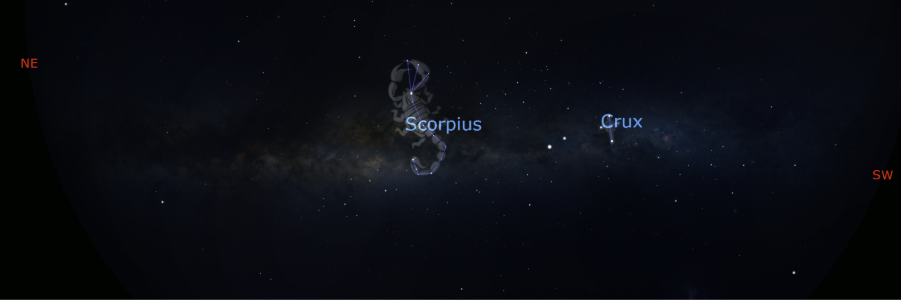
If you can get away from the city lights, the brightest parts of the Milky Way will be stretching across the sky in a dazzling sight worth the journey. Even from a populated area you should have no trouble tracing a line from the Southern Cross to Scorpius, extending it to either horizon and noticing the bright smear of the galaxy across the sky.
Credit: Stellarium
Venus dominates the western evening sky and is backdropped by Leo, the lion. This results in a close encounter with Regulus, the brightest star in Leo, on 10 July.
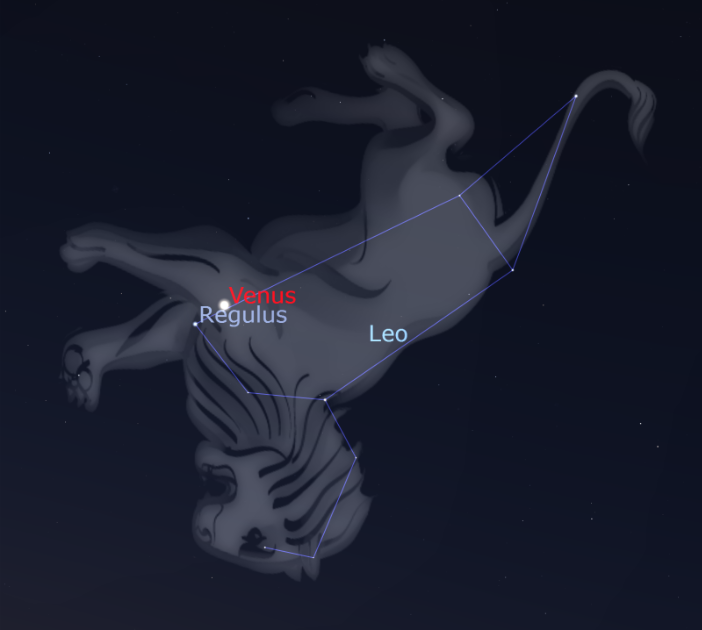
Credit: Stellarium
The eastern pre-dawn sky on 11 July presents a nice sight of Mars, the Moon and (with a telescope!) Uranus. This is backdropped by Taurus and the Pleiades/Seven Sisters cluster, with the bright red star Aldebaran not to be confused with Mars.
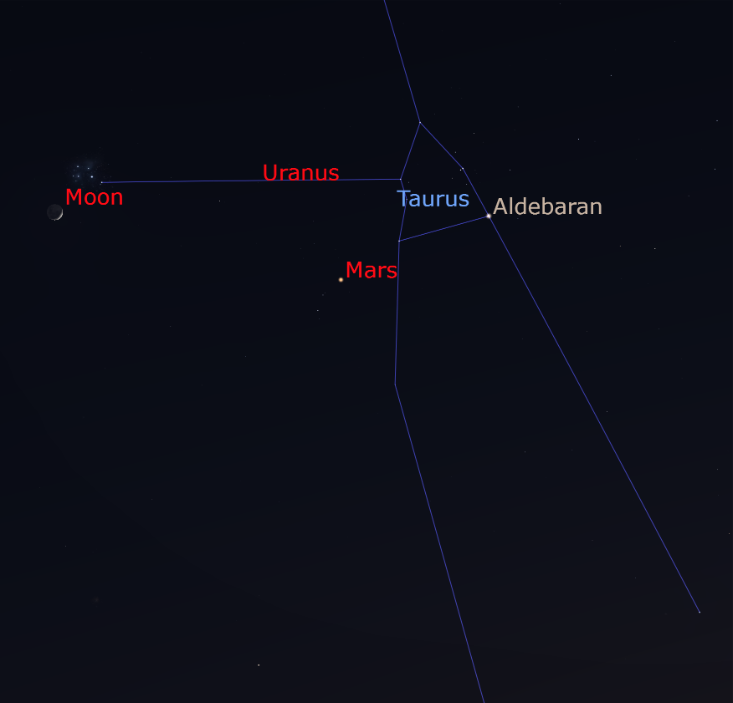
Credit: Stellarium
Earth reaches aphelion on 7 July. This is the point on its orbit where our planet is furthest from the Sun. A seasonal reminder that Earth’s increased distance from the Sun is not the cause of winter (remember, it’s summer in the northern hemisphere right now!).
While the increased distance does have some effect on temperature, the largest contribution to our wintery weather is Earth’s tilt, currently pointing the southern hemisphere away from the Sun, resulting in less solar energy reaching us at this time of year.
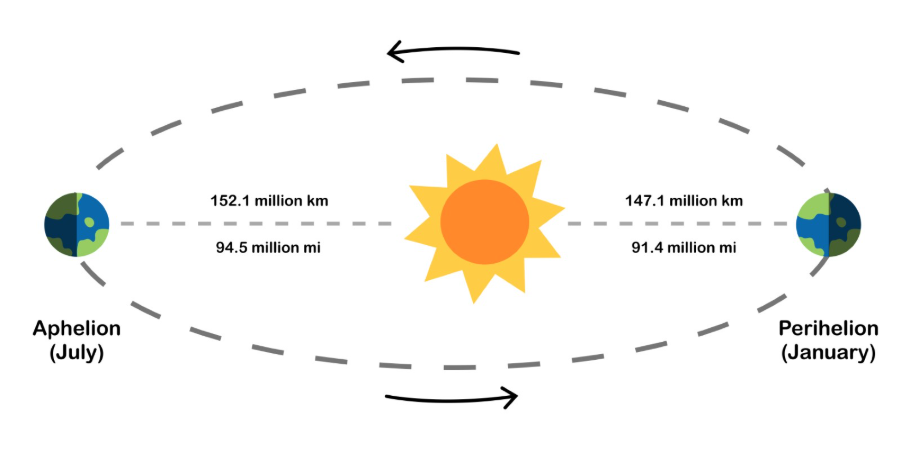
Credit: Littlenm/Getty Images
20 July is International Moon Day, marking the anniversary of the historic landing of Apollo 11 in 1969 putting the first humans on its surface. Take a moment to think about the Moon on this date. You’ll be able to see its waxing crescent sitting above Venus in the evening sky.
ISS sightings from Perth
The International Space Station passes overhead multiple times a day. Most of these passes are too faint to see but a couple of notable sightings* are:
| Date, time | Appears | Max Height | Disappears | Magnitude | Duration |
| 1 July 6:23 PM | 10° above SSW | 37° | 23° above E | -3.2 | 4.5 min |
| 3 July 6:23 PM | 10° above SW | 57° | 10° above NNE | -3.1 | 6.5 min |
Source: Heavens above, Spot the Station
*Note: These predictions are only accurate a few days in advance. Check the sources linked for more precise predictions on the day of your observations.
Moon phases
8 July: Last Quarter
14 July: New Moon
21 July: First Quarter
29 July: Full Moon
Dates of interest
7 July: Earth at aphelion
8 July: Moon close to Saturn
11 July: Moon, Mars and Taurus in eastern morning sky
20 July: International Moon Day
Planets to look for
Venus is ruling the northwestern sky this month, a place it will occupy until mid-October. After the Sun and the Moon, Venus is the brightest solar system object visible in the night sky, so you can’t miss it.
Say goodbye to Jupiter, as the giant planet that has been dominating the northwestern sky slowly sinks below the horizon. You can catch it in the west during twilight in the early days, but by mid-month it will be lost in the Sun’s glare.
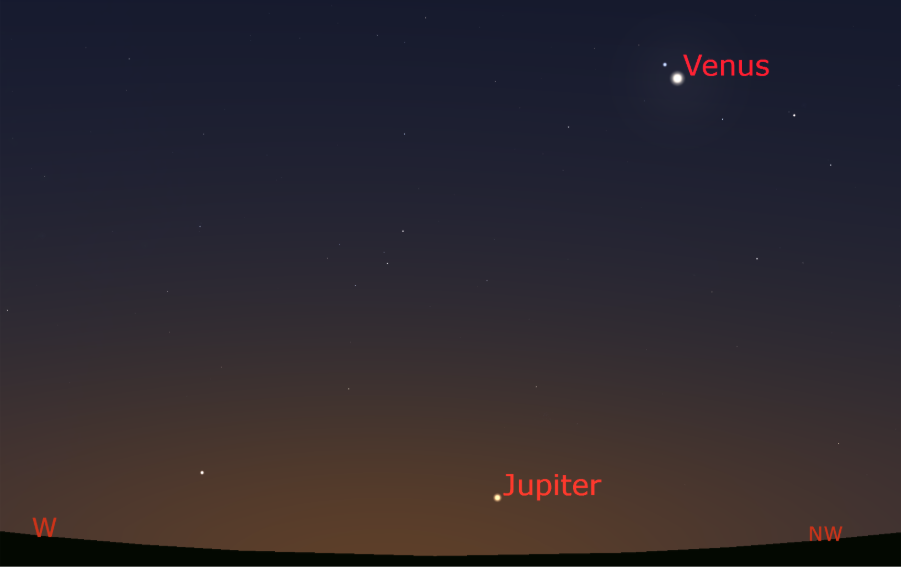
Credit: Stellarium
Saturn is rising about midnight during July, so is best viewed in the northern sky before sunrise.
Mercury is lost in the glare of the Sun most of July, appearing low on the western horizon after sunset in the latter days of the month.
Constellation of the month
Virgo – The Maiden
Virgo is a the second largest large constellation in the sky – visble in the northwest during July evenings. The constellation is usually interpreted as a maiden holding an ear of grain and is often associated with fertility.
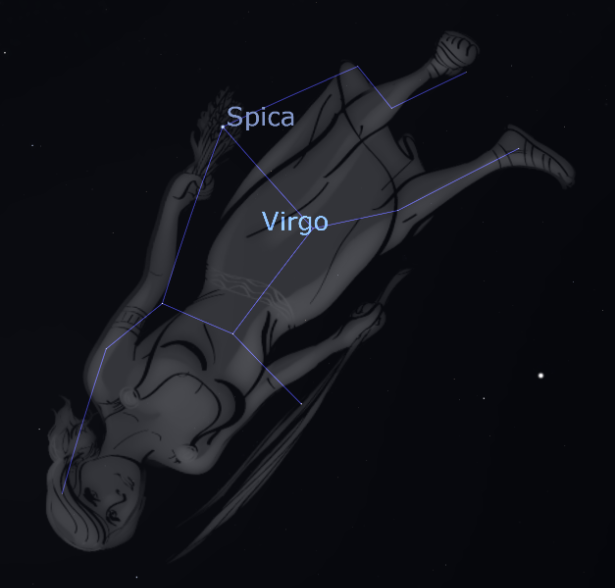
Credit: Stellarium
The constellation’s brightest star Spica, meaning ‘The Virgin’s ear (of grain)’ is a rotating ellipsoidal variable system – two stars who orbit so close together their mutual gravity stretches both stars into egg shapes.
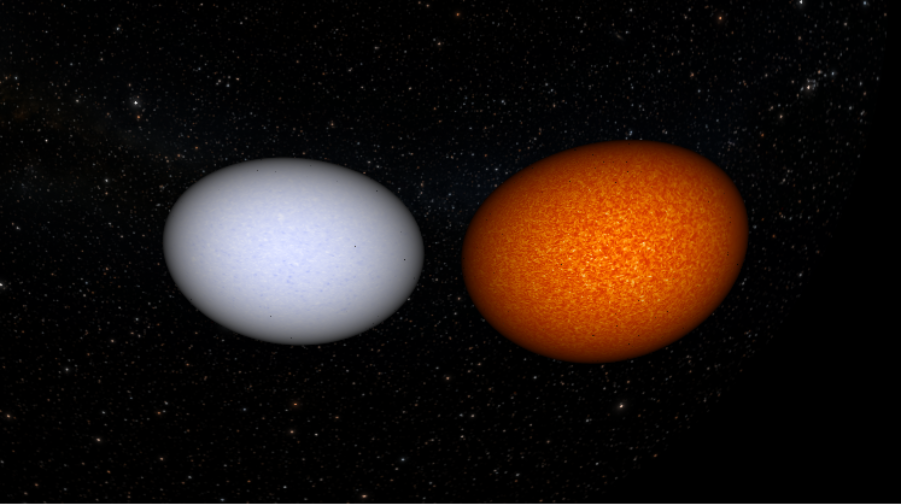
Credit: Smith/Scitech
Virgo is home to the Virgo Cluster, the nearest large cluster of galaxies to the Milky Way, containing about 1,300 galaxies. The Virgo Cluster forms the core of the Virgo Supercluster, an agglomeration of about 50,000 galaxies – including the Milky Way – all bound by their mutual gravity.
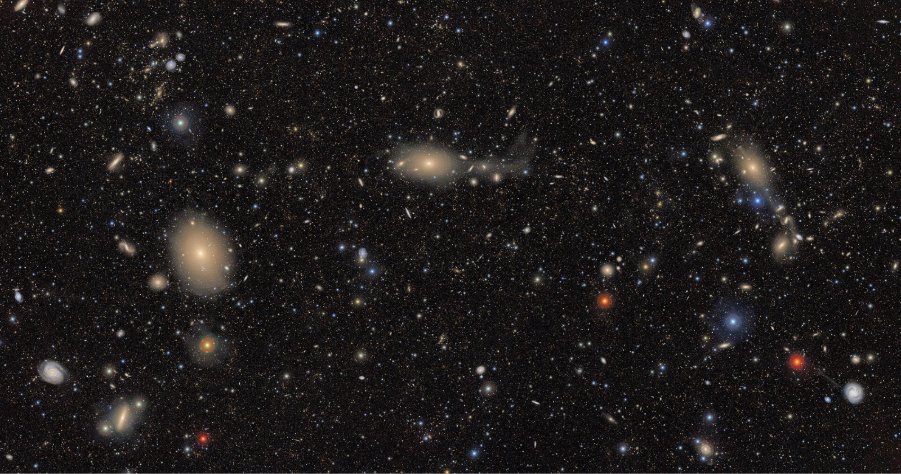
Credit: RubinObs/NOIRLab/SLAC/NSF/DOE/AURA – The Cosmic Treasure Chest, CC BY 4.0
Near the centre of the Virgo Cluster is the giant elliptical galaxy M87, one of the largest known galaxies in the Universe. The active core of M87 is the source of an enormous jet of material ejected from the galaxy, as well as extremely bright emissions across most of the electromagnetic spectrum.
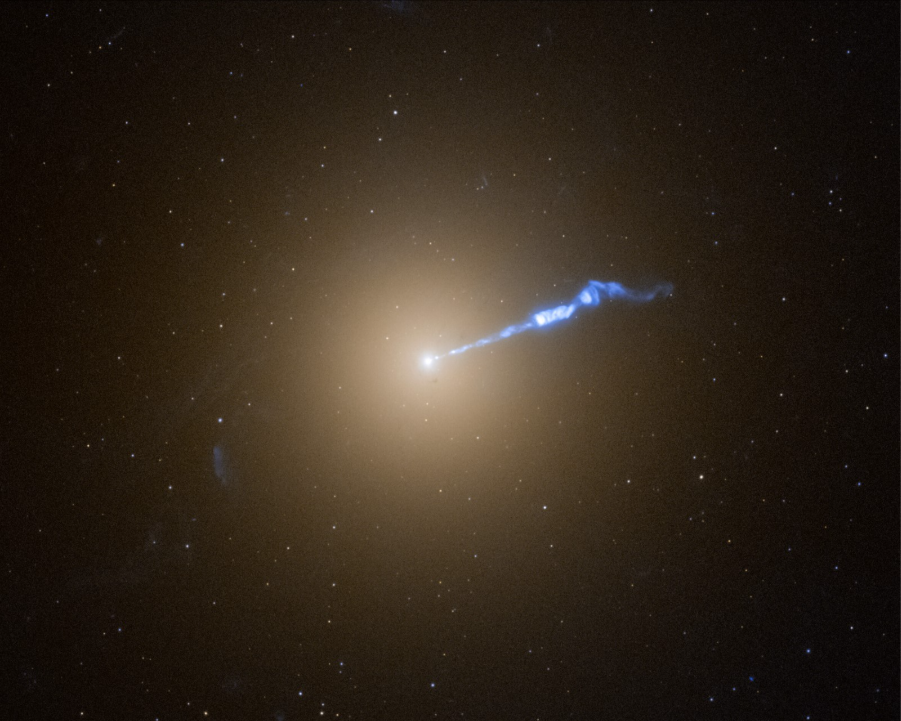
Credit: NASA, ESA, A. Lessing (Stanford University), E. Baltz (Stanford University), M. Shara (AMNH), J. DePasquale (STScI)
Long suspected to be the location of a super massive black hole, in 2017 the core of M87 was imaged by the Event Horizon Telescope. The results were consistent with the presence of a super massive black hole 6.5 billion times heavier than the Sun, and produced the first published image in 2019.
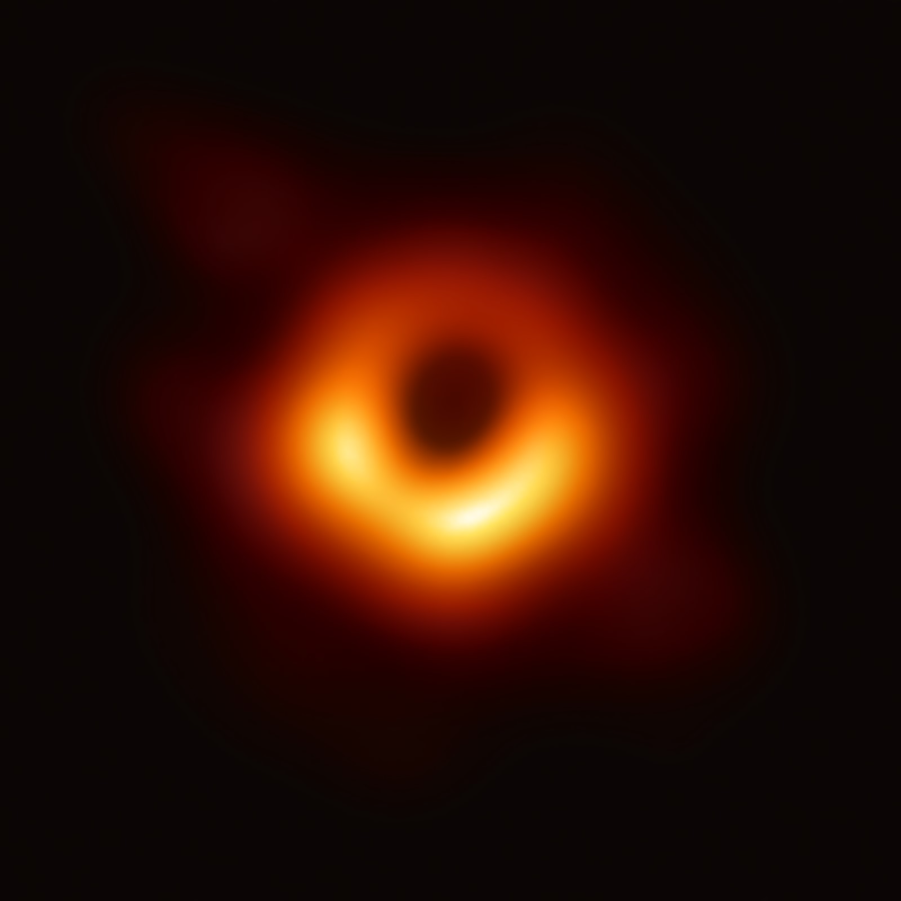
Credit: EHT Collaboration
The study of galaxies and their super massive black holes is an active area of research, forming a cosmological chicken and egg conundrum – which came first?
Do supermassive black holes form, and then accrete a galaxy’s worth of material? Or do galaxies form first and produce supermassive black holes? Only more science will reveal the answer.
Objects for the small telescope
The Sombrero Galaxy
Located in Virgo, though not part of the Virgo Cluster, the Sombrero Galaxy is a striking and unusual galaxy.
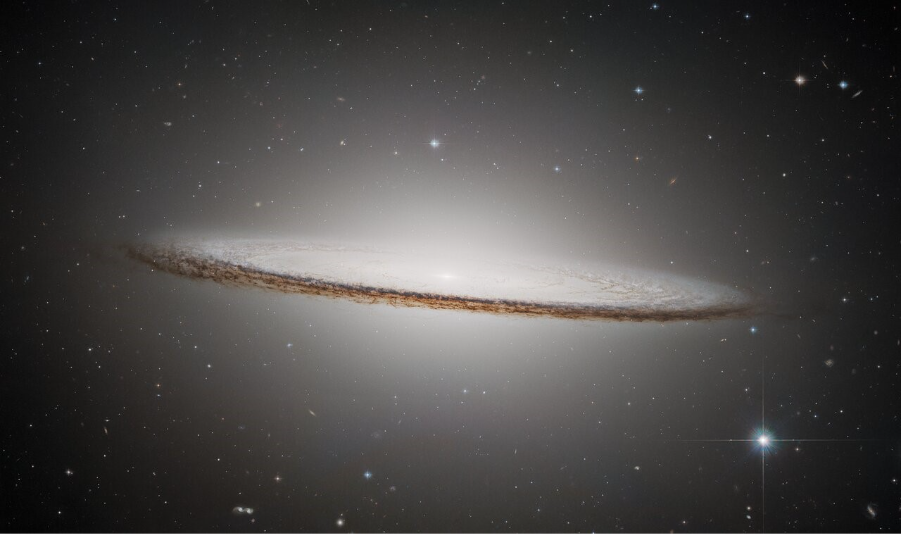
Credit: ESA/Hubble & NASA, K. Noll
With an apparent magnitude of 8.0, the Sombrero Galaxy is one of the brightest galaxies in the night sky and is easily visible in telescopes or good binoculars, presenting a rewarding target of the keen observer.
At first glance the galaxy appears to be a spiral galaxy viewed side-on, but the unusual star formation properties, extended halo and large number of globular clusters – traits of elliptical galaxies – make the morphology of this haberdashery headpiece somewhat uncertain.