READ

A DAY IN THE LIFE OF A MUSEUM PREPARATOR

What lies behind the lab doors of the Western Australian Museum?
Kelly Hopkinson
Kelly Hopkinson
A DAY IN THE LIFE OF A MUSEUM PREPARATOR

Kirsten Tullis has an attention to detail and a creative vision like no other.

When she was 5, she furnished her dollhouse from scratch.

“I used to love making things as a child. I made a miniature book and some pyjamas for my teddy bear,” says Kirsten.

Kirsten is now the senior preparator at the Western Australian Museum.

Kirsten started at the museum in 1981 after studying biology at Murdoch University. She was taken under the wing of renowned naturalist Glen Storr, where she learned the meticulous art of taxidermy.

45 years on and Kirsten has carved out her own path behind the scenes – crafting new techniques, preserving countless creatures and designing exhibits to stop visitors in their tracks.   

MODEL CITIZENS

Kirsten’s talents extend far beyond the realms of taxidermy. Her true passion is making models.

“It can involve all sorts of different techniques and materials. And sometimes you’re making something that no one in the world [has] ever made before,” says Kirsten.
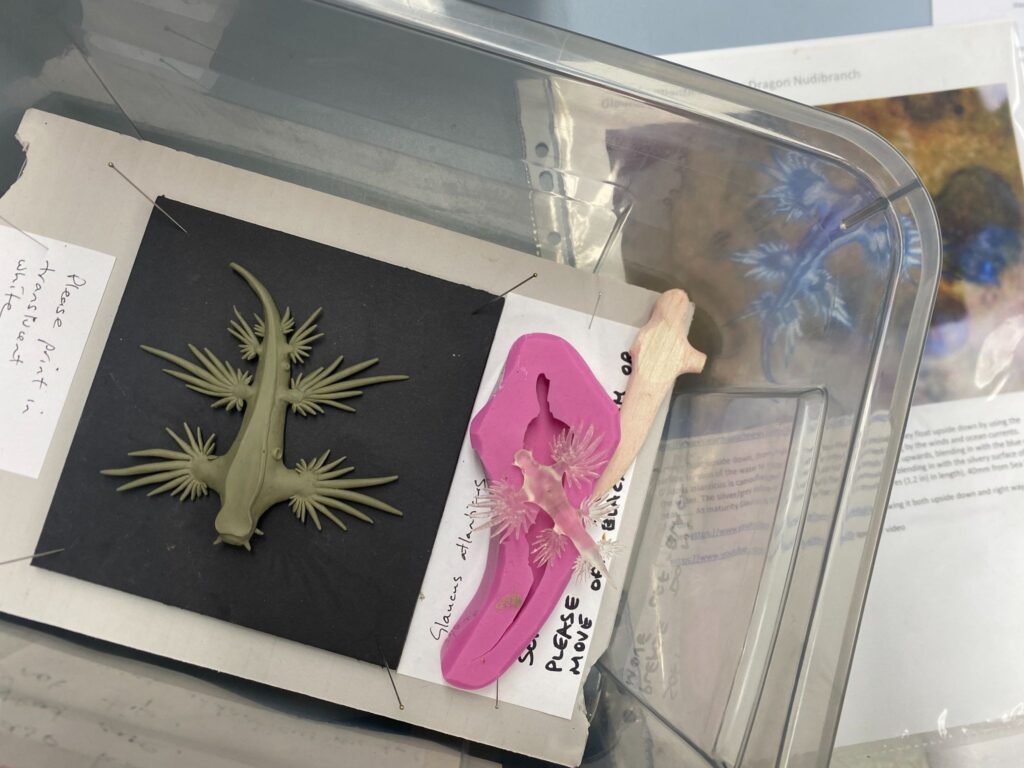
Caption: A handcrafted clay model of the majestic blue dragon sea slug (Glaucus atlanticus) by Kirsten, shown alongside a silicone mould and 3D-printed replica. Casting each model in silicone rubber allows it to be reproduced with fibreglass resin or epoxy.
Credit: Kelly Hopkinson

From clay and wax to 3D printing, the world is her (replica) oyster.

The sprawling sponge garden lining the walls of the Wildlife Gallery at WA Museum Boola Bardip is Kirsten’s magnum opus. 

This 6-metre-long display showcases more than 300 specimens in an immersive underwater wonderland.

Each exhibit is complex, and finding the best approach takes time. 

“It’s a lot of trial and error,” says Kirsten.

“I make copious notes and take photographs of my work so that I remember how I’ve done something, and I can go back to it or it’s good for someone who’s coming along later like Teori.”
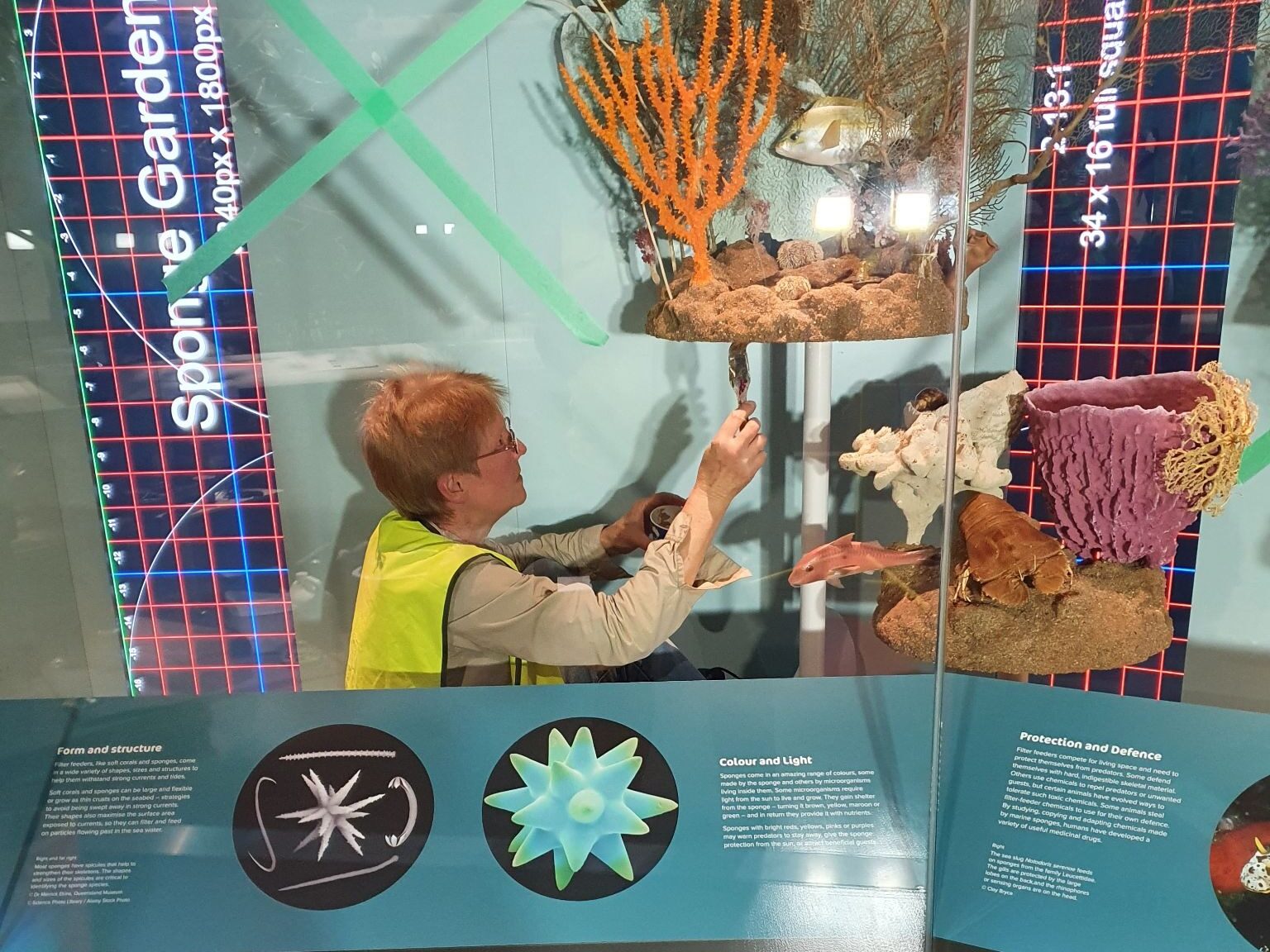
Caption: Kirsten carefully installing specimens into the sponge garden display, which has an amalgamation of models, marine replicas and hand-painted specimens designed for longevity.
Credit: Amanda Barker

BIRDS OF A FEATHER

Teori Shannon has been a taxidermist at the museum since 2011 and is following in Kirsten’s footsteps.

“As a kid, I was constantly collecting bones, rocks, feathers – anything natural I could find,” he says.

After working as a wildlife carer, his passion for preservation flourished at the museum.

Teori pulls an Australian ringneck out of the freezer to defrost.

Forget frozen peas – the museum’s icy cabinet of curiosities holds rows upon rows of animals great and small.

“We’ve got them all stored, labelled, and then we can just choose from our spreadsheet,” says Teori.

Specimens are ethically sourced from all walks of life, from the unfortunate fate of roadkill to zoo animals that pass away from old age.

Together, Kirsten and Teori create pieces to be shared across WA.

The defrosting ringneck is being prepared for an exhibition at the Museum of the Great Southern in Albany.

“In the 1800s, Indigenous people would collect parrots and … trade them with the soldiers or other settlers,” says Teori..

“This [Australian ringneck] will represent that time in history.”

Teori dusts the parrot with borax and explains his plan to mount it on a Victorian era perch to convey its story.

Once the parrot skin is prepped, the specimen gets a bubble bath and blow-dry before being mounted and shipped off to Albany.
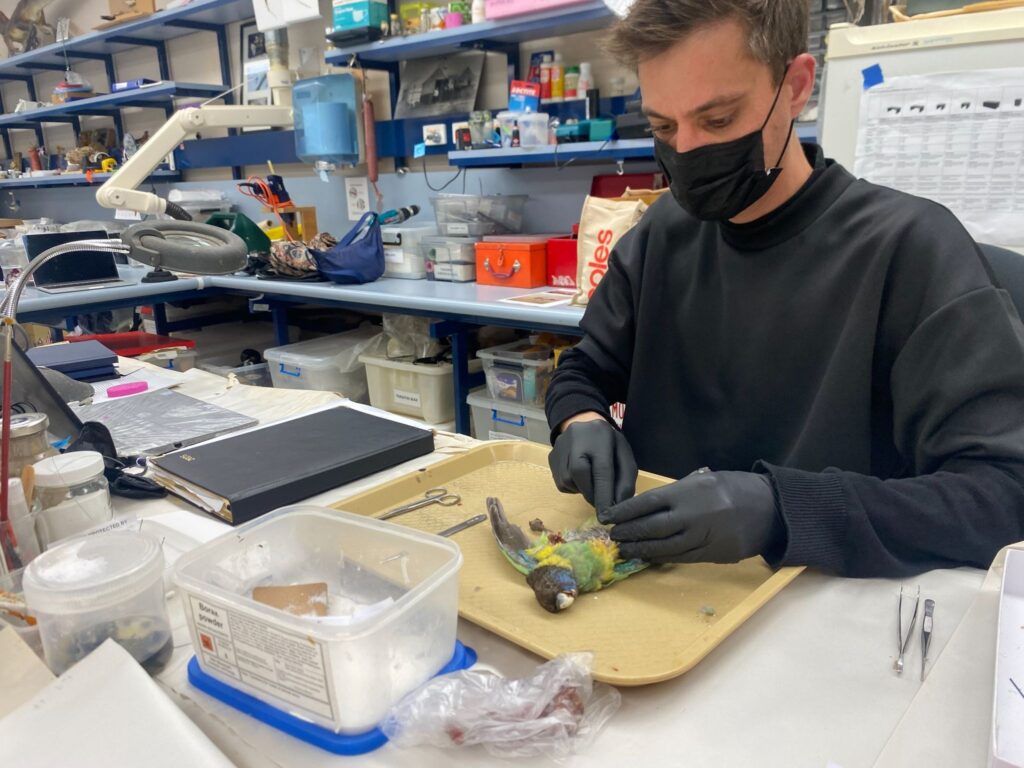
Caption: Teori creates careful incisions inside the wing of the Australian ringneck (Barnardius zonarius) specimen and coats the body cavity with borax to stop bacterial growth and deter insects.
Credit: Kelly Hopkinson

CRAFTING CRITTERS FOR COUNTRY

In the north of the state, a cryptic lizard sits on the banks of Kumpupintil Lake (previously Lake Disappointment).

This species was discovered in 2007 and is rarely seen by the Indigenous Martu people, whose Country encompasses the lake.

Few people have ever seen the reptile, so Teori is perfecting a model to give back to the community. 

“We’ve only got two holotypes of these dragons,” says Teori. 

“[The curator of herpetology] wants replicas done of them so we can give one back to the mob up there, so they’ve got something for education.”  

By positioning a trial lizard with pins, he can fine-tune the procedure before moving onto the real deal.

Each creation that leaves the lab carries a story far and wide.
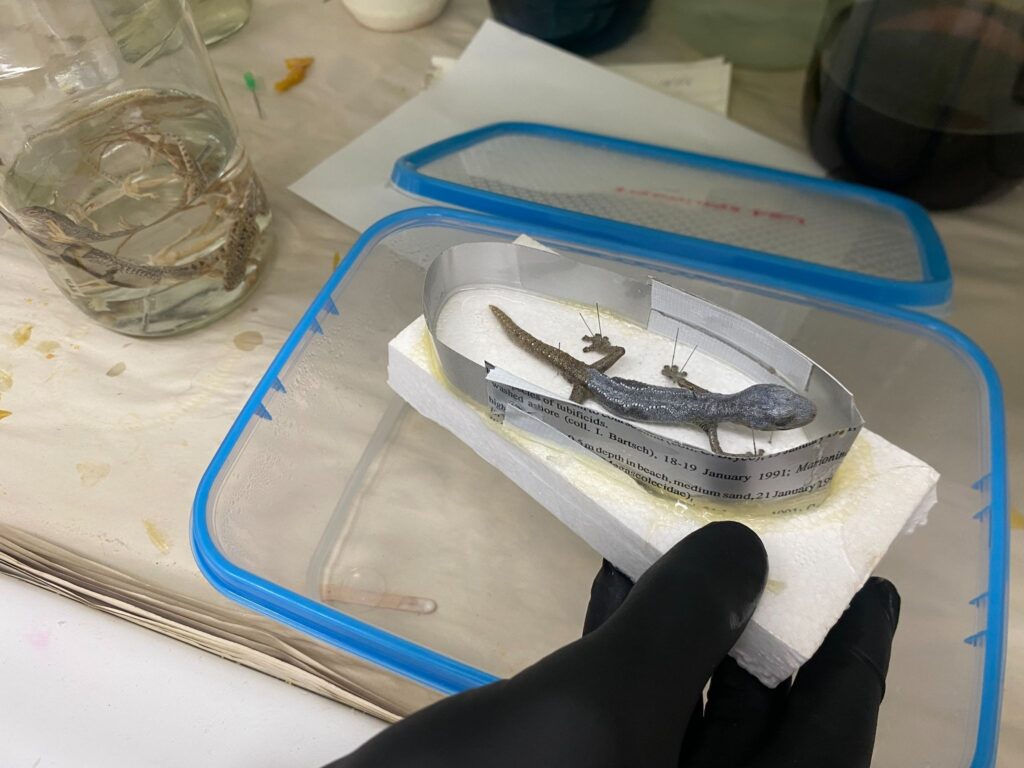
Caption: The wet specimens of the Lake Disappointment dragon (Ctenophorus nguyarna) sit in a jar of ethanol (left) while Teori perfects the model-making technique by pinning a trial specimen in preparation for silicone casting.
Credit: Kelly Hopkinson

MOUNTING EVIDENCE

Through intricate displays, preserved specimens and lifelike replicas, Kirsten and Teori hope to inspire curiosity while bridging the gap between art, tradition and science.

“Taxidermy isn’t just mounting an animal. It involves conservation, chemistry, anatomy, pest management, record keeping and long-term preservation planning,” says Teori.

“It’s a very respectful, methodical process.”

While the work continues quietly behind closed doors, Kirsten and Teori’s impact remains proudly on display.
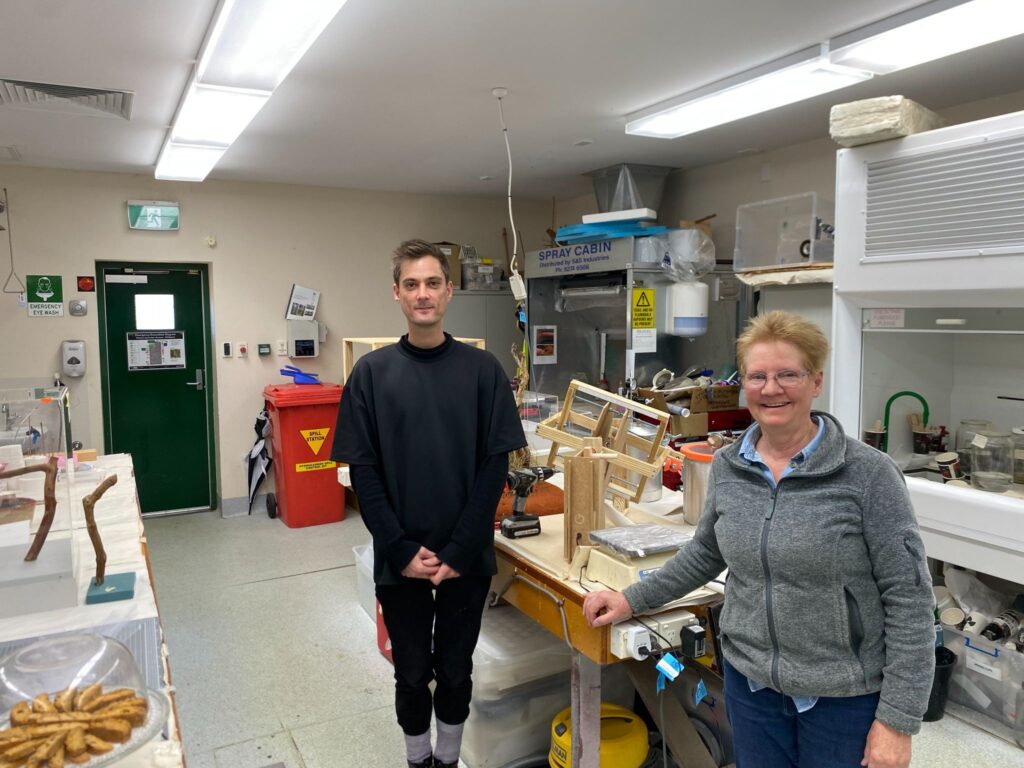
Caption: Teori and Kirsten standing proudly in their lab.
Credit: Kelly Hopkinson
Kelly Hopkinson
About the author
Kelly Hopkinson
Kelly is a zoologist, science communicator and nature enthusiast. With a background in conservation biology and a childhood spent in the outback you’ll often find her hiking or getting lost in the bush. She enjoys knitting in unusual places, sharing obscure facts with anyone who’ll listen and firmly believes Dad jokes are always funny.
View articles
Kelly is a zoologist, science communicator and nature enthusiast. With a background in conservation biology and a childhood spent in the outback you’ll often find her hiking or getting lost in the bush. She enjoys knitting in unusual places, sharing obscure facts with anyone who’ll listen and firmly believes Dad jokes are always funny.
View articles

NEXT ARTICLE

We've got chemistry, let's take it to the next level!

Get the latest WA science news delivered to your inbox, every fortnight.

This field is for validation purposes and should be left unchanged.

Republish

Creative Commons Logo

Republishing our content

We want our stories to be shared and seen by as many people as possible.

Therefore, unless it says otherwise, copyright on the stories on Particle belongs to Scitech and they are published under a Creative Commons Attribution-NoDerivatives 4.0 International License.

This allows you to republish our articles online or in print for free. You just need to credit us and link to us, and you can’t edit our material or sell it separately.

Using the ‘republish’ button on our website is the easiest way to meet our guidelines.

Guidelines

You cannot edit the article.

When republishing, you have to credit our authors, ideally in the byline. You have to credit Particle with a link back to the original publication on Particle.

If you’re republishing online, you must use our pageview counter, link to us and include links from our story. Our page view counter is a small pixel-ping (invisible to the eye) that allows us to know when our content is republished. It’s a condition of our guidelines that you include our counter. If you use the ‘republish’ then you’ll capture our page counter.

If you’re republishing in print, please email us to let us so we know about it (we get very proud to see our work republished) and you must include the Particle logo next to the credits. Download logo here.

If you wish to republish all our stories, please contact us directly to discuss this opportunity.

Images

Most of the images used on Particle are copyright of the photographer who made them.

It is your responsibility to confirm that you’re licensed to republish images in our articles.

Video

All Particle videos can be accessed through YouTube under the Standard YouTube Licence.

The Standard YouTube licence

  1. This licence is ‘All Rights Reserved’, granting provisions for YouTube to display the content, and YouTube’s visitors to stream the content. This means that the content may be streamed from YouTube but specifically forbids downloading, adaptation, and redistribution, except where otherwise licensed. When uploading your content to YouTube it will automatically use the Standard YouTube licence. You can check this by clicking on Advanced Settings and looking at the dropdown box ‘License and rights ownership’.
  2. When a user is uploading a video he has license options that he can choose from. The first option is “standard YouTube License” which means that you grant the broadcasting rights to YouTube. This essentially means that your video can only be accessed from YouTube for watching purpose and cannot be reproduced or distributed in any other form without your consent.

Contact

For more information about using our content, email us: particle@scitech.org.au

Copy this HTML into your CMS
Press Ctrl+C to copy