


READ

Particle 101: The Federal Budget

It promised a range of funding for science and research but there were some glaring omissions.
Emily Evans
Emily Evans
Freelance Writer
Particle 101: The Federal Budget

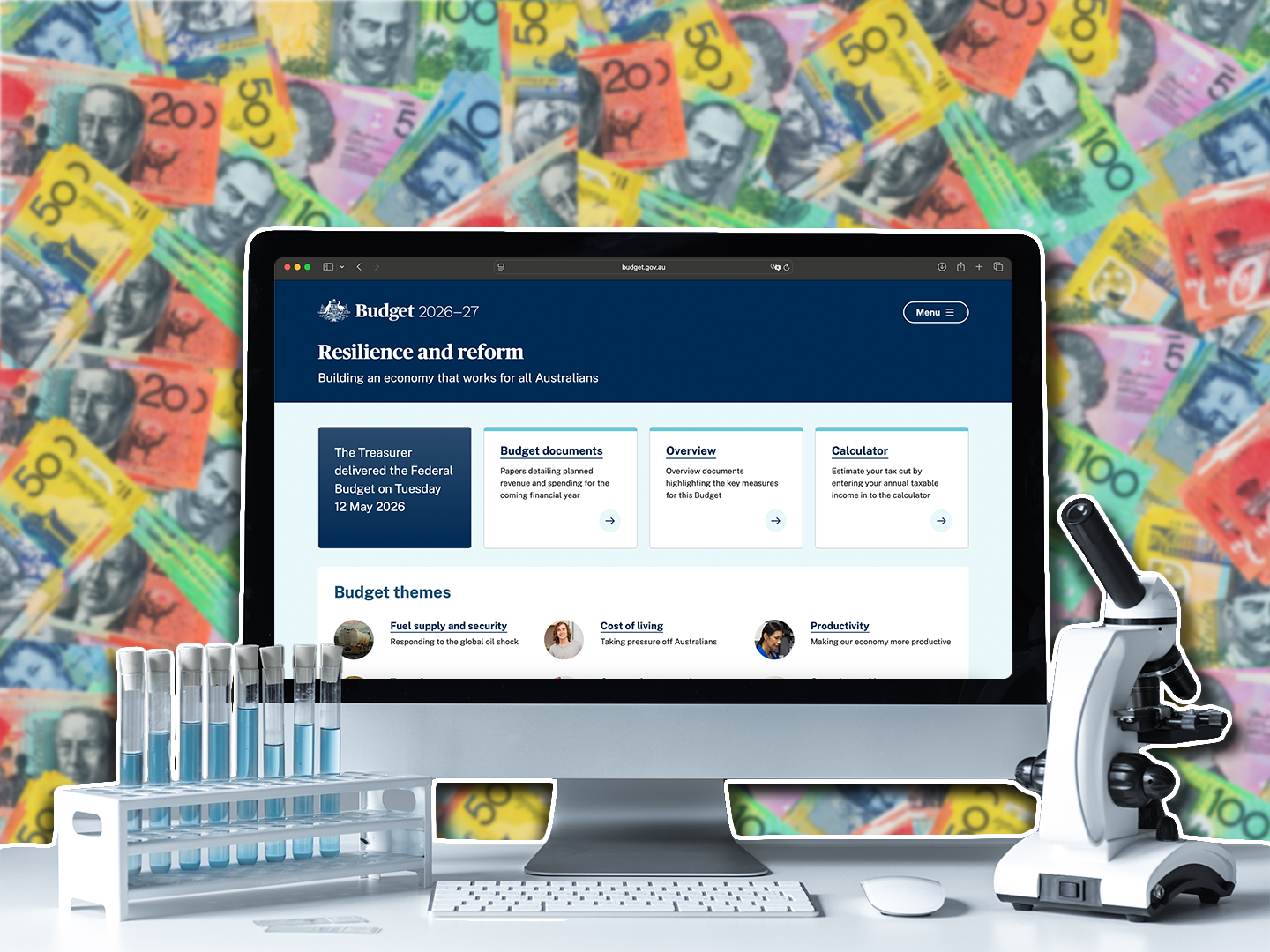
The Federal Budget is revealed to Australia on the third Tuesday night in May each year.

The Budget papers outline government spending for the next 4 years, highlighting where investments will be made.

For Australia’s science sector, there was a mixed bag of Budget measures, including increased investment and cuts to major research programs.

SPENDING ON SCIENCE

The headline figure for science this year was a $1.5 billion investment in research and science institutions, including funding to create a National Resilience and Science Council.

The council is designed to better coordinate research and development investment and ensure it remains aligned with Australia’s economic goals.

More than $387 million was announced for national science agency CSIRO, while just over $21 million was allocated to the Australian Space Agency.

The government also pledged $589 million to support Australian clinical trials and $508.5 million for the Medical Research Future Fund, which supports health and medical research.

Reforms to the Research and Development (R&D) Tax Incentive were also outlined, aiming to simplify the scheme and better support businesses involved in R&D.

Taking effect from 1 July 2028, the changes will provide stronger financial incentives for businesses to spend on R&D activity.

The reform was backed by a range of peak bodies and companies, including the Business Council of Australia and hearing implant company Cochlear.

Despite the long list of investments, there were also notable cuts.

NOT ENOUGH FOR FUTURE GROWTH

The largest cut was to Australia’s Economic Accelerator, created to support research commercialisation programs.

The grant program will be axed, with $800 million in funding redirected towards other research activity.

The Budget papers also confirmed that the Trailblazer Universities Program will be scrapped and $67 million will be cut from the National Environmental Science Program.

The reaction from industry has been pointed.

The Australian Academy of Science stated that the 2026–27 Budget “falls well short” of reversing a decade of underinvestment in a media release.

Meanwhile, Universities Australia warned the nation will not become “more productive or competitive by investing less”.

As with every Federal Budget, there will be winners and losers. Only time will tell whether Australia’s science sector benefits from this year’s fiscal plans.


Emily Evans
About the author
Emily Evans
Emily has worked in the media and communications industry in Western Australia as both a TV journalist and media advisor. She has a passion for scientific research and enjoys writing about the latest and quirkiest discoveries. Emily is also a big fan of going on adventures, eating Mexican food, and travelling the world.
View articles
Emily has worked in the media and communications industry in Western Australia as both a TV journalist and media advisor. She has a passion for scientific research and enjoys writing about the latest and quirkiest discoveries. Emily is also a big fan of going on adventures, eating Mexican food, and travelling the world.
View articles

NEXT ARTICLE

We've got chemistry, let's take it to the next level!

Get the latest WA science news delivered to your inbox, every fortnight.

This field is for validation purposes and should be left unchanged.

Republish

Creative Commons Logo

Republishing our content

We want our stories to be shared and seen by as many people as possible.

Therefore, unless it says otherwise, copyright on the stories on Particle belongs to Scitech and they are published under a Creative Commons Attribution-NoDerivatives 4.0 International License.

This allows you to republish our articles online or in print for free. You just need to credit us and link to us, and you can’t edit our material or sell it separately.

Using the ‘republish’ button on our website is the easiest way to meet our guidelines.

Guidelines

You cannot edit the article.

When republishing, you have to credit our authors, ideally in the byline. You have to credit Particle with a link back to the original publication on Particle.

If you’re republishing online, you must use our pageview counter, link to us and include links from our story. Our page view counter is a small pixel-ping (invisible to the eye) that allows us to know when our content is republished. It’s a condition of our guidelines that you include our counter. If you use the ‘republish’ then you’ll capture our page counter.

If you’re republishing in print, please email us to let us so we know about it (we get very proud to see our work republished) and you must include the Particle logo next to the credits. Download logo here.

If you wish to republish all our stories, please contact us directly to discuss this opportunity.

Images

Most of the images used on Particle are copyright of the photographer who made them.

It is your responsibility to confirm that you’re licensed to republish images in our articles.

Video

All Particle videos can be accessed through YouTube under the Standard YouTube Licence.

The Standard YouTube licence

  1. This licence is ‘All Rights Reserved’, granting provisions for YouTube to display the content, and YouTube’s visitors to stream the content. This means that the content may be streamed from YouTube but specifically forbids downloading, adaptation, and redistribution, except where otherwise licensed. When uploading your content to YouTube it will automatically use the Standard YouTube licence. You can check this by clicking on Advanced Settings and looking at the dropdown box ‘License and rights ownership’.
  2. When a user is uploading a video he has license options that he can choose from. The first option is “standard YouTube License” which means that you grant the broadcasting rights to YouTube. This essentially means that your video can only be accessed from YouTube for watching purpose and cannot be reproduced or distributed in any other form without your consent.

Contact

For more information about using our content, email us: particle@scitech.org.au

Copy this HTML into your CMS
Press Ctrl+C to copy