
You might be interested

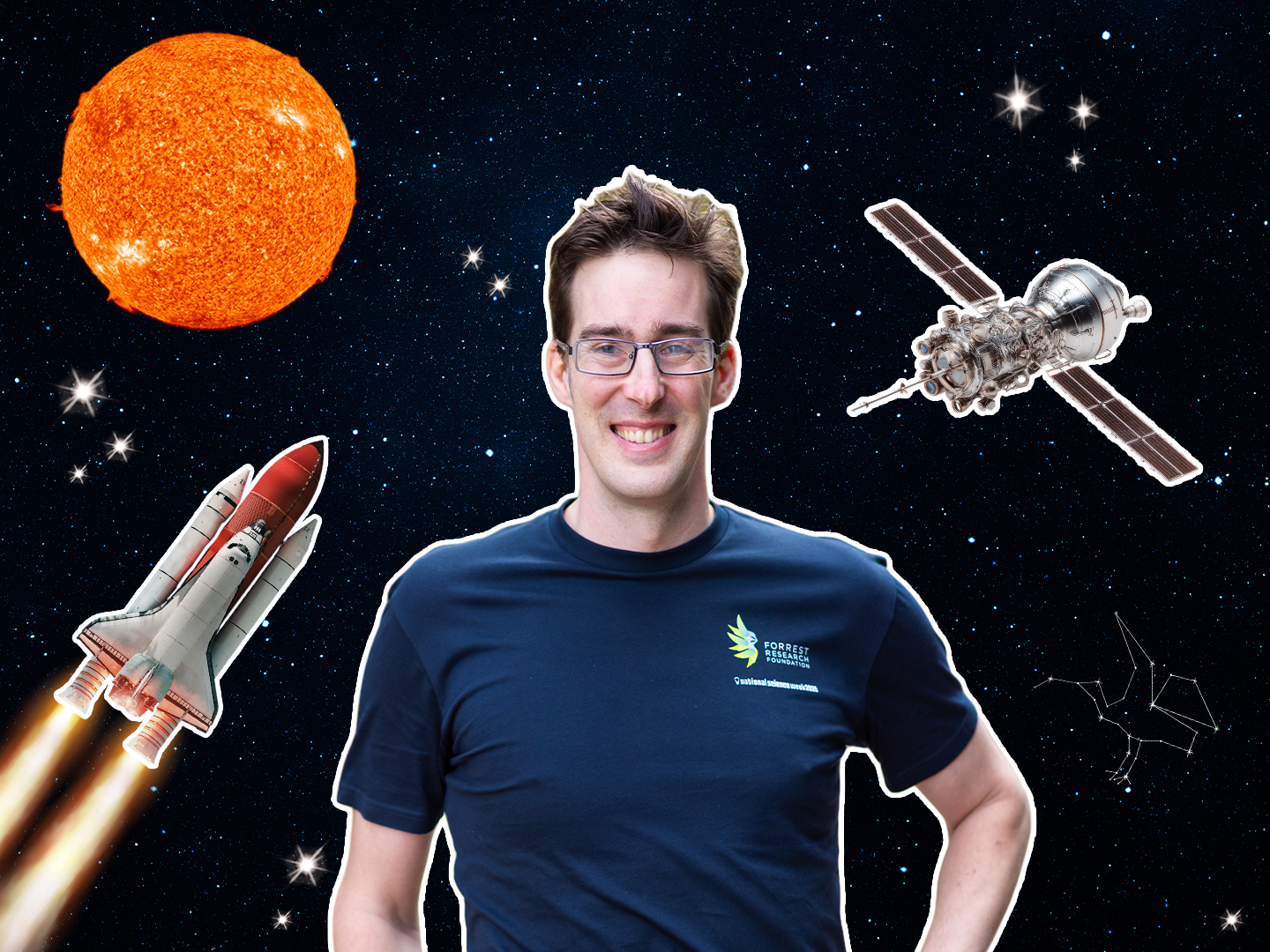
Connor Bottrell didn’t look through a telescope until he was an adult, which makes his current job all the more intriguing.
Today, the Forrest Foundation Research Fellow studies galaxies. More accurately, he studies the chaos that ensues when galaxies crash into each other.
“The big question I’m trying to answer is what is the missing mass in the universe?” he says.
The vast majority of mass in our universe is unaccounted for. There’s an invisible something hiding out there. We know it’s there because it leaves its fingerprints on the things in the universe we can see – the light, gas and stars.
Scientists call this invisible something “dark matter” and have all manner of ingenious methods of studying those fingerprints. Connor’s method, though, might be the most extreme.
In the beginning …
Connor grew up in Victoria, Canada, and his parents helped foster an interest in the natural world.
Although he excelled at maths in school, particularly applying maths to nature, by university, he realised it wasn’t the path he wanted to go down.
So he course-corrected, moving towards big datasets associated with observations of our universe.
After completing his PhD at the University of Victoria, Connor wanted to pursue a career around the world – and Australia was high on his list.
“I had a lot of very amazing conference experiences in Australia. So I thought, oh, I’ll just go straight there after my PhD.”
It wasn’t to be. After an unsuccessful application, he considered other trans-Pacific options and found himself in Japan, where he worked at the Kavli Institute for the Physics and Mathematics of the Universe.
“You’ve got proper mathematicians, physicists who are working on particle colliders, cosmologists who are working on the most exotic physics you can think of in the early universe, and then some galaxy people, like me,” he says.
Those experiences with other scientific disciplines were eye-opening, Connor says, because they forced him to think how his work fit into a larger context. But his eyes were still on Australia.
Collisions
After his 2 year stint in Japan, he found the position he’d long been after in Western Australia.
At the Forrest Research Foundation, in conjunction with the University of Western Australia, Connor spends his days trying to nail down what dark matter could be.
To do so, he can’t just go and smash a few galaxies together – he doesn’t have that kind of power.
Instead, he simulates galaxy collisions with powerful computers and compares those computer-generated results with real-world observations.
It’s hoped this work will enable particle physicists to narrow their search for the elusive something that makes up dark matter.
Connor is kind of like a detective, though he’s not trying to find a murderer – he’s dusting for fingerprints at the crime scene.
Experimental physicists, with colliders and detectors buried deep underground, then can use those fingerprints on their road to discovery.
Knee to Know
It’s not all galaxy-gazing, however. Connor spends 2 days a week working at ArthroLase, a medtech company in Perth that is aiming to improve robotic knee surgeries. Sure, galaxies don’t seem to have a lot in common with joints, at first blush.
But for a computational astrophysicist, the same models can be used to study both.
“The beauty of medtech is that all the diagnostics and stuff are images,” Connor says. “And images are the currency of astronomers.”
About 80,000 Australians undergo knee replacement surgeries every year, and the aim at ArthroLase is to more accurately guide the robots that cut away damaged tissue and bone.
Connor says some weeks he is using the same tools to create better maps of the cartilage and bone.
Whether knees or galaxies, Connor’s mindset is shaped by a hunger for knowledge. And it has to be.
It’s not always easy – science is a slow and difficult process and Australian funding for research is at historic lows.
It can feel like a daunting career, particularly for young researchers. But it can take you to some amazing places, half way across the world and back.
Connor’s advice is simple but incisive.
“We sacrifice a lot for this,” he says. “Curiosity has to be your priority.”