

READ

This Ship Sucks

If you’ve been around Fremantle lately, you might have seen a ship that looks a little bit … different.
Rocky McGellin
Rocky McGellin
Freelance writer
This Ship Sucks

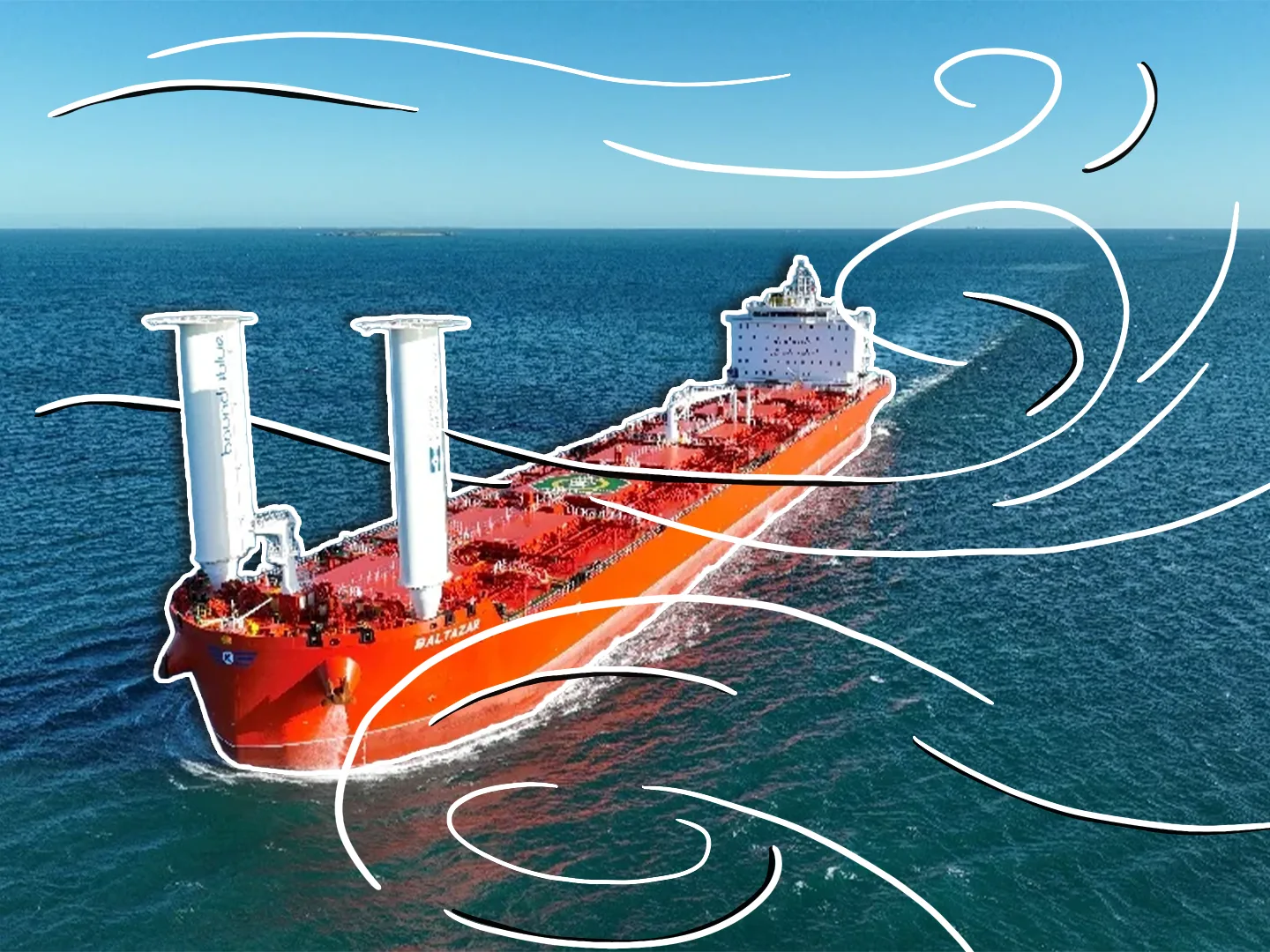
While the back half of MV Baltazar is a normal-looking bulk carrier, the front really stands out. 

Two pillars, 24 metres tall, project from the ship’s bow, towering over the rest of the ship.

What the heck are they?

They’re sails!

MV Baltazar is a sailing ship, and those pillars are the sails.

All sails, even ‘normal’ ones, work a bit like wings – but these ones really show it. 

They’re curved like an aeroplane wing to deflect the wind, creating a difference in air pressure that pushes the boat forward.

Unlike regular sails, which rely on just their shape to create lift, these sails are powered. 

They’re called suction sails, or turbosails, and were first proposed by Jacques Cousteau in the 1980s. 

They’re hollow, with vents at the back and a fan at the top that pulls air in. 

This helps the wind ‘stick’ to the sail, keeping air flowing smoothly and making the sail much more effective.

We’re talking WAPS (wind-assisted propulsion systems)

Suction sails are just one type of wind-assisted propulsion. Some have vertical wings that look more like traditional sails.

Others, like MV AFROS, which visited Geraldton in 2018, have spinning cylinders called Flettner rotors, taking advantage of the same aerodynamic effect that makes spinning balls curve.

A big advantage of these systems is that they can be installed on ships that already exist. They can be computer controlled (so they don’t need more crew) and can be lowered to the deck (so they fit in existing ports).

It’s also their downside – so far, all of these systems supplement, rather than replace, the ship’s regular engines.

Sailing the hy-brid seas

A bit like a hybrid car, MV Baltazar’s sails help to reduce fuel use, making trips greener and cheaper. It’s estimated the sails will reduce its fuel use by about 12%.

But every bit counts – and a little wind-assisted efficiency might make other technology, like batteries or ammonia, more viable.

As the shipping industry works to decrease its enormous carbon footprint, we’ll probably see more funky sails making their way along WA’s exceptionally windy coastline.


Rocky McGellin
About the author
Rocky McGellin
Rocky is a freelance writer. He has a Masters in Science Communication from UWA. He enjoys science fiction books, and his favourite solar system object is Epimetheus.
View articles
Rocky is a freelance writer. He has a Masters in Science Communication from UWA. He enjoys science fiction books, and his favourite solar system object is Epimetheus.
View articles

NEXT ARTICLE

We've got chemistry, let's take it to the next level!

Get the latest WA science news delivered to your inbox, every fortnight.

Republish

Creative Commons Logo

Republishing our content

We want our stories to be shared and seen by as many people as possible.

Therefore, unless it says otherwise, copyright on the stories on Particle belongs to Scitech and they are published under a Creative Commons Attribution-NoDerivatives 4.0 International License.

This allows you to republish our articles online or in print for free. You just need to credit us and link to us, and you can’t edit our material or sell it separately.

Using the ‘republish’ button on our website is the easiest way to meet our guidelines.

Guidelines

You cannot edit the article.

When republishing, you have to credit our authors, ideally in the byline. You have to credit Particle with a link back to the original publication on Particle.

If you’re republishing online, you must use our pageview counter, link to us and include links from our story. Our page view counter is a small pixel-ping (invisible to the eye) that allows us to know when our content is republished. It’s a condition of our guidelines that you include our counter. If you use the ‘republish’ then you’ll capture our page counter.

If you’re republishing in print, please email us to let us so we know about it (we get very proud to see our work republished) and you must include the Particle logo next to the credits. Download logo here.

If you wish to republish all our stories, please contact us directly to discuss this opportunity.

Images

Most of the images used on Particle are copyright of the photographer who made them.

It is your responsibility to confirm that you’re licensed to republish images in our articles.

Video

All Particle videos can be accessed through YouTube under the Standard YouTube Licence.

The Standard YouTube licence

  1. This licence is ‘All Rights Reserved’, granting provisions for YouTube to display the content, and YouTube’s visitors to stream the content. This means that the content may be streamed from YouTube but specifically forbids downloading, adaptation, and redistribution, except where otherwise licensed. When uploading your content to YouTube it will automatically use the Standard YouTube licence. You can check this by clicking on Advanced Settings and looking at the dropdown box ‘License and rights ownership’.
  2. When a user is uploading a video he has license options that he can choose from. The first option is “standard YouTube License” which means that you grant the broadcasting rights to YouTube. This essentially means that your video can only be accessed from YouTube for watching purpose and cannot be reproduced or distributed in any other form without your consent.

Contact

For more information about using our content, email us: particle@scitech.org.au

Copy this HTML into your CMS
Press Ctrl+C to copy