

You might be interested


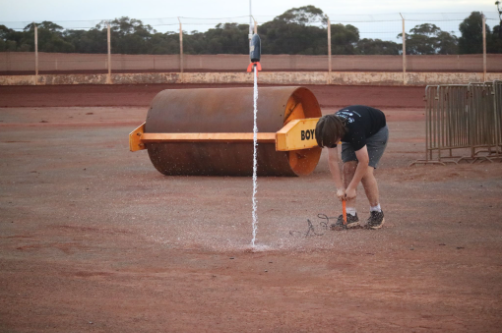
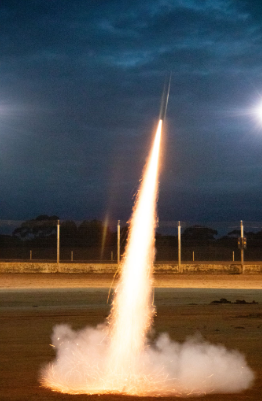
In the middle of Western Australia’s outback, dozens of primary school students spent the holidays shooting satellites into the sky.
The handmade rockets were launched from the Kalgoorlie Speedway as part of an educational program run by the Binar Space Program.
Pronounced BIN-ah, ‘binar’ is the Noongar word for ‘fireball’.
It was the first time the BinarX School Holiday Program had been brought to regional WA, with the hope it will inspire the next generation of space enthusiasts.
“We wanted to make [the program] accessible to not only kids that live in Perth, but also the kids that live in the regions,” says Binar Space Program Director of Research Dr Robert Howie.
“Our objective is to power up the space economy of WA – technical advances in engineering is only one part of it,” says Robert.
“Without the workforce to actually deliver on that economic potential, you really can’t go anywhere.”
Credit: Supplied Binar Space Program
Credit: Supplied Binar Space Program
LAUNCHING THE NEXT GENERATION
The Binar Space Program, based at Curtin University’s Space Science and Technology Centre, was allocated $2.5 million to continue its educational programs and keep sending its satellites into space in the State Government’s $6.5 million investment in the WA space industry.
Binar launched the first WA-built satellite into orbit in 2021 and has since completed three other missions sending satellites to the International Space Station.
“When we built Binar 1, not everything worked exactly as we had hoped,” says Robert. “We learned quite a lot from that experience, which we applied to the next mission.”
“It’s definitely very rewarding to see the team’s years’ worth of work and effort go into [those] 3 seconds where they push the button on the International Space Station and your spacecraft gets deployed into low Earth orbit.”
“It’s super exciting but it’s also a little bit nerve-wracking.”
A SPACE RACE FOR ALL
Perth-headquartered consortium Australian Remote Operations for Space and Earth (AROSE) was allocated $4 million to strengthen WA’s position in the global space industry.
“It’s always great to see the government stepping forward because these are the things that help diversify our economy or make it more resilient,” says AROSE CEO Jason Crusan.
“There’s more money coming into the [global] space sector than there has been probably ever since Apollo.
“It’s a space race, but in a way that everyone wins, not just one country.”
AROSE works with major resource companies to apply Australia’s expertise in remote operations developed across mining and agricultural industries on Earth to space.
Jason says the funding will help them to grow next-generation space systems and increase the number of AROSE members involved in knowledge sharing and collaboration.
“We want people to come in that have … hard problems to work on that we can dig our teeth into, along with the other members,” says Jason.
Credit: NASA/Unsplash
GROUND CONTROL TO WA
While rockets and astronauts often steal the spotlight, much of WA’s space expertise lies in developing cutting-edge technologies that can solve problems both on Earth and beyond.
“The space industry – especially outside of Australia – looks to Australia’s capabilities and remote operations and autonomy as world-leading,” says Jason.
This provides a major foothold for WA in the global space industry, as the state begins its own space mission.
“Australia’s in kind of the fledgling space agency phase at the very beginning,” says Jason.
“We just need to see that continued support because the space activities contribute in many different ways to the economy.”
Like many industries, growth begins at the grassroots level, which makes Binar’s school holiday program a key factor in building WA’s future workforce in the space sector.
“We’re looking to do more of that under this new tranche of funding … so people should expect to see us out and about throughout WA,” says Robert.