READ

NUTRITION WITH A MISSION

Ellie Dunlop is changing food policy – one vitamin at a time.
Cat Williams
Cat Williams
Freelance Writer
NUTRITION WITH A MISSION

After working at Telstra for 10 years, Ellie Dunlop wanted a career change. 

“I started studying nutrition as a mature-age student,” says Ellie. “I was really just looking for something sort of interesting and useful to do while my kids were at school.”

The ‘useful and interesting’ thing she landed on was a degree in nutrition, which eventually led to Ellie completing her Master of Dietetics. 

“I didn’t know about dietetics when I first started studying nutrition. All the young people on the course, they knew what was going on, and I was like, I don’t know what dietetics is!” she laughs.

Now, Ellie is a research fellow at Deakin University and is an early career finalist at the Premier’s Science Awards. 

VITAMIN D

“I did the dietetics course and really, really enjoyed it,” says Ellie. “I kind of had this vision of going into either private practice or clinical practice.

“But while I was doing the master’s, I did a small research project with one of my lecturers, Jill Sherriff, and someone I hadn’t even heard of, that was Lucinda Black. 

“Now, 10 years later, Lucinda and I are still working together in research.”

Ellie’s master’s research project was looking at vitamin D in white fish and chicken eggs. Ellie says there was plenty of research on oily fish, but they wanted to test whether white fish was also a good vitamin D source. 

This project served as pilot data that became Ellie’s PhD, which looked at dietary vitamin D in Australia. 

“We made the first comprehensive vitamin D food composition database for Australia,” says Ellie. 

“We found that there was like 95% of Australians [who] were not consuming enough vitamin D.

“Then we were looking at ways that we might be able to help people get more vitamin D in their diet.”

The food composition database explains how much vitamin D is in a variety of different foods.

The data has been adopted by Food Standards Australia New Zealand and is used by the Australian Bureau of Statistics (ABS) to estimate nutrient intake for the Australian population.

Ellie says it’s really satisfying to see her work being used to guide policy and enable people to make better food choices. 
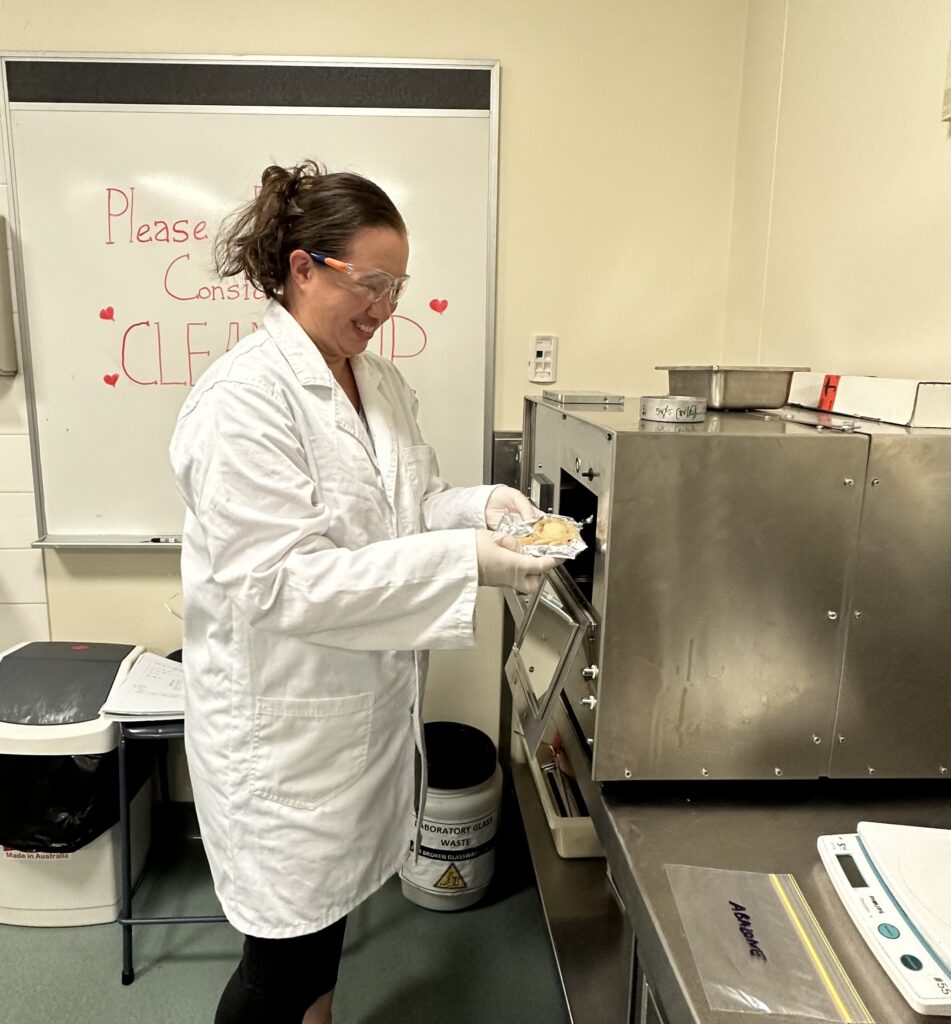
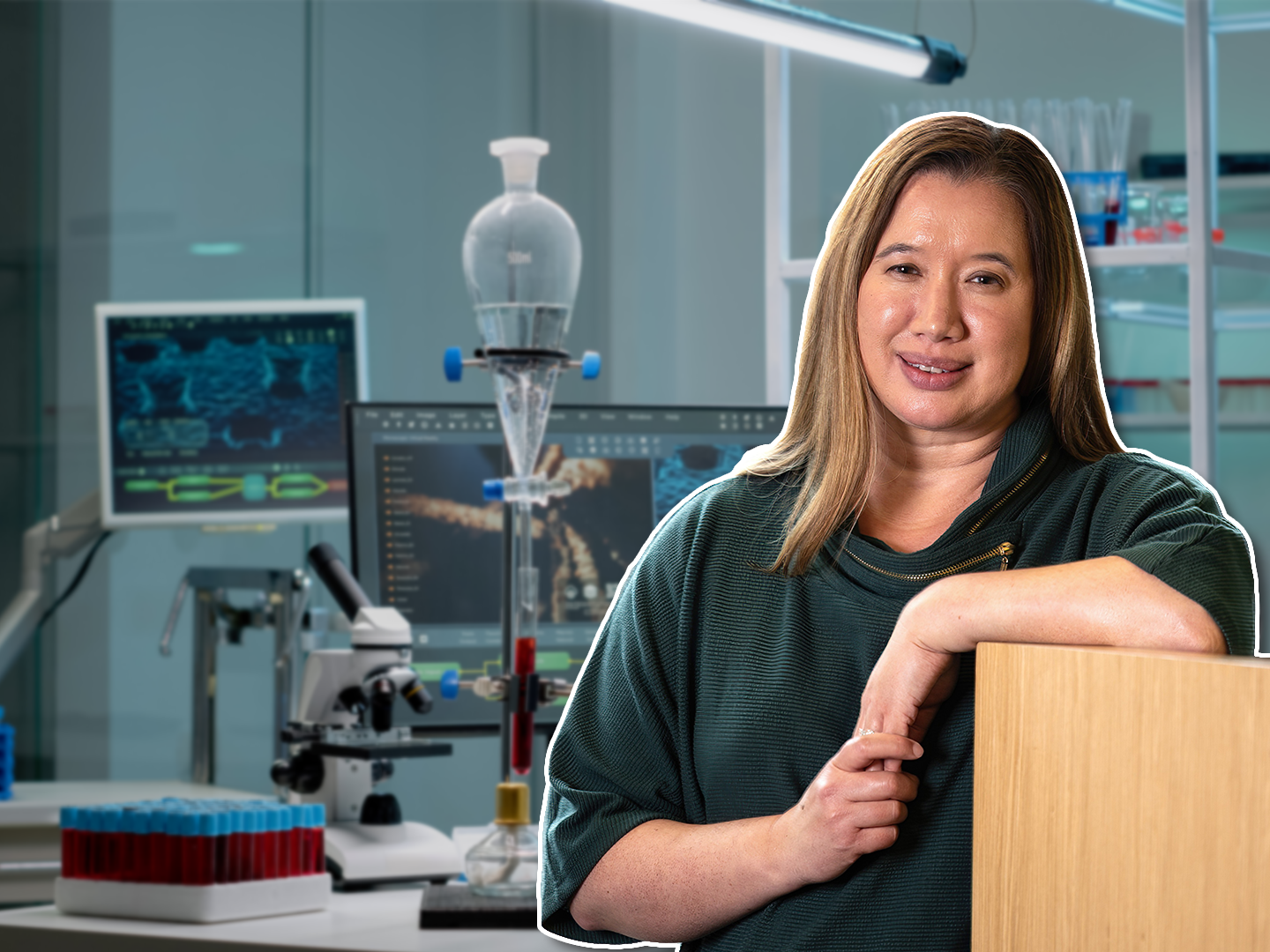
Caption: Ellie in the lab.
Credit: Supplied Ellie Dunlop

‘A REALLY LOVELY MELTING POT’ 

Alongside her colleagues, Ellie has also been working with Aboriginal communities to help understand the food composition of traditional foods.  

“We’ve been collaborating with communities here on Noongar Country and also across the Kimberley,” she says. 

“I’ve learned so much from Elders and community members. They’re really generous with sharing their knowledge.”

The research team is measuring the nutrient content of different bush foods to collate into a resource for mob. 

Many of the findings from the lab work aligned with traditional food uses the Elders had spoken of. 

“It all matches up, and [Elders] say, ‘We knew that was a good food!’, and it turns out that it has the nutrient content that matches up with that knowledge,” says Ellie.  

“It’s this really lovely melting pot of different knowledges.”

COLLABORATION IS KEY

Ellie says she’s really proud of the collaborations and team work that she has fostered with her colleagues and that being a finalist for the Premier’s Science Awards is a team effort.

“For the team and our collaborators, it’s just a really nice recognition of the work of a lot of people. I’m very, very grateful,” says Ellie. 

The strength of her collaborators and mentors is something Ellie says is important for anyone wanting to go into research. 

“Definitely choose your supervisors and mentors really carefully,” she says. 

“Choose people who are going to be really generous with their advice … Having good people around you is really important.”

Cat Williams
About the author
Cat Williams
Cat is a freelance science writer and communicator. Her work has been featured in publications including Cosmos Magazine, the Griffith Review and The Saturday Paper. When not at her writing desk, Cat enjoys travelling and patting every single dog that enters her periphery.
View articles
Cat is a freelance science writer and communicator. Her work has been featured in publications including Cosmos Magazine, the Griffith Review and The Saturday Paper. When not at her writing desk, Cat enjoys travelling and patting every single dog that enters her periphery.
View articles

NEXT ARTICLE

We've got chemistry, let's take it to the next level!

Get the latest WA science news delivered to your inbox, every fortnight.

This field is for validation purposes and should be left unchanged.

Republish

Creative Commons Logo

Republishing our content

We want our stories to be shared and seen by as many people as possible.

Therefore, unless it says otherwise, copyright on the stories on Particle belongs to Scitech and they are published under a Creative Commons Attribution-NoDerivatives 4.0 International License.

This allows you to republish our articles online or in print for free. You just need to credit us and link to us, and you can’t edit our material or sell it separately.

Using the ‘republish’ button on our website is the easiest way to meet our guidelines.

Guidelines

You cannot edit the article.

When republishing, you have to credit our authors, ideally in the byline. You have to credit Particle with a link back to the original publication on Particle.

If you’re republishing online, you must use our pageview counter, link to us and include links from our story. Our page view counter is a small pixel-ping (invisible to the eye) that allows us to know when our content is republished. It’s a condition of our guidelines that you include our counter. If you use the ‘republish’ then you’ll capture our page counter.

If you’re republishing in print, please email us to let us so we know about it (we get very proud to see our work republished) and you must include the Particle logo next to the credits. Download logo here.

If you wish to republish all our stories, please contact us directly to discuss this opportunity.

Images

Most of the images used on Particle are copyright of the photographer who made them.

It is your responsibility to confirm that you’re licensed to republish images in our articles.

Video

All Particle videos can be accessed through YouTube under the Standard YouTube Licence.

The Standard YouTube licence

  1. This licence is ‘All Rights Reserved’, granting provisions for YouTube to display the content, and YouTube’s visitors to stream the content. This means that the content may be streamed from YouTube but specifically forbids downloading, adaptation, and redistribution, except where otherwise licensed. When uploading your content to YouTube it will automatically use the Standard YouTube licence. You can check this by clicking on Advanced Settings and looking at the dropdown box ‘License and rights ownership’.
  2. When a user is uploading a video he has license options that he can choose from. The first option is “standard YouTube License” which means that you grant the broadcasting rights to YouTube. This essentially means that your video can only be accessed from YouTube for watching purpose and cannot be reproduced or distributed in any other form without your consent.

Contact

For more information about using our content, email us: particle@scitech.org.au

Copy this HTML into your CMS
Press Ctrl+C to copy