
You might be interested

When Tropical Cyclone Alfred made landfall over southeast Queensland on 8 March 2025, it brought heavy rainfall, storms, and life-threatening flash flooding.
Queensland was already reeling from consecutive years of flooding, including earlier that year.
By the end of 2025, Queensland had also recorded 261 melioidosis cases – a 200% increase compared with an average year. Of these cases, 37 resulted in death.
A HIDDEN THREAT
Endemic to the tropics, the bacterium Burkholderia pseudomallei, which causes melioidosis, lurks in contaminated soil and water and can be exposed when the ground is churned up by floods.
“Heavy rainfall changes the distribution of B. pseudomallei in the environment, bringing it towards the soil surface and into surface water, which is associated with more efficient transmission potential,” explains Professor Jeffrey Warner, Professor of Microbiology at James Cook University.
Transmitted via broken skin, inhalation or ingestion, melioidosis symptoms include a cough, fever, skin ulcers, pneumonia and sepsis. It is particularly dangerous for the immunocompromised.
Changing times
Ex-Tropical Cyclone Alfred was not your typical cyclone. The storm travelled erratically, stopping and starting, and was the first cyclone in over 50 years to make landfall that far south.
Alfred carried significantly more water than usual, in part because the Coral Sea – the storm’s birthplace – was experiencing record high temperatures.
The frequency of tropical cyclones is predicted to decrease with climate change (it has already dropped by about 13%). Although there will be fewer of them, those that do occur are likely to be more severe.
Severe rainfall and flood events like those seen in Queensland and New South Wales for several years now will become more frequent and destructive as the global average temperature goes up.
The hidden public health cost
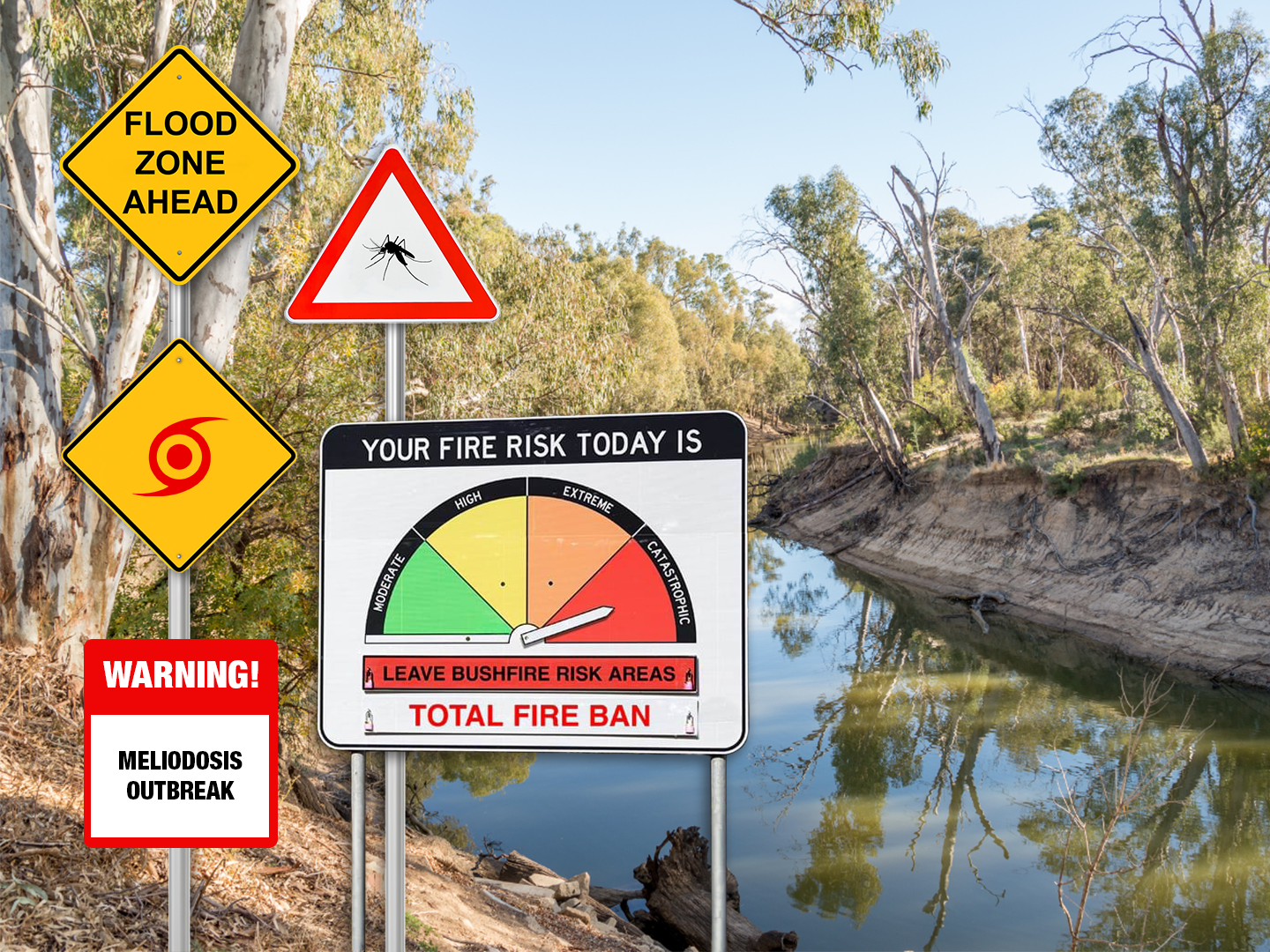
The melioidosis outbreak in Queensland is one example of a broader trend. When it comes to extreme weather, the health cost is not confined to a single point in time but trickles outwards in a cascade of after-effects.
For example, intense summertime rain in February 2020 in coastal NSW was associated with a rise in cases of two mosquito-borne diseases, Ross River virus (RRV) and Barmah Forest virus (BFV).
Mosquitoes breed in water, so they thrive in the water-logged conditions floods leave behind.
Severe rainfall may have also contributed to the unprecedented outbreak of another mosquito-borne disease, Japanese encephalitis (JE), in Australia in 2022. While JE is endemic to Asia-Pacific, the distribution of the potentially fatal disease may expand to Australia under warmer, wetter conditions.
“For mosquito-borne diseases such as Ross River virus, Barmah Forest virus and Japanese encephalitis, flooding can create extensive mosquito breeding habitat,” says Jeffrey.
“Rather than saying climate change will inevitably make JEV endemic, I would say it is likely to increase the environmental opportunities for transmission and establishment when the other ecological conditions are also present.”
Turning up the heat
Floods are not the only weather-related event that can imperil public health – heatwaves and bushfires take a toll too.
Monash University estimates heatwaves caused 1,009 deaths across Australia between 2016 and 2019.
During the 2019/20 Black Summer Australian bushfire season, which razed more than 46 million acres of land and caused 33 direct fire-related deaths, 417 people died as a result of inhaling bushfire smoke, with a further 3,151 hospitalisations for smoke inhalation.
“What we see oftentimes is that we have a number of fatalities related to exposure to the fires, but then we have a much larger number of deaths attributable to poor air quality,” says Sotiris Vardoulakis, Professor of Environmental and Public Health at the University of Canberra and Director of the National Health and Medical Research Council’s Healthy Environments and Lives (HEAL) Network.
“This is not only in the immediate proximity of the fires but also at some distance, even tens or hundreds of kilometres away.”
What does this mean for WA?
Droughts and heatwaves are predicted to become more frequent and more severe in southwestern WA, increasing the risk of bushfires.
A study of Perth hospital admissions between 2015 and 2017 found surges were directly linked to bushfires and high concentrations of PM2.5 in the air.
PM2.5 is particulate matter that is 2.5 micrometres or less in diameter (about 30 times smaller than the width of a human hair). PM2.5 was responsible for an estimated 4.9 million premature deaths globally in 2023 and is released copiously during extreme bushfires.
Meanwhile, northern WA is vulnerable to floods during the wet season as well as mosquito-borne diseases, including RRV and BFV.
In January 2023, floodwaters inundated and isolated parts of the Kimberley after rainfall from unusually slow-moving ex-Tropical Cyclone Ellie saw the Martuwarra (Fitzroy) River swell to 50 kilometres across.
The CSIRO draws a link between climate change and the slower pace of tropical cyclones as they move across the Earth’s surface.
It’s important however, Jeffrey says, not to draw linear conclusions about how changing weather patterns will affect human health.
“I would not expect every tropical infectious disease simply to increase everywhere,” says Jeffrey. “The more likely outcome is a change in where, when and how intensely outbreaks occur.”
A tale as old as time
The concept that climate can change the course of human health is not new.
The medieval Black Death plague that killed approximately half the European population and 30–50% of the Asian population may have been partly caused by the so-called Little Ice Age – a period of climate cooling between 1300 and 1850 AD.
And El Niño years may have been linked to past cholera outbreaks.
Sotiris says reducing the root causes of climate change is imperative, but if warming continues at current projections, there are some ways to mitigate the impacts.
“That includes improving environmental health literacy, building the infrastructure, building community resilience,” says Sotiris.
“Many of these are engineering interventions or planning interventions but also behavioural interventions, including better asthma control, better adherence to medication and better treatments.”