


You might be interested

The Casual Observer
October takes us into the season of Kambarang, signalling the start of warmer weather. Correspondingly, the brightest parts of the Milky Way – marked by Sagittarius and Scorpius – have moved lower in the western sky during the evenings as spring sets in.
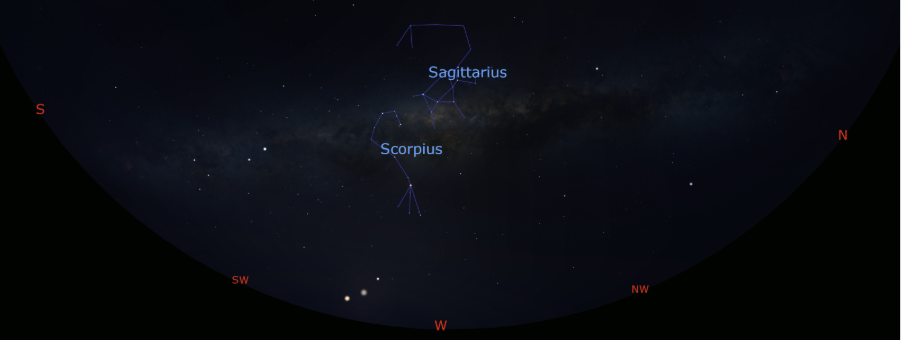
Credit: Stellarium
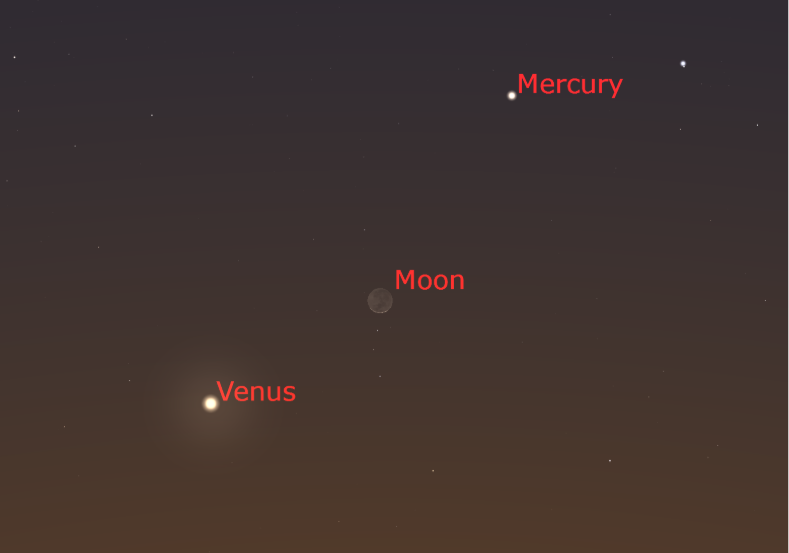
This is your last chance to see Venus in the evening sky. Having dominated the western sky for the past five months, the planet is soon passing in front of the Sun and will be lost in the glare by mid-October.
There is one last hurrah as a nice conjunction of Venus, Mercury and the Moon on 12 October. It’s definitely worth going out for. Venus will reappear in November in the eastern morning sky for the early risers to admire.
Credit: Stellarium
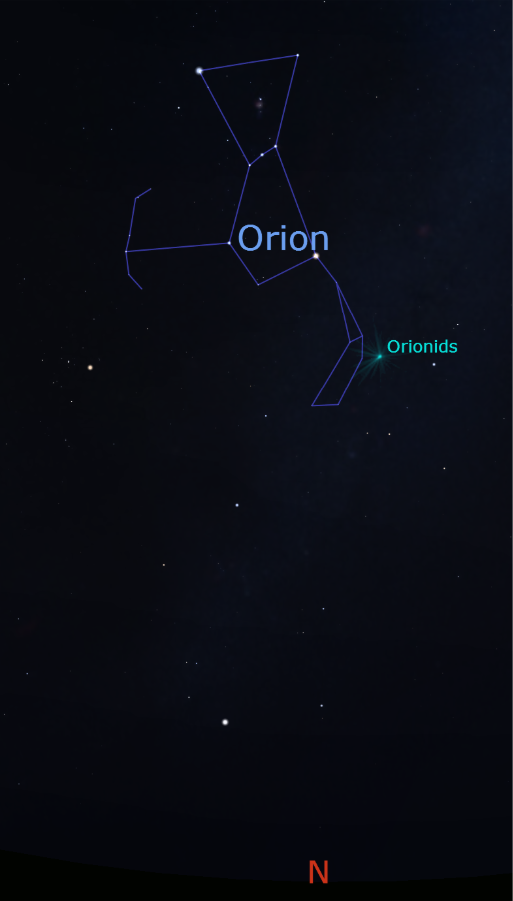
The Orionids meteor shower peaks around 22 October and makes for great viewing for the keen observer. The best time to see these is before sunrise in the northern sky, just beneath the sword of the hunter.
In good conditions you might expect to see a meteor every few minutes.
Credit: Stellarium
These fast-moving meteors come from Halley’s comet. Over its 76-year orbit, the comet spends most of its time far from the Sun in the cold of space.
When it dips into the inner solar system, heat from the Sun boils away material from the comet’s fragile surface of icy dust. This boiled-off debris cloud lies scattered through the inner Solar System and occasionally, Earth ploughs through, resulting in this spectacular meteor shower.
The Japan Aerospace Exploration Agency will be launching the Martian Moons eXploration mission on 20 October. This ambitious mission will study the two moons of Mars – Phobos and Deimos – with the intention of collecting a sample of material from the larger Phobos and returning it to Earth by 2031 for scientists to study.
ISS sightings from Perth
The International Space Station passes overhead multiple times a day. Most of these passes are too faint to see but a couple of notable sightings* are:
| Date, time | Appears | Max Height | Disappears | Magnitude | Duration |
| 6 Oct 05:01 AM | 10° above SW | 59° | 10° above NNE | -3.7 | 6.5 min |
| 9 Oct 7:19 PM | 10° above NW | 84° | 10° above SE | -3.7 | 6.5 min |
Table: Times and dates to spot the ISS from Perth
Source: Heavens above, Spot the Station
*Note: These predictions are only accurate a few days in advance. Check the sources linked for more precise predictions on the day of your observations.
Moon phases
3 October: Last Quarter
10 October: New Moon
19 October: First Quarter
26 October: Full Moon
Dates of interest
12 October: Venus, Mercury and the Moon close in the western evening sky
20 October: Launch of Martian Moons eXploration mission
22 October: Peak of Orionids Meteor Shower
Planets to look for
Set a reminder for 12 October to see Venus, Mercury and the Moon in the western evening sky.
Mercury makes for great viewing all month in the west just after sunset. This is the best time of year to see this small elusive planet.
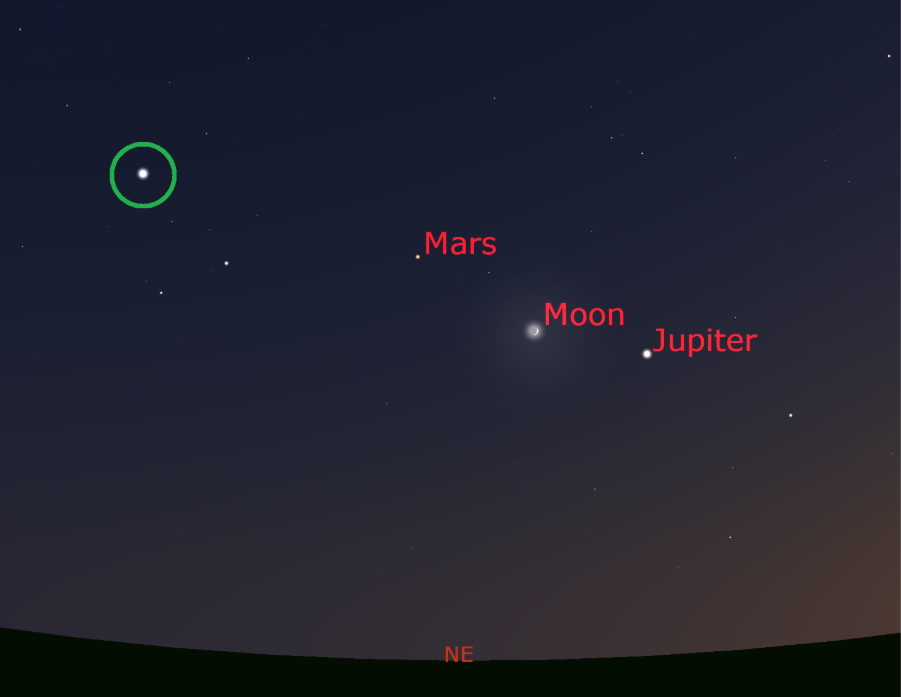
Mars and Jupiter are visible in the northeastern sky before sunrise this month. They are joined on 6 October by the Moon for a night sky delight. The savvy observer may wish to time their observations with the passover of the International Space Station just after 5am.
Credit: Stellarium
Saturn is visible making its way across the northern skies all evening during October.
Constellation of the month
Dorado: The Dolphinfish
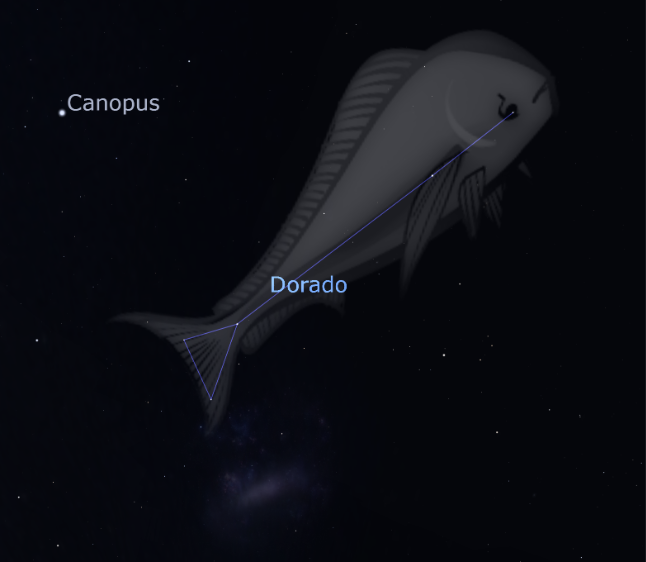
Dorado is a smallish constellation in the far southern sky. It is circumpolar from most locations in Western Australia. This means the entire constellation never dips below the horizon, with the caveat that some of it does, depending on where you are.
The constellation is often interpreted as a mahimahi, or dolphinfish, which is known as Dorado (golden) in Spanish. The etymology of the constellation as Spanish instead of Latin, like most constellations, is interesting of itself.
Credit: Stellarium.
The brightest star Alpha Doradus is a magnitude 3.3 star, making the constellation quite faint. Interestingly, the second brightest star Beta Doradus is a special type of star called a Cepheid Variable.
These stars are unique for their predictable pulsating brightness, making them an important tool for measuring cosmic distances across the universe due to the period-luminosity relation.
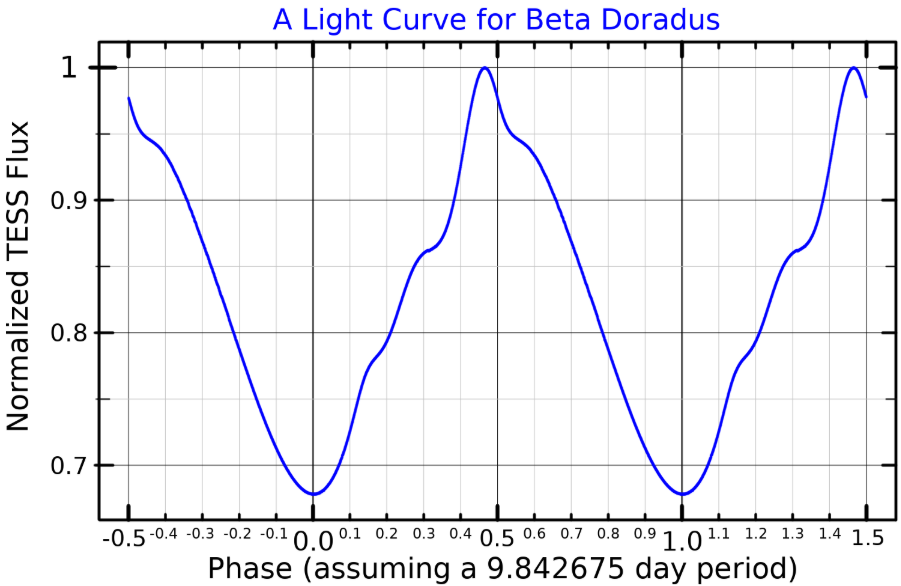
Credit: Pope Pompus (CC BY-SA 4.0)
Within a Cepheid Variable star, cold transparent helium from the outer layers of the star’s atmosphere sinks into the warmer layers below, where it is heated and ionised.
Ionised helium is opaque, so it absorbs the star’s own light, making the star appear dimmer to us. The absorbed starlight overheats the helium which expands, cools, and becomes transparent once more. The star’s brightness increases again and the cycle repeats.
Fascinatingly, the time it takes a Cepheid Variable star to pulsate is directly related to how bright the star is.
By timing how long the star takes to pulse, astronomers can determine how bright the star really is. By comparing this to how bright the star appears, they can then work out how far away the star is.
Dorado is most notably the location of most of the Large Magellanic Cloud (LMC). This irregular dwarf galaxy 150, 000 light years away is estimated to contain about 20 billion stars and looks like a blotchy cloud in the night sky about the size of your outstretched hand.
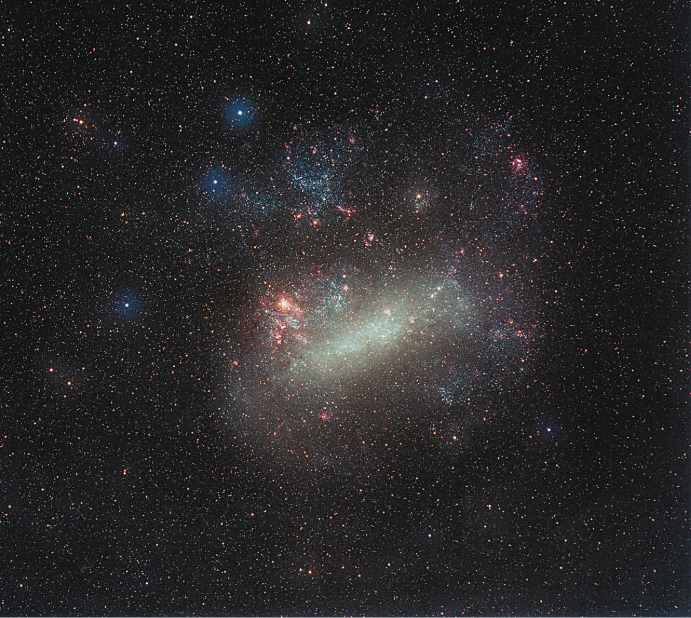
Credit: Eckhard Slawik/e.slawik@gmx.net
The LMC, heavily distorted in shape by interactions with the Milky Way and the nearby Small Magellanic Cloud, is predicted to merge with the Milky Way in a few billion years.
Famously, the supernova SN1987A was located in the LMC. The first detected (A) supernova of 1987 provided astronomers with great confirmation of the core-collapse model of exploding stars.
In this model, the core of a massive star is crushed by its own gravity. The outer layers of the star then sink down and rebound off the crushed core, then thrown into space in a stellar explosion visible across the universe.
The expanding field of debris from the supernova is now interacting with material ejected from the progenitor star about 20,000 years ago, resulting in an unusual glowing ring with numerous hot spots marking the place of the wreckage.
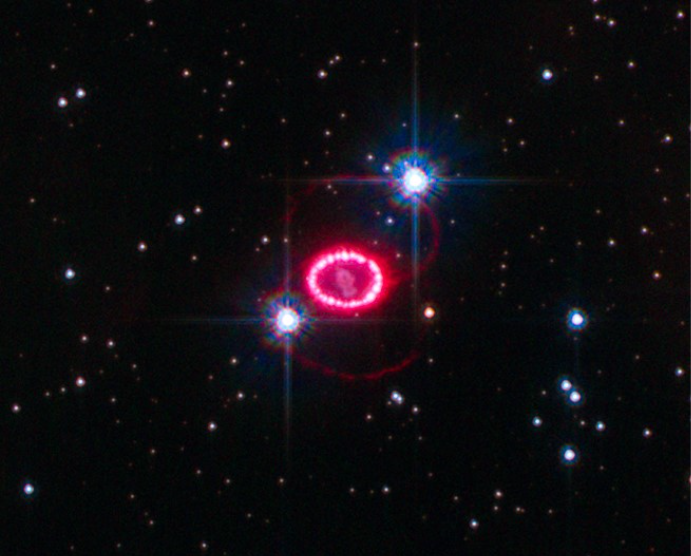
Credit: NASA Goddard Space Flight Center
Object for the small telescope
The Tarantula Nebula
A favourite of astronomers of every level, the Tarantula Nebula is an enormous star forming region in the Large Magellanic Cloud.
The nebula is so large and bright that if it were located as far away as the well-known Orion Nebula it would fill half the sky and cast visible shadows on the ground.
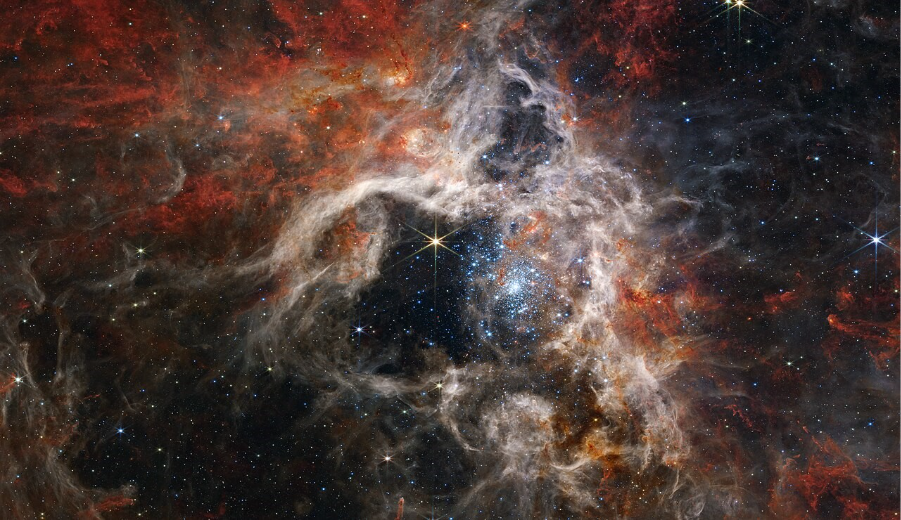
Credit: NASA, ESA, CSA, STScI, Webb ERO Production Team
In the centre of the nebula, clumps of gas collapse under their own weight to form new stars, seen blue in the centre of the image. These new stars then burn away pockets of the surrounding gas, giving the nebula its bubbly and tendril-like structure from where it gets its name.