

READ

MARTIAN MOON MYSTERIES

A new mission is seeking to bring the first ever sample of Martian moon dust back to Earth.
Leon Smith
Leon Smith
Planetarium Lead
MARTIAN MOON MYSTERIES

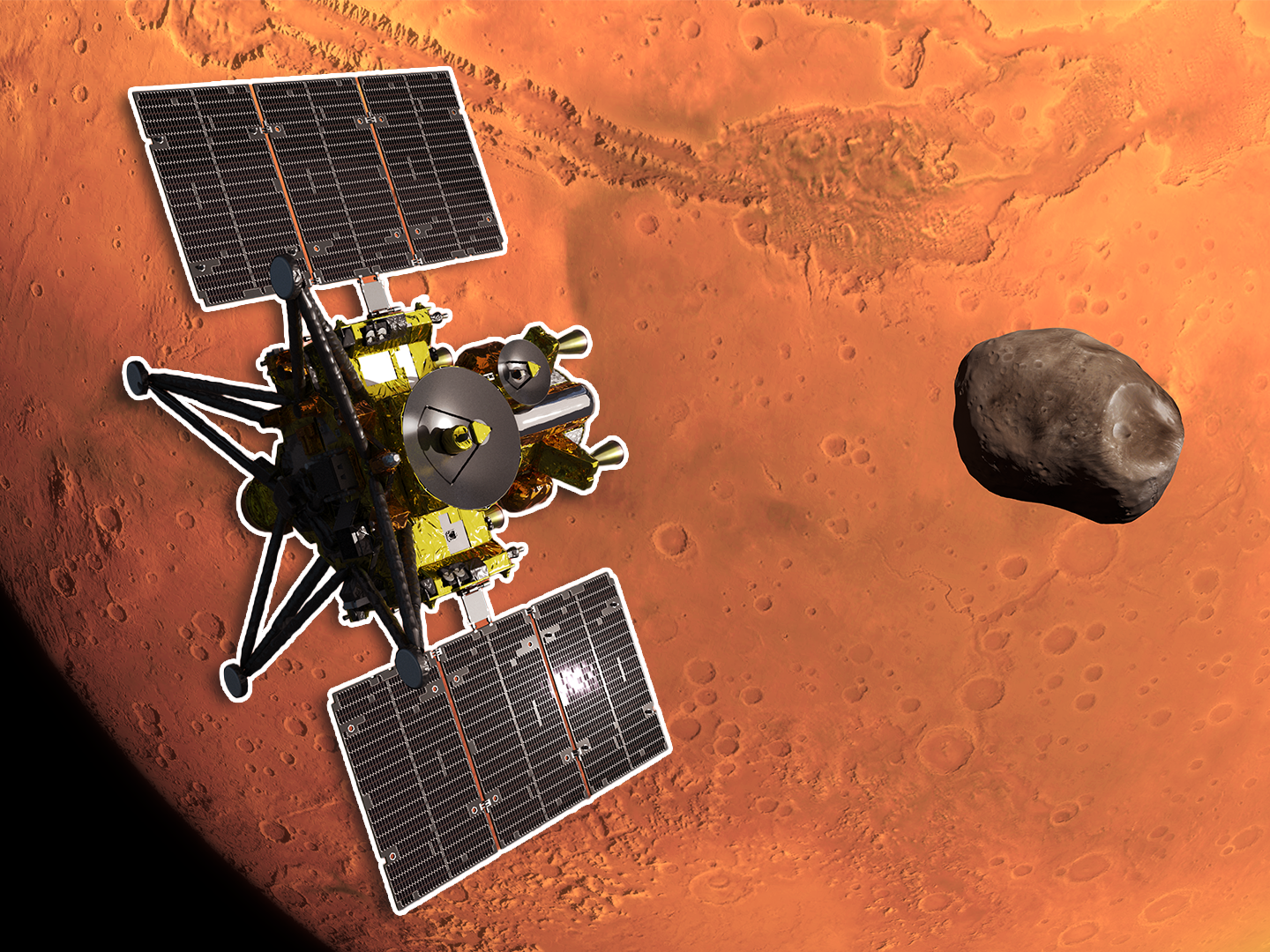
If all goes well, the Japan Aerospace Exploration Agency (JAXA) will be launching the Martian Moons eXploration (MMX) mission on 20 October. 

This ambitious program will study the two moons of Mars – Phobos and Deimos. The mission intends to collect a sample of material from Phobos, and return it to Earth by 2031 for scientists to study. 

That’s quite a sentence so let’s unpack it.  

Why Martian Moons? 

Mars has two Moons – the 15km wide Deimos and the 25km wide Phobos, both sons of Mars in classical mythology.

The moons look like obese potatoes and are covered in craters, but they don’t have an obvious origin. 

Earth’s Moon is thought to have formed from a giant collision, and Jupiter’s large moons probably formed with the planet, while its smaller moons were later captured by its enormous gravity. 

Scientists want to understand how Phobos and Deimos formed – whether it was with Mars, blasted off the planet by an asteroid, or are themselves captured asteroids.  
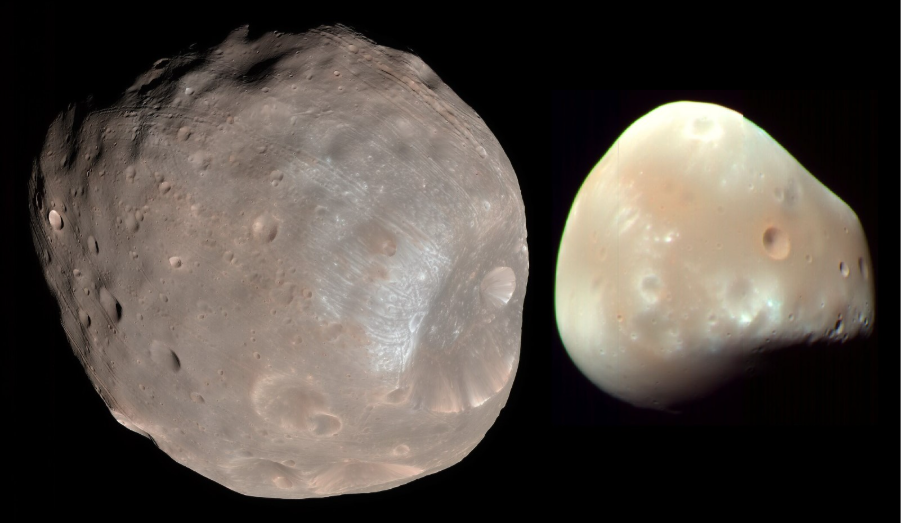
Caption: Phobos and Deimos.
Credit: NASA/JPL-Caltech/University of Arizona

The MMX mission’s intention is to better understand the formation of the Solar System.

The history of the solar system was much more violent than it is today, with collisions between objects much more common in the past. We only need to look at the number of craters on the Moon or Mercury to see this. 

Earth’s weather cleans away this history over time, making it difficult to understand how the solar system came to be by only studying rocks from the ground. 

JAXA hopes to tease details out of Mars’ moons about this past by studying rocks from Phobos. 

How To Study A Martian Moon 

The MMX spacecraft is an enormously ambitious mission. 

It will take around one year to get to Mars, where the spacecraft will enter Mars’ orbit and focus most of its attention on Phobos.  

Two cameras and a LIDAR (radar but with lasers) ranging system will give detailed information about the surface of Phobos. 

An infrared and neutron spectrometer will allow scientists to determine what Phobos is made of and whether it’s the same stuff Mars is made of. 

Two more instruments will study the dust and sparse gas around Mars and Phobos.
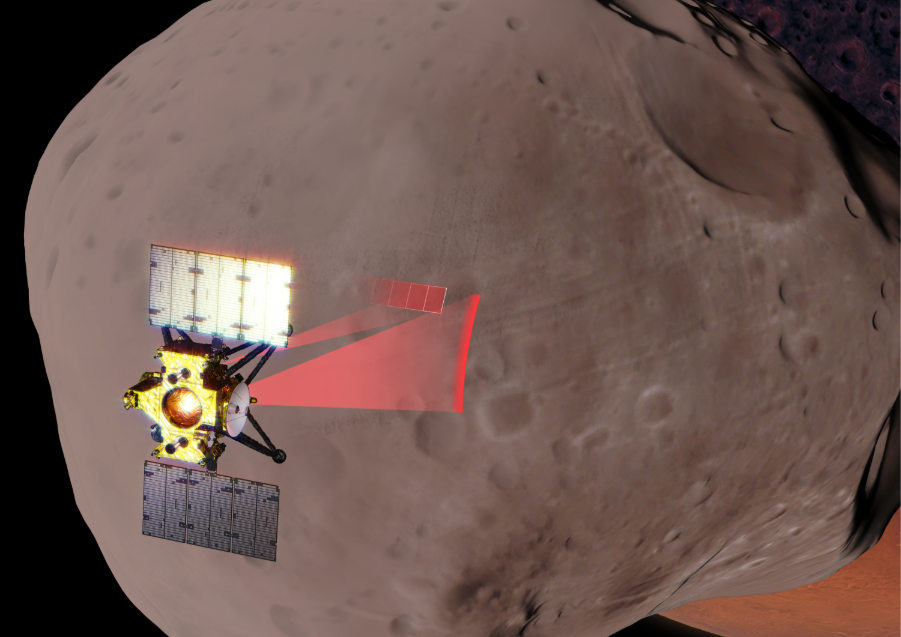
Caption: Artist impression of MMX studying Phobos.
Credit: JAXA

10 grams of Rock 

The main goal of the mission is for the MMX spacecraft to land on Phobos, collect a sample of at least 10 grams of surface material, and return the sample to Earth. 

To do this, the spacecraft will first deploy a tiny rover called Idefex. 

This 25 kg robot will land on Phobos, collect data about its surface and study how a wheeled vehicle performs in low gravity. 

Data from Idefex will inform where and how MMX approaches Phobos.  

After an estimated  three years at Mars, MMX will deploy its (hopefully full) sample canister back to Earth. About a year later, the canister will land in Australia and be collected for study. 

If successful, this will be the first sample return mission from Mars in history.

Leon Smith
About the author
Leon Smith
Leon runs the Scitech Planetarium. It's pretty sweet. Theoretical physics is his expertise, science communication is his passion. Tends not to mince words. He stays up too late and drinks too much coffee.
View articles
Leon runs the Scitech Planetarium. It's pretty sweet. Theoretical physics is his expertise, science communication is his passion. Tends not to mince words. He stays up too late and drinks too much coffee.
View articles

NEXT ARTICLE

We've got chemistry, let's take it to the next level!

Get the latest WA science news delivered to your inbox, every fortnight.

This field is for validation purposes and should be left unchanged.

Republish

Creative Commons Logo

Republishing our content

We want our stories to be shared and seen by as many people as possible.

Therefore, unless it says otherwise, copyright on the stories on Particle belongs to Scitech and they are published under a Creative Commons Attribution-NoDerivatives 4.0 International License.

This allows you to republish our articles online or in print for free. You just need to credit us and link to us, and you can’t edit our material or sell it separately.

Using the ‘republish’ button on our website is the easiest way to meet our guidelines.

Guidelines

You cannot edit the article.

When republishing, you have to credit our authors, ideally in the byline. You have to credit Particle with a link back to the original publication on Particle.

If you’re republishing online, you must use our pageview counter, link to us and include links from our story. Our page view counter is a small pixel-ping (invisible to the eye) that allows us to know when our content is republished. It’s a condition of our guidelines that you include our counter. If you use the ‘republish’ then you’ll capture our page counter.

If you’re republishing in print, please email us to let us so we know about it (we get very proud to see our work republished) and you must include the Particle logo next to the credits. Download logo here.

If you wish to republish all our stories, please contact us directly to discuss this opportunity.

Images

Most of the images used on Particle are copyright of the photographer who made them.

It is your responsibility to confirm that you’re licensed to republish images in our articles.

Video

All Particle videos can be accessed through YouTube under the Standard YouTube Licence.

The Standard YouTube licence

  1. This licence is ‘All Rights Reserved’, granting provisions for YouTube to display the content, and YouTube’s visitors to stream the content. This means that the content may be streamed from YouTube but specifically forbids downloading, adaptation, and redistribution, except where otherwise licensed. When uploading your content to YouTube it will automatically use the Standard YouTube licence. You can check this by clicking on Advanced Settings and looking at the dropdown box ‘License and rights ownership’.
  2. When a user is uploading a video he has license options that he can choose from. The first option is “standard YouTube License” which means that you grant the broadcasting rights to YouTube. This essentially means that your video can only be accessed from YouTube for watching purpose and cannot be reproduced or distributed in any other form without your consent.

Contact

For more information about using our content, email us: particle@scitech.org.au

Copy this HTML into your CMS
Press Ctrl+C to copy