

You might be interested
Galactic winds don’t seem to really align with a common understanding of space. After all, it’s hard to imagine a tree blowing around on the Moon.
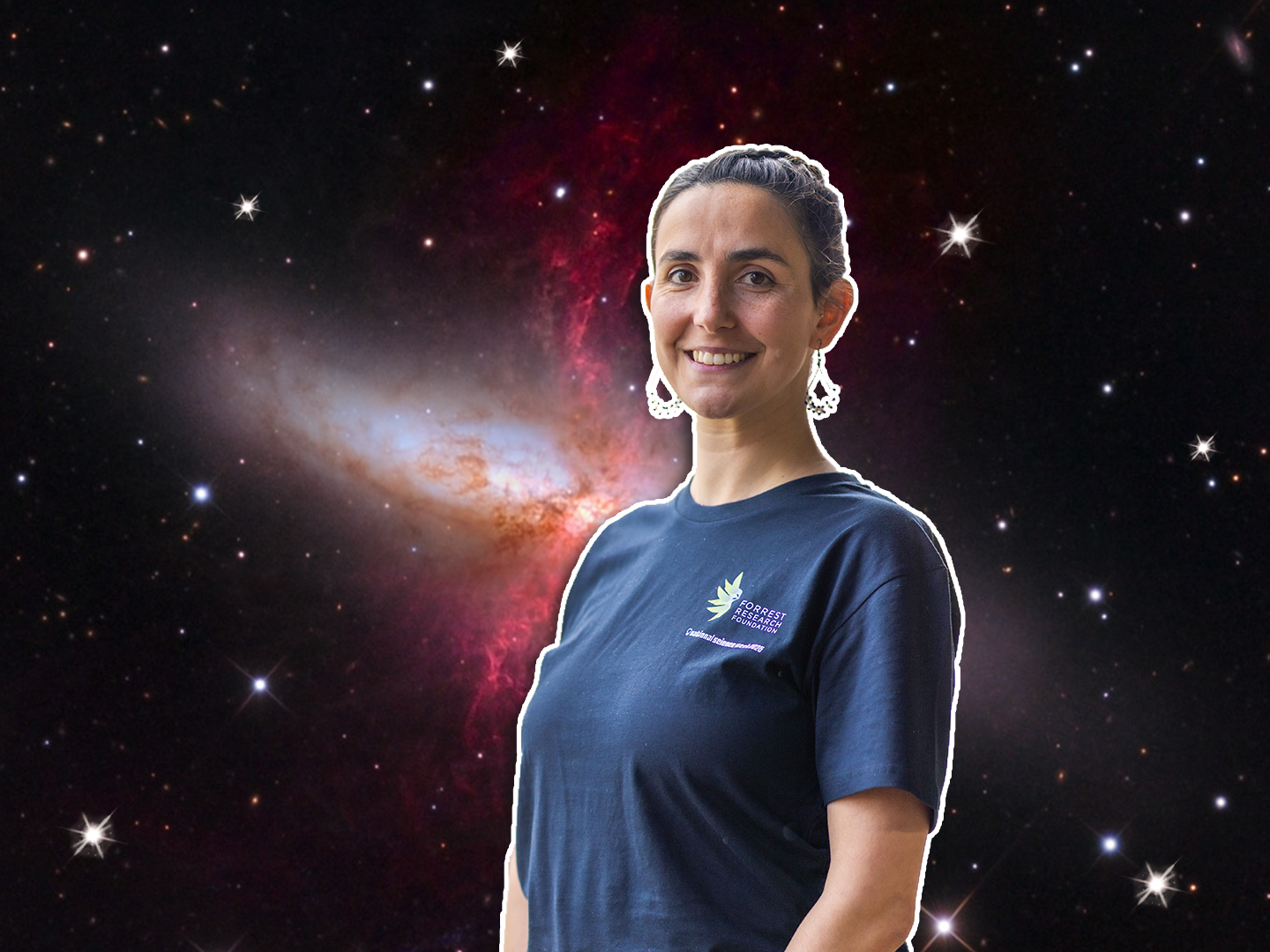
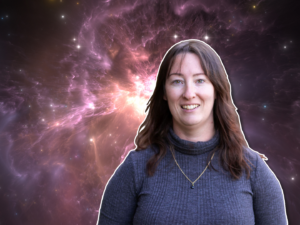
Fortunately, researchers like Dr Barbara Mazzilli Ciraulo are making sense of this fascinating mystery.
Barbara is an astrophysicist at the International Centre for Radio Astronomy Research (ICRAR), part of the University of Western Australia.
She’s researching galactic winds and star formation as part of a fellowship with the Forrest Research Foundation.
Earthly beginnings
Barbara says that astrophysics wasn’t something she planned to do, but her fascination with space helped in her career decision making.
“I’ve always been very curious about things and eager to learn. I had this curiosity about what’s going on above our heads,” says Barbara.
“I remember having to give a presentation during elementary school, and I chose space, because I had this educational video game, and I was like, ‘Oh, that would be a good start for my presentation’.”
From those tiny sparks, a universe of possibility was born for Barbara. Many years of committed studying have guided her trajectory from France to Melbourne and now to Perth.
It was in Melbourne that Barbara specialised in galactic winds.
Galactic what?
Essentially, galactic winds occur when matter is expelled from galaxies based around massive stars.
These are caused by “super powerful explosions that we call supernovae”, says Barbara.
“Those supernovae are so powerful that they’re capable of blowing material out of the galaxies.”
“The whole idea is to understand how [galactic winds] affect the life cycle of their host galaxies, because these winds regulate the galaxy’s growth and evolution.”
In theory, galactic winds might remove the gas that is needed to form the new generations of stars.
“If the winds carry away too much matter, then it will slow down the star formation process,” says Barbara.
These galaxies are basically gas, stars and dust that are pulled together by gravity.
Simulations suggest that galactic winds should be moving fast enough to shoot gas out of the galaxy and into space, but Barbara’s groundbreaking research provides compelling evidence otherwise.
“If it’s not travelling fast enough and far enough, it will rain back onto the disk of the galaxy. That’s what we call a galactic fountain,” she says.
In some cases, it’s like a geyser or cone that is expanding out of the galaxy.
“Interestingly, there is a huge discrepancy between what was predicted and what we actually observe,” says Barbara. “This gas does travel really fast, but in terms of being able to escape the gravitation of the galaxy, it’s not enough.”
What’s on the horizon?
Barbara wants this work to continue onwards into the future. There are still countless questions that remain unanswered, yet sit tantalisingly close, there in the night sky above us.
“I’ve always been interested in understanding how galaxies evolve through their lifetime and why they stop forming stars,” she says.
Barbara’s research is exciting, because in theory, every galaxy at some point should exhibit galactic winds during the process of star formation.
“My whole job is trying to understand why this discrepancy happens.”
The jury is still out, though, as more evidence is required to really prove Barbara’s work as fact. This will be her focus for the next few years, at least.
“I’m really excited about the new generation of instruments that are being added onto the Very Large Telescope,” she says.
“The next decade will be really exciting in terms of the amount and the beauty of the observations.”