

Read next
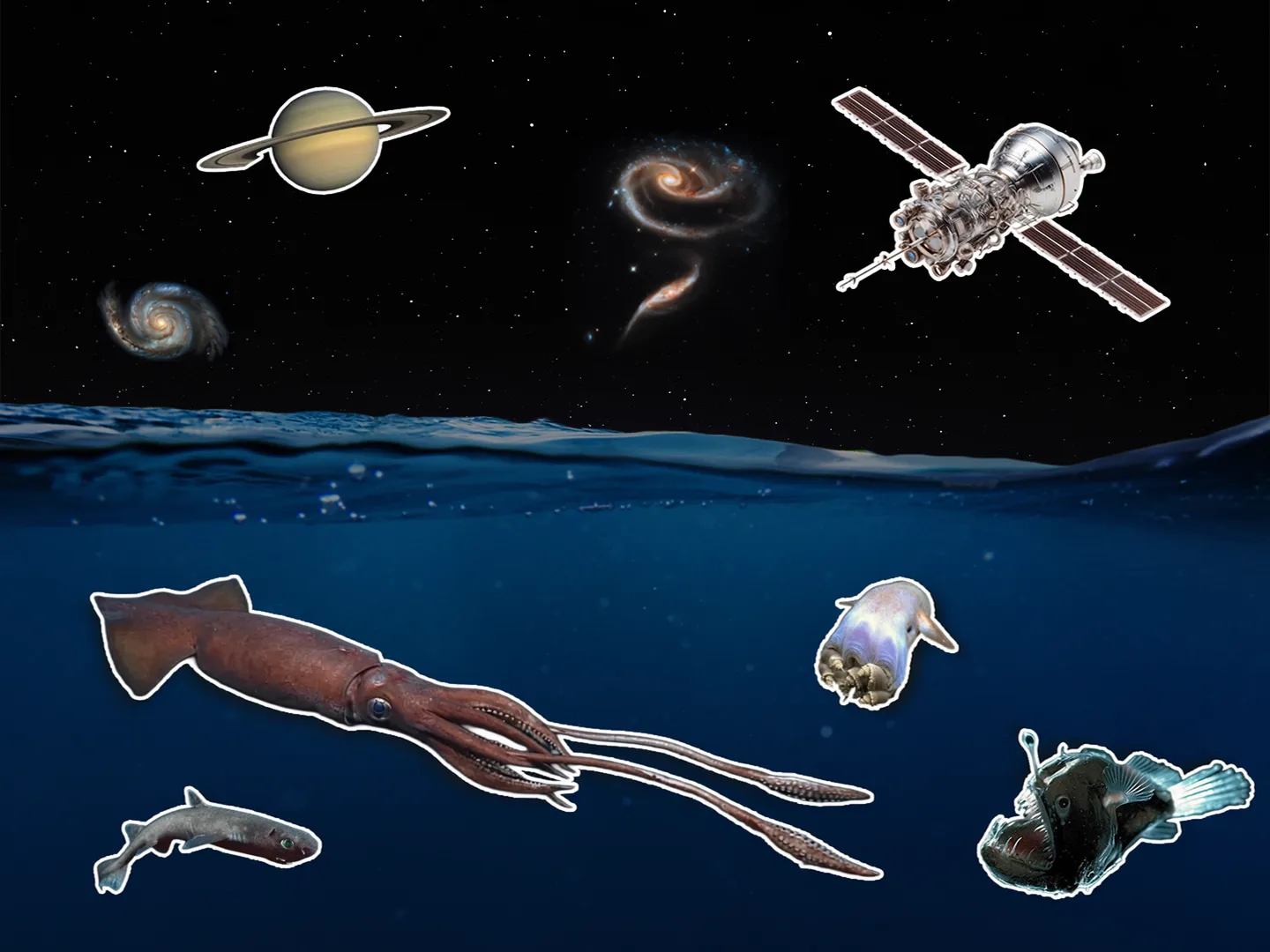
New discoveries are made about the world every day – a species of deep sea fish here, a new galaxy there.
There’s a saying, ‘We know more about space than the ocean’. But is this true?
How do we determine ‘knowing’? Is it the number of things we have directly observed, or is it a matter of resolution?
To get to the bottom of this unknown, oceanographer Associate Professor Jeff Hansen and astrophysicist Dr Kat Ross weigh in.
MAPPING THE OCEANS
More than 70% of the Earth’s surface is ocean.
A whopping 94% of that water is deep ocean – that is, greater than 200 metres deep – yet only 0.001% of it has been observed.
Most of what we know about the ocean comes from scientists mapping the underwater terrain.
“A lot of the technologies that exist to measure and map things don’t work well in water”, says Jeff.
These technologies often use electromagnetic radiation including lasers, radar or gamma waves.
The problem, Jeff says, is that water absorbs all of these wavelengths. “That’s why it’s pitch black at the bottom of the ocean, no light can get there,” he says.
Oceanographers have opted for sonar, which works by pinging sound into the ocean and then measuring the time it takes for the signal to return after reflection. Unfortunately, Jeff says it’s “extremely slow”.
“That’s why most of the ocean hasn’t been mapped in any sufficient resolution.”
As of early 2026, only 28.7% of the ocean floor has been accurately mapped using sonar.
“It’s easier to map Mars,” says Jeff.
MAPPING THE HEAVENS
The technologies that don’t work so well in water, work wonders in space.
“The web of structure within the universe that links all the galaxies and clusters together all require a different form of mapping”, says Kat.
There are optical telescopes for mapping what we can see and radio telescopes for recording what we can’t.
For team optical, the Dark Energy Spectroscopic Instrument has plotted a staggering 5.6 trillion-pixel map, accounting for 75% of the night sky.
For radio heads, the Very Large Array Sky Survey has mapped 82% of the sky – it can map places where space dust is too thick for visible light to penetrate.
“Every time we think we’ve got a grip on things we discover something entirely new that we had not even considered was possible,” says Kat.
FUMBLING IN THE DARK
Whilst more of the night sky has been mapped, both environments have a unique set of research challenges.
“Once you get down to those depths the pressure is just crazy,” says Jeff.
In the Mariana trench – the deepest point in the ocean – pressures reach over 1000kg/cm2. That’s equivalent to having a small car parked on your fingernail.
Pressure aside, no light can penetrate more than 200 metres down, and GPS won’t make it past the ocean’s surface.
“It’s like you walk into a room that is well lit… and then you turn the lights off and try to navigate by remembering where everything was,” says Jeff.
Being able to demonstrate what you’ve seen when you can’t even see, seems difficult.
NOTHING BUT NOISE
“Radioastronomy faces an issue called ‘confusion’, where we can’t measure what’s background noise and what’s source,” says Kat.
This noise comes from every electrical thing around us and interferes with radio telescopes.
“If we put a mobile phone on the moon, that [radio signal] is 300x brighter than the brightest radio galaxies that we look at.”
With the ever-increasing number of satellites in Earth’s orbit, Kat says we might be approaching a critical tipping point where radio telescopes will cease to cut through the interference.
Unlike the ocean, space is seemingly infinite and you can’t just wade in. It takes massive teams with massive budgets years to learn anything new about space.
WILL WE EVER KNOW?
This may have been a fruitless exercise. How can we compare how much we know between two topics if we can’t even define ‘know’?
Where do we draw the line on what counts as ocean or space research? Such enormous fields are difficult to constrain.
Both environments are forever changing.
“There’s just so many interactions and dynamic processes that are happening in every part of the universe,” says Kat.
Jeff expresses a similar sentiment about the ocean, “It’s not static, unfortunately, you have to keep measuring it.”
How can we know everything there is to know if it’s always in a state of flux?
Perhaps the uncomfortable truth is, we never will, but at least there’s no shortage of new discoveries to be made.