


Read next

Jurassic Park gave us a mosquito in amber, dinosaur DNA and a fantastic argument against opening a theme park.
No mosquitoes were needed for this recent discovery, because the dinosaur fossil preserved its own bloody evidence of a land before time.
In a world first, researchers found heme – a molecule in blood – inside a fossilised dinosaur bone.
It also nearly didn’t happen.
Let’s meet the dinosaur behind the blood and bones first.

Credit: Maurilio Oliveira/Wikimedia Commons (CC BY 4.0)
COME TO BRAZIL
Aratasaurus museunacionali was a theropod — a dinosaur who walked on two legs.
It belonged to the same family as velociraptors, tyrannosaurus and modern birds, and lived in the Early Cretaceous period in what is now modern day Brazil, around 115 million years ago.
After the dinosaur died, a series of incredibly fortunate events kicked off.
The team of researchers hypothesise that the dinosaur’s remains were rapidly buried in sediment in an environment low in oxygen, but high in microbes.
“Microbial communities would have built a biofilm around the bone and protected the bone from decomposition”, says Professor Kliti Grice in a statement.
The fossilised right hind limb was discovered in a gypsum mine after somehow surviving multiple blastings from previous mining activity.
It then survived the 2018 National Museum of Brazil fire, where nearly 20 million items were destroyed, as it was housed in a separate annex building that escaped the fire.
A. museunacionali is named for this remarkable part of its story – literally the ‘dinosaur born from the national museum fire’.
HEME, RHYMES WITH MEME
If the A. museunacionali fossil wasn’t lucky enough, the researchers then found heme inside it.
Heme isn’t blood, but zoom in a few times and you’ll find it.
First stop? Blood, which contains red blood cells.
Inside red blood cells, a protein called haemoglobin transports oxygen around the body.
Haemoglobin contains heme, a molecule with an iron atom at the centre of a ring of atoms.
Each haemoglobin molecule contains four heme groups, and each heme can bind one oxygen molecule.
You can think of haemoglobin as one of Jurassic Park’s green and yellow tour cars, with heme providing the four seats where oxygen molecules hop on to for the ride.
But what did the researchers glean from the heme?

Credit: Curtin University
CHEMISTRY SET IN STONE
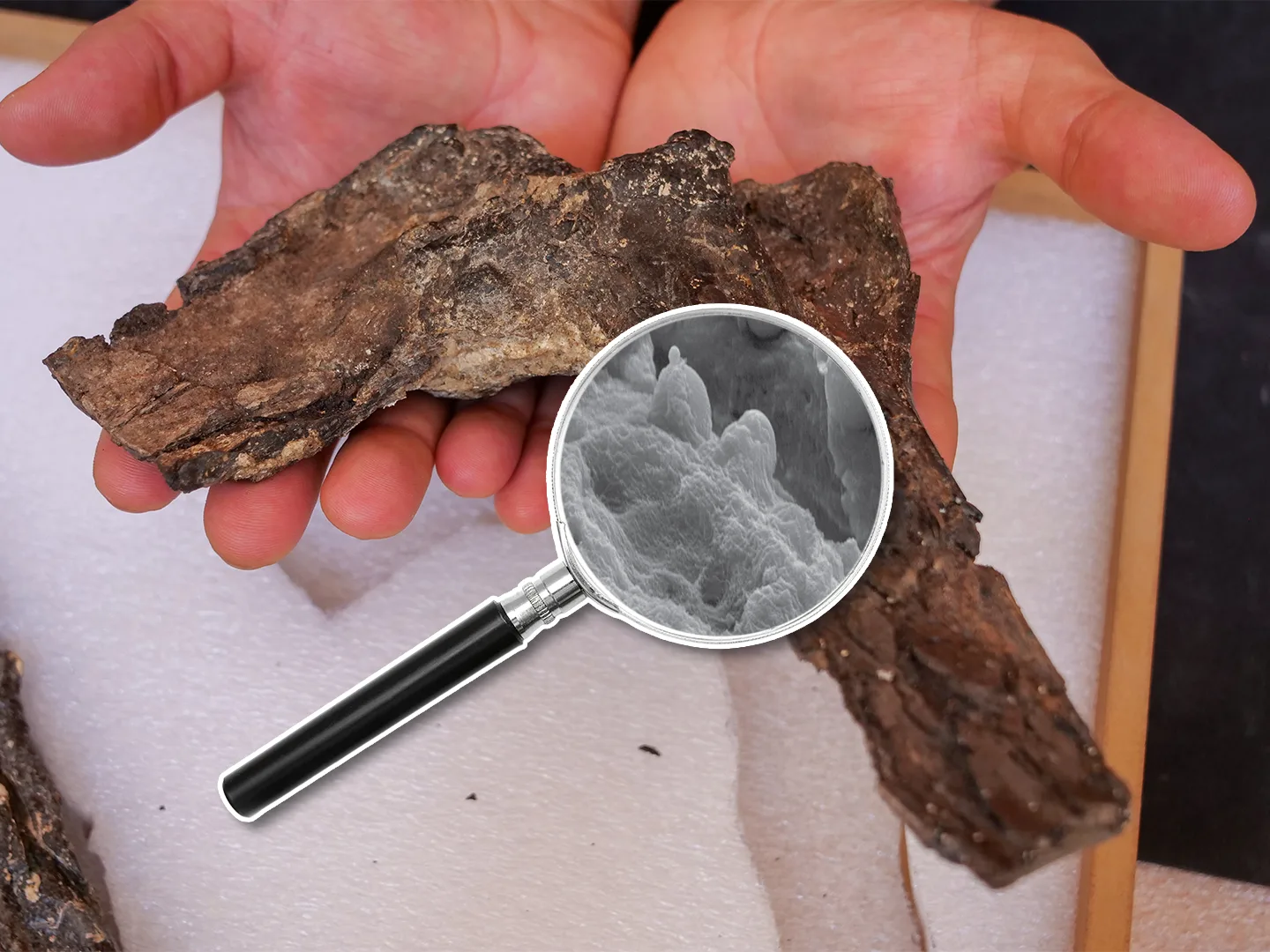
The researchers examined the fossilised bone with electron microscopy. They found tiny oval shaped structures inside the vascular canals, where blood vessels used to be.
The team’s chemical analysis detected heme in the fossilised bone, inside tiny oval structures.
This doesn’t mean the researchers found red blood cells. They interpreted the ovals as possible red blood cells whose shape had been preserved by minerals.
“To detect intact heme derived molecules in 115-million-year-old red blood cells is astonishing: this really is a landmark discovery,” says Grice.