

You might be interested



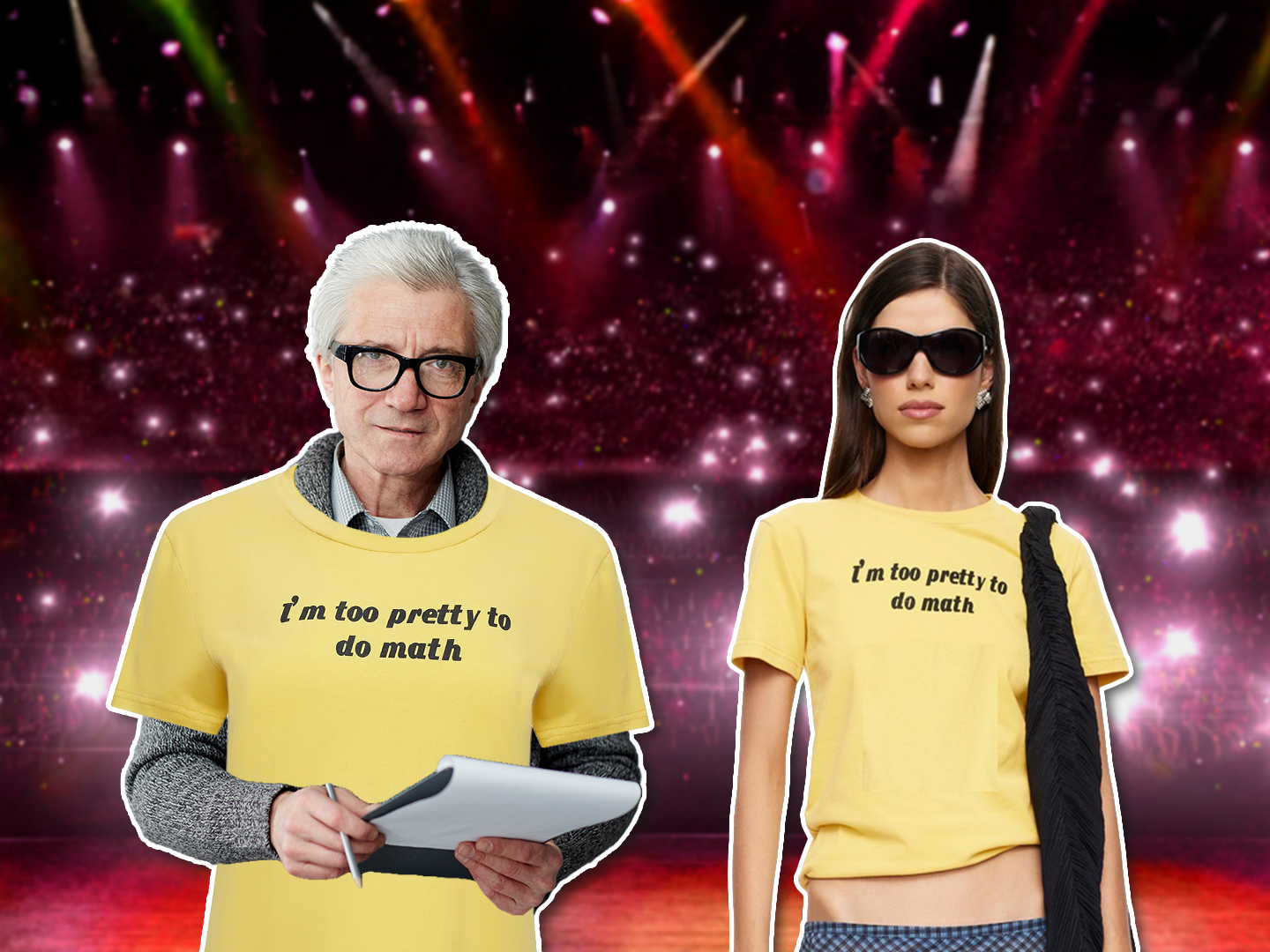
Australian fast-fashion brand Lioness created a T-shirt that reads, “I’m too pretty to do math.”
The shirt is modelled by beautiful women with long hair and, apparently, a dubious grasp of their multiplication tables.
This is the kind of item that makes you roll your eyes or exhale through your nose in a sort-of laugh. There is not much more to say, in theory. It is only a T-shirt. But it was not conceptualised in a vacuum.
We know what the T-shirt says – but what does it actually mean, for the wearer and the world?
Can Girls Do Math(s)?
Professor Sender Dovchin is a linguist at Curtin University and says there is a lot packed into the slogan.
“The line is linguistically playful,” says Sender. “The humour, though, depends on the reader recognising a cultural stereotype – that ‘femininity’ and ‘attractiveness’ are at opposite ends of a spectrum from ‘intellectual seriousness’.”
This is where the plot thickens. What exactly is the slogan saying about the stereotype that pretty girls cannot also be smart girls – and, implicitly, that smart girls are ugly? Is it reproducing this stereotype or parodying it?
“There cannot be a fixed answer, regardless of the maker’s intention,” says Sender. “The meaning depends on who wears it, plus who reads it and what they bring to the interaction.”
Worn by a mathematics professor, the shirt might be read as ironic. On a model at a fashion event, it might seem self-deprecating. To a woman denied access to mathematics because of her family or geography, the slogan is an affront.
The T-shirt also implies an old idea about what girls are for. If a girl is pretty, she has already reached the pinnacle of what a woman’s life can be. She has secured the quality society values most in her, so mathematics is something she does not need.
With pretty girls having achieved their True Purpose, other women are left to find value elsewhere – in mathematics, humour or a career. Intelligence becomes a consolation prize for the ugly.
We cannot ask only what the text says. We need to ask who is saying it and what the words mean in context.
What, then, have we been telling girls about maths to birth the concept of this T-shirt, and how has language shaped the message?
How Words Hurt
The rhyme goes ‘sticks and stones may break my bones, but words will never hurt me’. Of course, we all learned that this was totally flawed logic after 2 days in primary school.
Hurt feelings are just the tip of the iceberg – the language we use can also create a more profound damage, in shaping our shared understanding of reality.
“Language doesn’t just reflect culture,” says Sender. “It also teaches us how to see ourselves and shapes what kinds of identities feel possible.”
A study from earlier this year shows how small linguistic choices can influence our beliefs about the relationship between gender and mathematical ability.
Researchers presented participants with subtly biased statements such as: ‘girls are just as good at maths as boys’. That sentiment seems positive, right?
Alas, participants who read that sentence were more likely to view boys as naturally more skilled at maths. Despite apparent good intentions, the wording of the statement made boys the benchmark for mathematical skill.
Even a well-meaning sentiment can become distorted with poorly framed language.
When a Joke Sticks
Little language mishaps have contributed to a prevailing stereotype. Researchers undertook a systematic review of 25 years of research on gender stereotypes and mathematics.
Among “the most persistent and socially embedded stereotype” was the belief that men possess “greater competence” in mathematics.
This is when a T-shirt becomes more than the sum of its parts.
“Repeated often enough, cultural messages can shape what people believe they should do, can do and even what they are ‘for’,” says Sender.
Repeated exposure to the message that men are naturally better suited to maths can contribute to mathematics anxiety and lower self-efficacy – both factors can affect women’s confidence and actual performance.
Collectively, our consistent use of language can shape women’s participation and success in mathematics.
Changing the Script
The problem is clear, and Sender offers clarity on a solution. We do not need a T-shirt that reads ‘I’m pretty and good at maths!’
Instead, we should challenge the underlying assumptions about what women’s work ought to be and whether there should be a relationship between beauty and intelligence at all.
“Language shapes possibility through the categories and associations it repeatedly makes available,” says Sender.
“We can therefore normalise expressions that position women as thinkers, creators, mathematicians, scientists, leaders and intellectuals without making their appearance the qualifier.”
The goal, Sender says, is not more baby tees with positive slogans. Instead, there must be a linguistic and cultural shift towards a world where “women’s intellectual capacity becomes so ordinary that it no longer needs explaining”.