

You might be interested



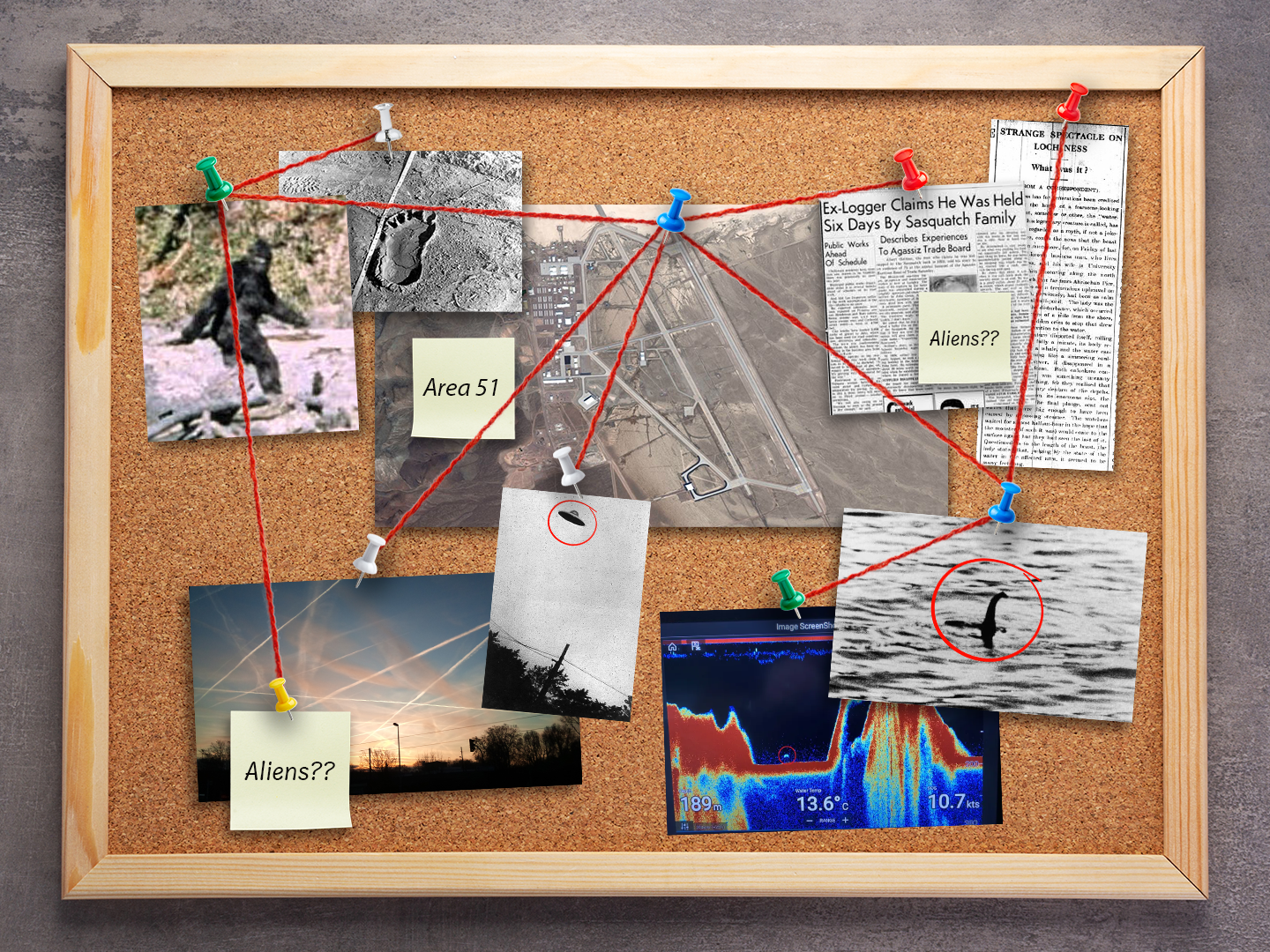
Log entry 51: A shadowy room, a glowing screen, a wall of images with threads tying everything together, forming an ominous red web.
The suspect is nowhere to be seen, the number of victims: countless.
STICKY THEORIES
Conspiracy theories are insidious things. They seek to explain notable events or a strange set of circumstances without scientific facts.
Whether it’s a hairy creature roaming the woods or chemtrails poisoning the air, at their core, they suggest that powerful entities keep secrets or alter the truth.
But why are conspiracy theories so difficult to disprove? What makes these ideas so pervasive, and persuasive, to some?

Credit: CC BY-SA 3.0
HOUR 0
Log entry 1: It seemed harmless in the beginning. An idea, nothing more. And yet, as it gained momentum, it became increasingly ‘true’.
The idea became ‘unfalsifiable’ – not capable of being proved false.
Then it took on a life of its own.
THE VICTIMS
Log entry 23: The victims appeared random at first. The popular narrative is that they were ‘simple-minded’ but there’s no clear link between intelligence and susceptibility. Digging a little deeper, patterns begin to emerge.
Those susceptible to believing conspiracy theories have a tendency to perceive threat and danger. While some have ‘odd’ beliefs and experiences, others rely too heavily on their intuition, then there are the antagonists who believe they’re superior to others.
All have a desire for certainty.
It also seems certain environmental conditions lead to increased acceptance of ‘alternative facts’ – a wider perception of inequality and corruption.
In times of uncertainty and upheaval, distrust in the powers that be becomes the perfect hunting ground for conspiracies – politicians lie, scientists are ‘in on it’ and institutions are just looking to profit.
THE CALLING CARD
Log entry 39: These new cases are familiar, executed in that same telltale way.
Conspiracy theories often follow the same formula.
There are the conspirators – usually a group in a position of power – who manipulate the narrative to keep a secret from the masses.
A ‘pattern’ is established by drawing connections between unrelated things to provide ‘meaningful evidence’, like how birds move in jerky movements proves that the government replaced them with drones to surveil us.
Finally, the good versus evil paradigm is put into play. This creates a struggle for truth seekers to fight against while pointing the finger at an unsuspecting scapegoat.
STAYING SAFE
Log entry 42: Finally, some progress. A witness has come forward to share their insights.
There are ways to prevent falling victim to conspiracy theories, or if you already have, it’s possible to change beliefs.
Awareness and critical thinking are the most effective defences.
Conspiracy theories are often presented in a sensationalised or strongly emotional way. They might be filled with ‘facts’ that explain everything, but these should be verified and tested.
Identifying where a conspiracy theory came from can help identify possible motives for the deception.
Remember, reliable sources are always transparent.
IMMORTAL IDEAS
The scalpel of science can be used to slice through the ‘alternative facts’, but because of their unfalsifiable nature, this often isn’t enough to silence them.
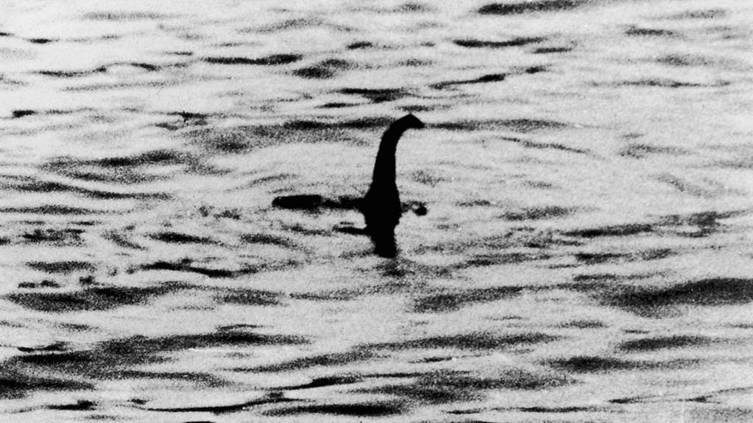
Log entry 52: The elusive beast got away, it’s Operation Deepscan all over again. Sonar equipment was used to scan the entirety of Loch Ness in search of Nessie, but despite the evidence that no such creature exists, the myth lives on.
Credit: PDM 1.0
And so it goes for many other cases. Mathematics confirming the Earth is a sphere, lunar samples proving mankind dropped by, rigorous science separating autism from vaccines – they’re all denied.
Log entry 66: Alas, another cold case. Another dossier closed unsatisfactorily and placed among its brethren, the abominable snowman, 911 and lizard people.
They’re still out there, manipulating the masses, causing harm, proffering false promises but maybe, just maybe, some of them are true.