
You might be interested


You need to tread carefully among the leaf litter of the Indonesian scrubland and its tropical rainforests. The dead leaves might seem caught in a gentle breeze, but there’s more here than meets the eye. Try plucking one from the ground and you’ll find an insect caught in the act of prayer.
Not a leaf, but a dead leaf mantis.
Dead leaf mantises are a marvel, their thorax sculpted by evolution to mimic the veins of dying vegetation. This clever act of camouflage helps them to hide from predators and ambush prey.
Kris Anderson, an independent researcher and mantis specialist, has seen more than his fair share of this genus, known as Deroplatys, in his decades collecting and categorising Mantodea, the order of insects that includes all mantises.
A new species recently caught his eye. As he browsed the citizen science platform iNaturalist – where he’s made more than 26,000 identifications – he came across a user-submitted image of a Deroplatys. The user claimed it was discovered in a tropical forest in Malaysia.
This particular specimen rested vertically on a branch, clinging with its hind legs – a diamond-shaped faux-leaf suspended like a shield over its body. While it had all the features of a dead leaf mantis, some inconsistencies caught Kris’s well-trained eye. The shape of its head, its antennae and the patterns that rippled across its body were all features he hadn’t seen before.
These inconsistencies were evidence of a deeper, more concerning truth: this mantis does not exist. It’s a fabrication, created with generative AI image tools.
As these tools improve, biodiversity platforms reliant on citizen science, such as iNaturalist and eBird among many others, may see increasing numbers of fakery and fraudulent depictions that are much harder to detect.
Kris has written twice about fake mantises in the past 6 months, sparked by entries on iNaturalist. He’s concerned the problem could spiral and that fake observations might even appear in scientific papers, surveys and environmental assessments without adequate verification processes in place.
“Because so much modern biodiversity research increasingly incorporates citizen science records, I felt it was important to document this vulnerability early, before AI-generated observations became commonplace,” says Kris.
However, there are already signs the AI-slopification of citizen science has arrived.
Tit for tat
In November 2025, descriptions of a willow tit in northeast Scotland captivated twitchers on social media. The tit, a palm-sized perching bird with a helmet of black feathers, is an extremely rare find.
And yet, in an image uploaded to a Scottish birding site, one seemed to be sticking its tiny beak into a birdfeeder.
When Alexander Lees inspected the photo, he broke into a cold sweat. He noticed the bird’s deformed feet and beak and clocked the image as a fake. A reader in biodiversity and bird specialist at Manchester Metropolitan University in England, Alexander has been uncovering more and more AI slop on citizen science platforms.
Those platforms have been crucial for his research – he’s published on everything from bird migration to the colours of woodpecker plumage based on observational data uploaded to these services.
In early July, he wrote an opinion piece published in Nature Ecology & Evolution alongside staff from iNaturalist, outlining how these databases could become “contaminated” by AI-generated data fabrication and public misinformation.
The willow tit was an extreme example – one in which an entire animal was generated wholly by code – and was almost convincing enough to fool some “ornithologists”, according to Alexander. But AI doesn’t need to create whole observations to contaminate the scientific record – enhancements could also prove problematic.
“Problems with denoising and ‘beautifying’ existing imagery are likely much [more common] than people trying to pass off entirely AI-generated imagery as a biological record, but both are highly problematic,” Alexander says.
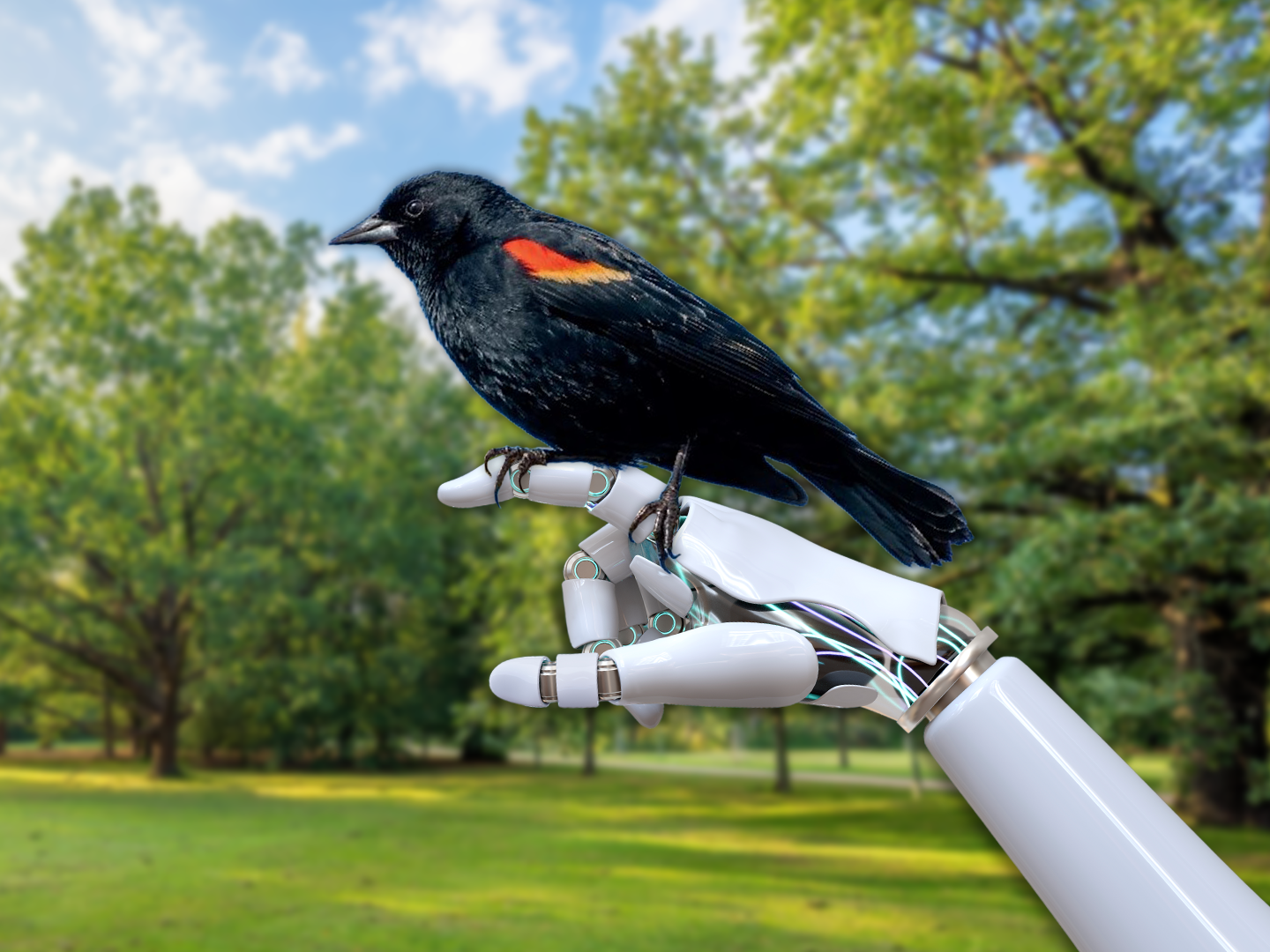
In their paper, Alexander and his team showed how easy it might be to generate a fake. They asked Gemini, the Google-backed chatbot, to generate an image of a red-winged blackbird on a branch backed by a blue sky. The result was fairly convincing, aside from an odd-looking amount of tail feathers.
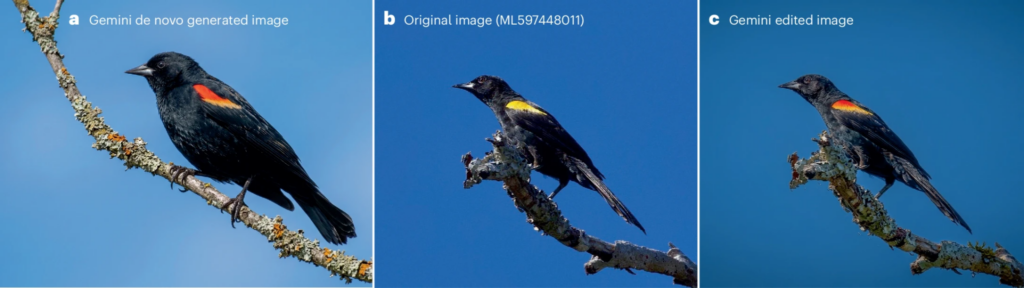
Credit: Lees et al. Citizen science platforms must mitigate against the threat of generative AI (2026); Nature Index Fig 1
They also took an image of an oriole native to South America and asked Gemini to “make this look better”. The image crafted by the AI seemed to add a red flare to the oriole’s wing, which led the team to suggest it might fool an expert ornithologist or computer-vision classifiers as a bona fide example of a red-winged blackbird.
This recently happened – innocently – on iNaturalist. A user had touched up an image in this same way, which led to the first description of the red-winged blackbird in Brazil. This was detected and the image was hidden from the database.
A history of hoaxes
The wings of the Charlton brimstone sparkle a vibrant yellow in the sun, only marked by two bold, blue moons, one on each wing. The butterfly was first described in the early 1700s by James Petiver, a London-based chemist, after he was gifted the spectacular Lepidopteran by a friend, William Charlton.
By 1763, the species had made its way into the scientific literature, appearing as one of the 100 invertebrates listed in the Centuria Insectorum Rariorum, a book penned by the father of modern biological classification, Carl Linneaus.
The specimen handed to Petiver remained at the British Museum throughout the 18th century, until it was inspected by Johann Christian Fabricius, a Danish insect specialist. Fabricius noted the two blue moons on the wings were not a mark of a species’ long evolution.
They were marks made on the wings of a common brimstone by human hands. The Charlton brimstone did not exist.
While it remains unclear if this was a deliberate deception (reports suggest a curator at the British Museum was so incensed with the fake that he stamped it to dust) or a simple prank gone awry, it highlights how hoaxes have long been a part of identifying and examining species – and their impact on the scientific record.
“Data quality is an issue in biodiversity data that pre-dates electronic data and even computers, let alone AI,” said a spokesperson for the Atlas of Living Australia (ALA). The ALA is a digital, open infrastructure that pulls together biodiversity data from across the country – and sometimes the mythic and the fantastic have slipped into the database.
“Like most data managers, the Atlas of Living Australia has seen its fair share of unicorns, tyrannosaurs and anonymous lovers submitted, which have been filtered out.”
Artificial intelligence is a force multiplier. Generative tools make it simple to perpetrate these kinds of forgeries. The tools are readily available for anyone who has the time to do so. On social media, fake species have proliferated at pace, usually accompanied by AI-generated descriptions about their behaviours and habitats. Often, the responses are credulous, believing the images to be real.
A community of spies
While citizen science platforms are vulnerable to AI-generated submissions, their communities are full of committed and honest contributors following their passion or looking to make a difference. These members are discerning and dedicated.
“There are lots of really capable reviewers and contributors out there that give vast amounts of their time to maintain the integrity of databases,” says Alexander. “I suspect we will need a helping hand with toolkits to flag potentially problematic records,” he adds.
For iNaturalist, which houses some 500 million images, the threat of fakes isn’t new. It has battled against Photoshopped images and erroneous records that use images obtained from elsewhere on the internet. Things are moving fast and iNaturalist knows it must move quickly too.
“As AI tools become more accessible and the tech landscape shifts, we’re working to adapt while keeping scientific integrity at the heart of what we do,” an iNaturalist spokesperson told Particle.
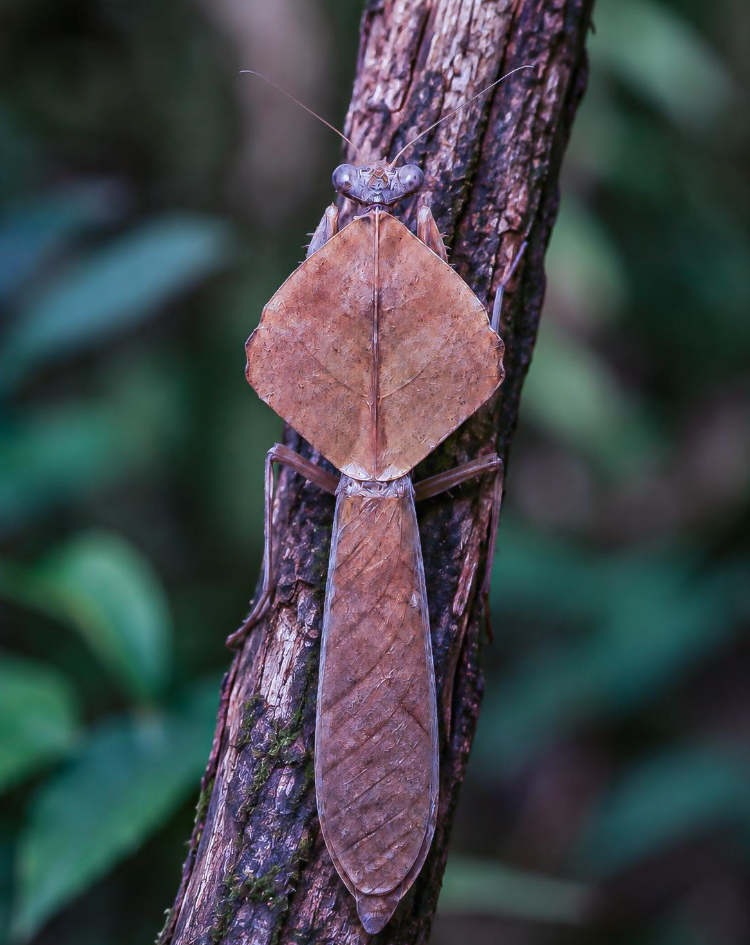
Credit: Anderson (2006) Synthetic Species in Practice: Documenting a Second AI-Generated Mantodea Observation. Available at Zenodo: https://zenodo.org/records/21305701
To combat the potential for AI-generated chicanery, the spokesperson noted the recent addition of community tools that flag AI-generated content in an effort to maintain the reliability of the biodiversity data on iNaturalist.
Kris, the mantis expert, is convinced that the scientific literature will eventually experience its own case of AI-generated fakery. Alexander agrees, saying “it would be easy to claim a discovery” and suggests that, if this trickery is knowingly performed by scientists, it would certainly be a case of misconduct and fraud.
“Let’s hope this doesn’t happen,” says Alexander.
That ecologists, conservationists and citizen science platforms are experiencing a rise in generative AI alongside the dual crises of climate change and biodiversity loss is deeply concerning. But a third crisis envelopes taxonomy – the science of classifying species. There aren’t enough experts describing and cataloguing species.
While the runaway train of generative AI is yet to crash into this triple crisis, it’s not a stretch to consider how ever-improving AI image models could soon produce such imperceptible differences between reality and fantasy that even the most discerning experts will struggle to tell the difference. How do we fight back?
Countermeasures
There are three aspects to countering the rise of AI in these spaces, according to Alexander. They suggest citizen science platforms should have robust image-authentication protocols and even metadata checks to ensure imagery uploaded is a legitimate observation.
A bigger piece is ensuring those using AI tools and citizen science platforms are aware of the pitfalls of the systems they’re using. “Given that a big part of the problem is the public adoption of a new technology then education of the problems this causes will hopefully help,” says Alexander.
While there is a strong desire to keep AI slop out of citizen science platforms, there are instances where AI and machine learning models may be beneficial to conservation and biodiversity efforts. “AI brings new challenges but also potentially new solutions,” says the ALA spokesperson.
Using eBird data, an AI model predicted bird migration patterns weeks before the birds got on the move. The CitClops project, a citizen science project that asks members of the public to take photos of seawater, used AI to monitor early signs of algal blooms.
And in Australia, machine learning systems – which work differently to the generative AI systems creating fakes – have recently been used by the Australian Wildlife Conservancy to interpret imagery from camera traps. This AI has been trained on more than 1.1 million images of wildlife (which were also vetted by a real human). That enables it to pick out, for instance, an emu or a wallaby, greatly reducing the manual labour of checking the camera traps. And, notably, species classification isn’t a role for the AI. The AI helps group imagery into a dataset and humans verify the work.
It’s that element – us – that appears to be key to any resistance we might mount against the explosion of misinformation and forgery that generative AI enables. It is the passionate and dedicated contributors and curators of citizen science platforms who are, so far, proving to be the best defence against the invasion of the slop.