


You might be interested



When Mingxin Ye’s father suffered from bone issues, his long recovery sparked an idea in the civil engineer.
“[My father] could not work for 3 months, so this made me think about how can I use engineering to help improve the way people recover from injuries and how can we make them heal faster,” says Mingxin.
This idea led Mingxin to switch from civil to biomedical engineering for his PhD at the University of Western Australia.
“Civil engineering focuses on stuff on a much bigger scale, so bridges and buildings. When we’re looking at material science, we’re making stuff on a smaller scale.
“The skill is different, but … the principles behind them is the same.”
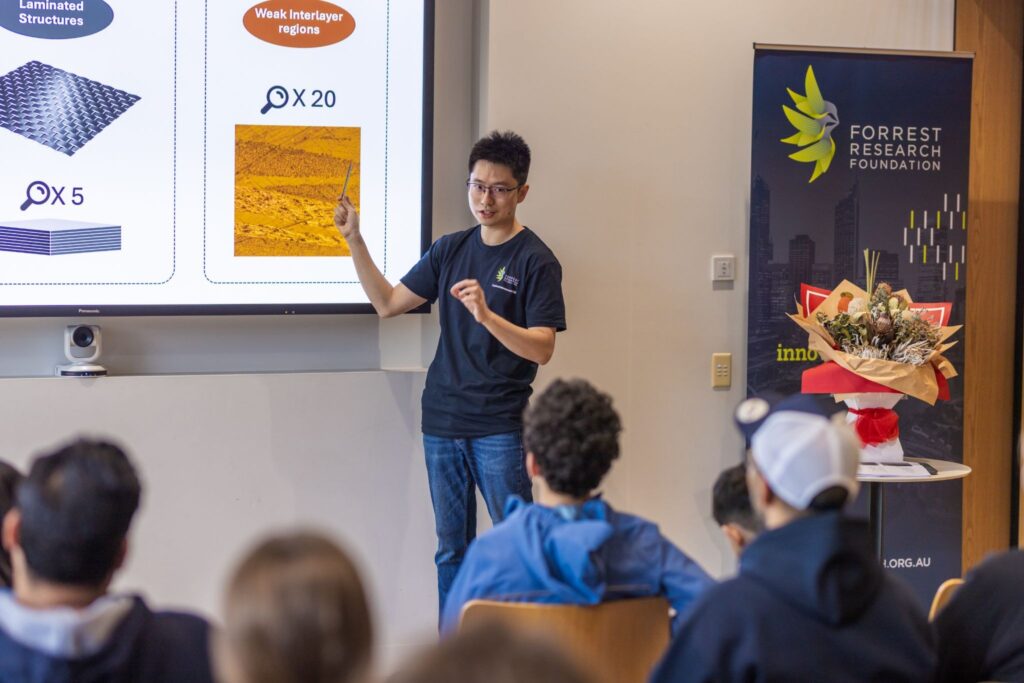
Credit: Supplied Mingxin Ye
STRENGTHENING BONES
Mingxin’s research is investigating how to strengthen implants that are attached to broken bones to help them heal.
This could result in longer-lasting implants, potentially minimising bone weakening or reduced bone density.
“Carbon fibre can solve some problems associated with metal implants, but there’s still a durability issue with a carbon fibre implant,” says Mingxin.
“This is what my research is trying to address. We’re trying to make [the implant] stronger so it will last much longer in a human body when a bone is healing.”
HARDER, BETTER, FASTER, STRONGER
As part of his laboratory trials, Mingxin is testing the use of Kevlar for the implants, a material renowned for its strength.
“Kevlar fibres are traditionally used in bulletproof vests,” says Mingxin.

Credit: Frederick Shaw/Unsplash
“It’s very, very impact resistant, so it can absorb energy, so we’re incorporating that inside carbon fibre composites.
“If you have a composite with these bulletproof fibres, it’s going to make the structure a lot stronger and result in a 20% increase in strength.”
Broken bones are the most common type of injury presented to emergency departments in Australia, with more than 407,000 fractures reported in 2024/25 alone.
Mingxin says his research could have the potential to both speed up the healing process and reduce the need for additional surgeries.
“I’m really interested in designing materials that can help people heal better and avoid complications and improve people’s health outcomes and quality of life,” says Mingxin.
SUPPORTING LIFE-SAVING RESEARCH
Mingxin’s research is supported by the Forrest Research Foundation, which helps more than 60 researchers from around the world with their PhD and post-doctorate studies.
He says the foundation has given him “tremendous academic freedom to pursue this breakthrough”.
“This is a reason why I’m able to conduct this research that no one has done before.”
His advice for anyone considering making a switch in their degree is to make the leap.
“Have a leap of faith and have belief in yourself that you can do it,” he says.