

You might be interested

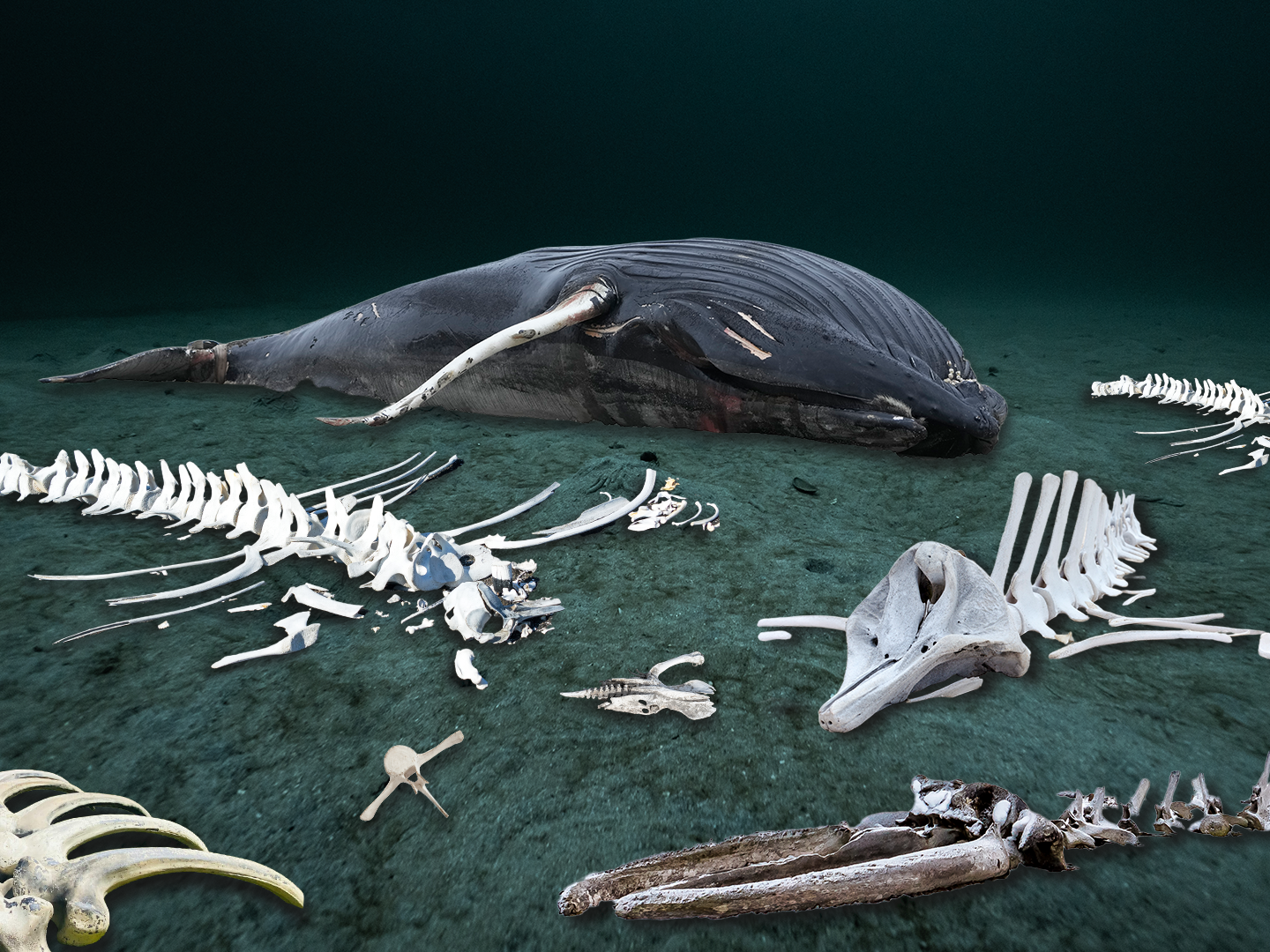
When whales die, their decomposing bodies sink to the ocean floor.
Known as a whale fall, why they happen in specific areas remains mysterious.
A research vessel recently discovered a 5.3-million-year-old whale graveyard containing close to 500 whale fossil sites and carcasses in the Dordrecht Deep – a trench in the Indian Ocean approximately 1,125 kilometres west southwest of Perth.
Is it a coincidence that so many whales have ‘fallen’ to the Dordrecht Deep, or are whales choosing it as their final resting place?
A DEEP-SEA WHALE BUFFET
Dr Vanessa Pirotta is at the forefront of whale research in Australia.
“A whale fall is the physical movement of a whale body down to the bottom of the ocean,” says Vanessa.
“When whales are alive, they service ecosystems.
“Feeding in one area, moving to another and moving nutrients around.”
“When a whale does die, it’s at the surface for a period of time and then it’ll fall to the bottom of the ocean, which moves nutrients to a new area.”
Once the carcass settles on the ocean floor, it creates a vibrant ecosystem. Deep sea creatures come from far and wide to feed on the smorgasbord laid out on the seabed.
The Dordrecht Deep contains five decomposing whales and almost 500 fossilised whales, dating back over 5 million years. The graveyard contains a previously unidentified and extinct species of beaked whale.
It is the biggest and deepest collection of whale fossils and falls found to date.
Many other species were also uncovered in the deep living off the remains of fallen whales, forming a never-before-seen ecosystem.
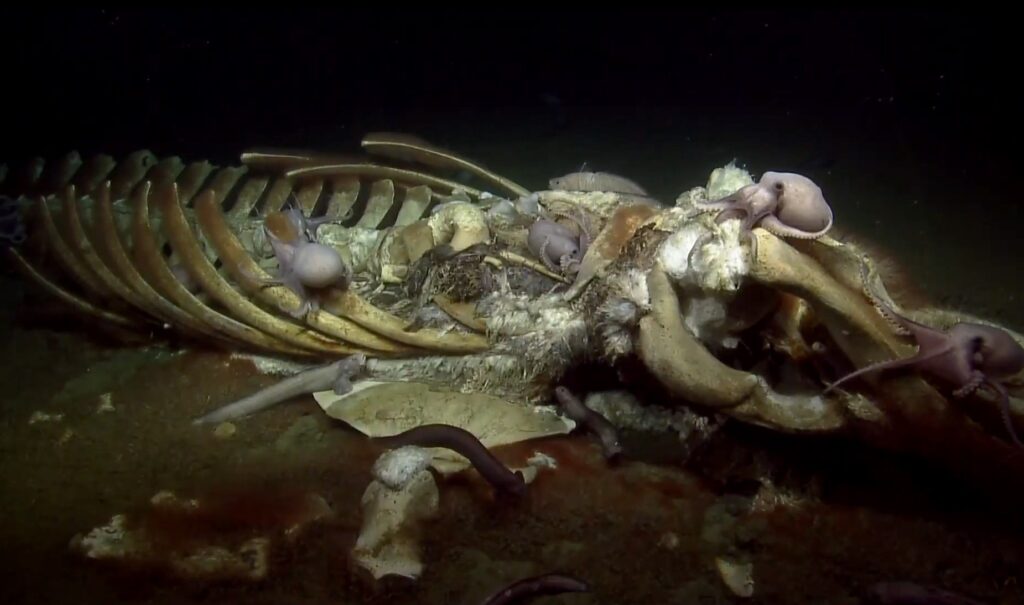
Credit: National Marine Sanctuaries (CC BY 2.0)/Wikimedia Commons
A WHALE OF A MYSTERY
While whales have been enigmatic and inspirational sea creatures for generations, many questions still remain unanswered.
We know sperm whales have languages known as coda. Others migrate all over the world and often beach themselves when their life is ending and sometimes seemingly for no reason at all.
How whales navigate the massive oceans is poorly understood, and those oceanic pathways seem to have a large impact on whale fall locations.
The Diamantina Fracture Zone, where Dordrecht Deep is located, spans 1,200 kilometres. To a migratory whale, this distance is little more than swimming a few laps.
Mass strandings of whales, which occur all over the world, aren’t clearly understood.
“We don’t understand why these [mass strandings] happen,” says Vanessa
Theories include illness, loud aquatic sounds and hunting practices gone wrong. There are documented cases of human sonar causing mass strandings in the Caribbean.
More research is required to truly understand the largest creatures left on Earth.
THAT’S ALL WHALE AND GOOD, BUT WHY HERE?
“The whales probably didn’t go, ‘Hey guys, let’s all die here!’,” Vanessa laughs.
“A whale fall can happen anywhere. Whales die of disease, but also age.”
“We don’t really understand how they all die of things, because whales are hard to study.”
The Dordrecht Deep may be a whale fall location because of its topography and oceanography.
“The ecosystem, the waves, the currents that have been favourable for these animals to move around and then stay in that area or funnel into that area,” says Vanessa.
“It’s probably not a function of the whales themselves, but most likely the environment.”
THE OCEANIC LOCATIONS OF CETACEANS
“There are some whales that live annually in a certain area or within certain warmth or latitudes,” says Vanessa. “And then there are other whales that migrate.”
Humpback whales, for example, migrate from Antarctica to Northern Australia, but the Bryde’s whale in New Zealand stays in one spot year-round.
Resident whales will inevitably fall in the areas where they spend their lives, while migratory whales can fall anywhere along their migration route.
It’s possible that 5 million years’ worth of whales all died above Dordrecht Deep by accident, or maybe it’s where they decided to say their last goodbye.
The truth is, we don’t completely understand why so many whales have laid to rest in the Dordrecht Deep.
The answer, like the whales, is lurking 7,000 metres below sea level, waiting to be unearthed.