
Read next



As the ironstone cliffs jut out from the night sky, a small beacon of light shines over the hilltop.
Robert Audcent, Monash University researcher and zoologist, focuses his headlamp on a tussock of spinifex in front of him. Beneath this spotlight lies one of the Pilbara’s most misunderstood reptiles.
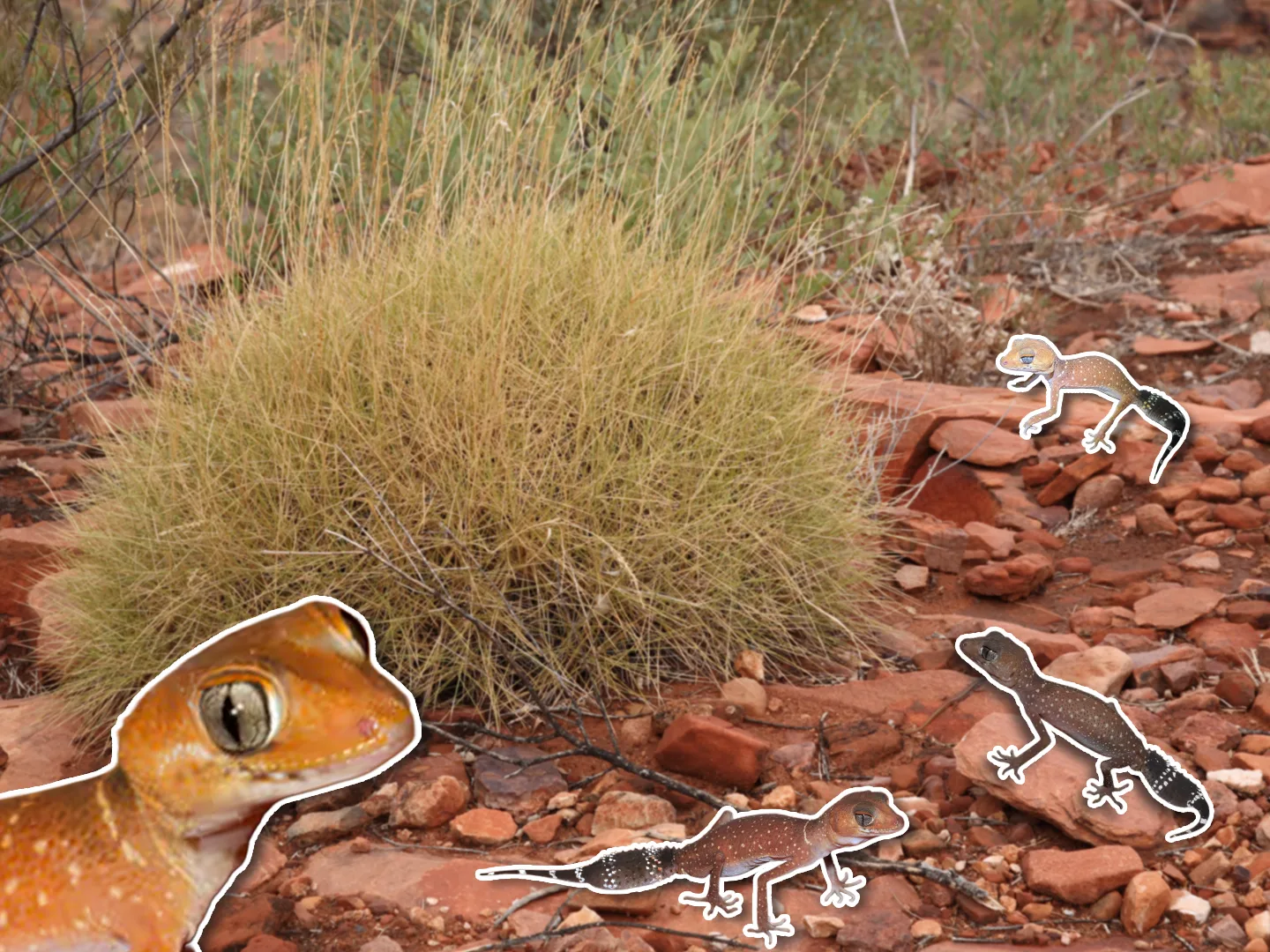
The Pilbara barking gecko (Underwoodisaurus seorsus) is a nocturnal lizard endemic to the Pilbara in Western Australia.
It was first described in 2011 and only 55 records existed.
“[It was] years of project planning and looking at maps,” says Robert. “To actually see one was a dream come true.”
Now, Robert’s research predicts they may vanish by 2060.
A SCALY STORY
The Pilbara barking gecko is found across the Hamersley Ranges – some 1,400 km north of Perth.
Unlike most reptiles that love the heat, these geckos like to keep cool and require specific microhabitat conditions. They can be found hiding in rocky crevices and – like most geckos – only come out at night.
Rising temperatures are now pushing their preferred microhabitats to higher elevations. Most of Robert’s geckos were found above 1,000 m, which makes the fieldwork somewhat less enviable.
“Having to find a way up some cliffs often involved some very interesting walking at night up very questionable, crumbly slopes,” says Robert.
SEARCHING FOR SEORSUS
After spending a combined 46 days in the field, Robert and his team found 10 new populations and 87 individual records.
Once the Sun set, the team traversed rocky mountain summits, breakaways and hilltops in search of the gecko.
“Sometimes some of the sites were so far away that the walk took almost 4 or 5 hours just to get back to the car,” says Robert.
One night spotlighting on Punurrunha/Mount Bruce, they recorded 19 individuals – over 10% of the known population – in one night.
“We got back to the car at 1am because we had to process so many geckos,” says Robert.
“There’s so few records of them it feels like you’re discovering the unknown. It’s exciting.”

Credit: Robert Audcent
THE ESCALATOR TO EXTINCTION
While the Pilbara is hot, harsh and rugged, the mountain tops around Karijini National Park remain cool.
These higher altitude microhabitats are often 2–5°C cooler than the surrounding landscape and offer refuge to species during periods of climatic stress.
But suitable microhabitats for the Pilbara barking gecko are dwindling.
“There’s so many mountains where [the gecko] don’t exist now, but they might have been there 20 years ago,” says Robert.
This is an ecological phenomenon called the escalator to extinction. As temperatures increase, species seek higher elevations to find suitable habitat.
When animals reach the top, there’s nowhere else to go.
A HOT COMMODITY
Robert’s climate modelling compares the gecko’s distribution against future warming scenarios.
The Pilbara is projected to warm by 1.5°C by 2030 and as much as 5.6°C by 2090.
“By 2060, under all climate scenarios, their available habitat is expected to decrease by 99%,” says Robert.
The Pilbara has some of the highest reptile diversity in Australia and some of the world’s largest iron ore deposits.
The expansion of mining operations in the region makes the gecko’s existence even harder.

Credit: Robert Audcent
REPTILES IN DECLINE
The number of threatened reptile species in Australia has almost doubled in the past decade, rising from 7% to 13% since 2017.
David Chapple is a herpetologist and head of the Australian Lizard and Snake Conservation Group.
“If you look at the current Threatened Species Action Plan, there’s 110 priority species on that list,” says David.
“Only 11 of those are reptiles.”
Despite reptiles only accounting for 10% of the priority species, they are the most species-rich terrestrial vertebrate group in Australia.
Most species remain understudied and underloved. Unconscious biases shape which animals we feel drawn to protect, with reptiles often overlooked in favour of more familiar, cuddly species.
“[Reptiles] need a really, really good PR consultant,” says David.
Research and awareness are essential – assessing poorly understood species means they can be properly recognised for protection.
FEELING LISTFUL
Robert and his team are calling for the Pilbara barking gecko to be relisted as endangered under the Environment Protection and Biodiversity Conservation Act 1999.
“Right now, it’s listed as Least Concern by the IUCN and Priority 2, or poorly known, on DBCA’s list, which means it gets no special protection,” says Robert.
“Prioritising their listing means [the Pilbara barking gecko] gets a seat at the table, and they’re considered every time a development happens,” says David.
While the road ahead is uncertain, researchers like Robert keep the light alive.
[IMAGE 5]