

You might be interested



Across Australia, various Traditional Owner-led ranger programs employ Aboriginal people to care for Country.
They look after land management, pest management, prescribed burnings and general conservation efforts.
These incredibly knowledgeable rangers are working to save native Aussie wildlife and landscapes.
But these programs are often geared towards those in their late 20s onwards. So what about younger Aboriginal kids?
That’s where turtle camp comes in.
TURTLE-Y COOL
Clodagh Guildea works for the Department of Biodiversity, Conservation and Attractions (DBCA).
She is the Education Project Officer for the North West Shelf Flatback Turtle Conservation Program (NWSFTCP).

Caption: A flatback turtle makes its way up the beach
Credit: © Calen Offield via seaturtlestatus.org
“This is a program that has funding for up to 60 years to conserve flatback turtles across the Pilbara region,” says Clodagh.
These turtles are endemic to northern Australia, meaning they’re found nowhere else in the world.
The NWSFTCP has three main goals: improving research outcomes for flatback turtles, informing stakeholders and increasing communication and education.
“Embedding educational opportunities for young people … on Country is a priority for this conservation program,” says Clodagh.
HAPPY CAMPERS
Part of these education efforts is to inspire and engage Aboriginal kids to continue or improve their connection to Country.
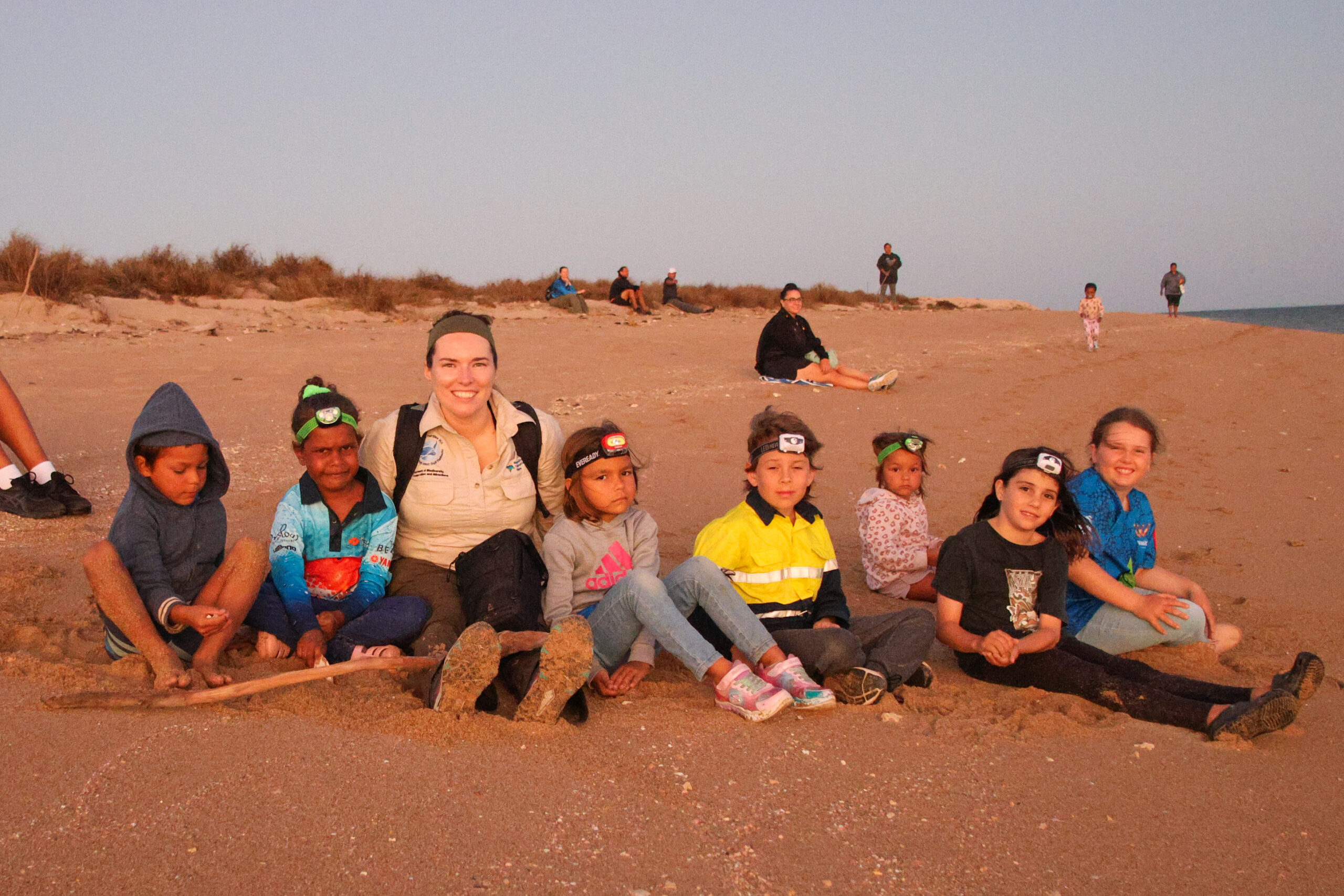
To do this, Clodagh and her colleagues work with various foundations, Aboriginal corporations and schools. The Waalitj Foundation, Onslow School and Roebourne District High School are the main groups involved.

Caption: Kids with their role models on Thevenard Island in 2024
Credit: Clodagh Guildea/DBCA
“We were liaising with them, thinking how do we get … the next generation of Aboriginal kids involved?” says Clodagh.
This collaboration resulted in an educational camp to engage kids in caring for Country and turtles.
‘Turtle camp’, as it’s affectionately known, allows kids from Onslow and Karratha to go out to remote Sea Country.
They participate in research with scientists and get up close and personal with turtles.
“The kids are always very energised and happy to be on the island and see the turtles and experience hands-on science,” says Clodagh.
“This is about connecting young people back to Country and [connecting] to conservation with positive role models.”
ALL HANDS ON DECK
While out on Country, kids get to be hands on and involved with the research branch of the NWSFTCP.
Clodagh says they work alongside scientists collecting data, scanning microchips and assessing turtle health.

Caption: Turtle camp participant Ryder measuring a flatback turtle shell with Clodagh Guildea
Credit: Suzanne Wilson
“We take the kids out … with the scientists. It gives them the opportunity to connect to Sea Country,” says Clodagh.
Clodagh says a key part of their job is providing hope and encouragement for these kids’ futures.
“We want to show them potential pathways and talk about those different opportunities and careers that exist in marine management,” she says.
A STARTING POINT
While turtle camp isn’t a direct pathway to the ranger program, Clodagh says it’s a starting point.
“We just want to make sure we’re engaging kids,” says Clodagh.
The Buurabalayji Thalanyji Aboriginal Corporation is developing a ranger program.

Caption: Students and staff from Roebourne District High School working on turtle research on Delambre Island
Credit: Tristan Simpson/DBCA
“Once the ranger program is established, we can explore establishing direct pathways through [turtle camp],” says Clodagh.
“We want kids to see this as a [career] possibility and get that connection to working on Country and working in conservation.”
“We do really want to form those pathways that kids can tangibly take to move from experiencing the science and experiencing working on Country to doing that in the future.”
ENGAGING THE FUTURE
Given the extended funding of the NWSFTCP, turtle camp has great potential.
To have any hope of protecting Aussie wildlife and ecosystems, it’s important current and future young people want to do something to help.

Caption: Kids learning about flatback turtle eggs and hatchlings
Credit: Clodagh Guildea/DBCA
“We need the next generation to be fully engaged in the environmental challenges that we’re facing going into the future,” says Clodagh.
For kids who are engaged in connecting to Country, anything is possible.