


You might be interested

The Casual Observer
May continues the season of Djeran and the cooler weather finally seems to be arriving. The night sky presents us with a choice – evening or morning?
The evening sky has Venus and Jupiter still dominating the western sky in the couple of hours after sunset while Orion looms in the background.
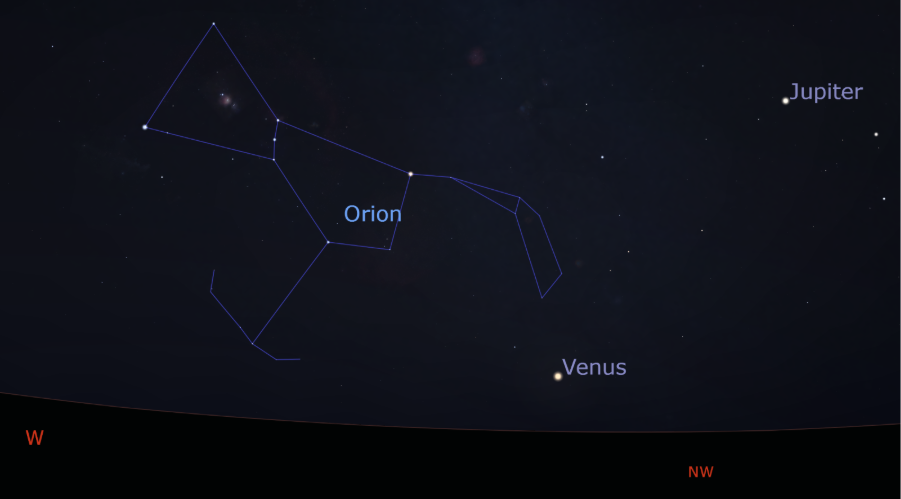
Credit: Stellarium
Hydra – the largest constellation in the sky – appears overhead along with its companion constellations Crater and Corvus. Some of the brighter parts of the Milky Way are just barely peeking over the eastern horizon.
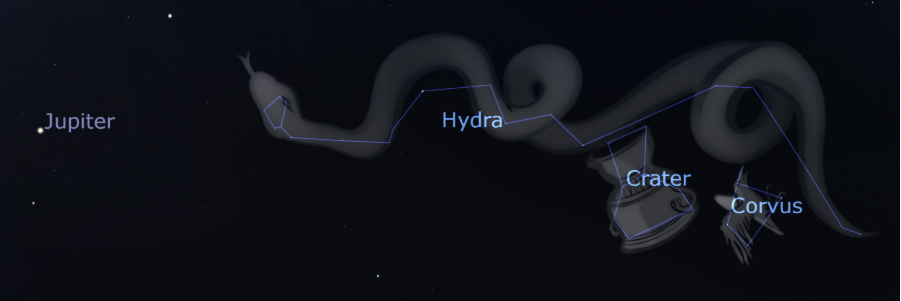
Credit: Stellarium
The morning sky presents observers with a view of Saturn and Mars in the eastern sky. By this time, the Milky Way has risen to its full glory overhead and makes for good viewing in the hour before sunrise.
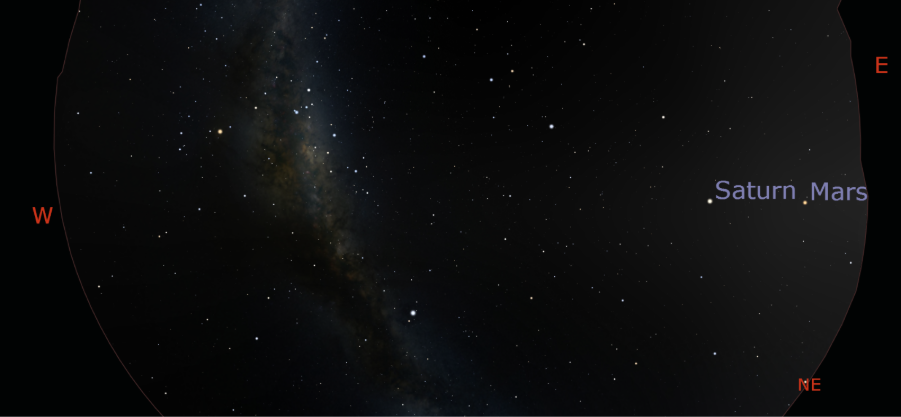
Credit: Stellarium
There are two full Moons this month, on 2 May and 31 May, the second one colloquially referred to as a Blue Moon. The Moon doesn’t actually appear any different colour, but the relative rareness of these events – every 2-3 years – is the basis of the saying ‘once in a blue moon’.
Be sure to offer George Lucas a small but meaningful gift on 4 May, Star Wars Day.
ISS sightings from Perth
The International Space Station passes overhead multiple times a day. Most of these passes are too faint to see but a couple of notable sightings* are:
| Date, time | Appears | Max Height | Disappears | Magnitude | Duration |
| 2 May 6:45 PM | 10° above SW | 78° | 18° above NE | -3.7 | 5.5 min |
| 3 May 5:58 PM | 10° above SW | 52° | 10° above ENE | -3.5 | 6.5 min |
Source: Heavens above, Spot the Station
*Note: These predictions are only accurate a few days in advance. Check the sources linked for more precise predictions on the day of your observations.
Moon phases
First Full Moon: 2 May
Last Quarter: 10 May
New Moon: 17 May
First Quarter: 23 May
Second Full Moon: 31 May
Dates of interest
4 May: Star Wars Day
19 May: Moon near Venus and Jupiter
31 May: Blue Moon (second Full Moon in a calendar month)
Planets to look for
Venus and Jupiter put on an interesting show in the western sky this month. Because of their motions relative to Earth, Venus seems to hang there, while Jupiter gets lower in the sky as the month goes on. The result is the two planets noticeably appear to move closer together by the end of the month.
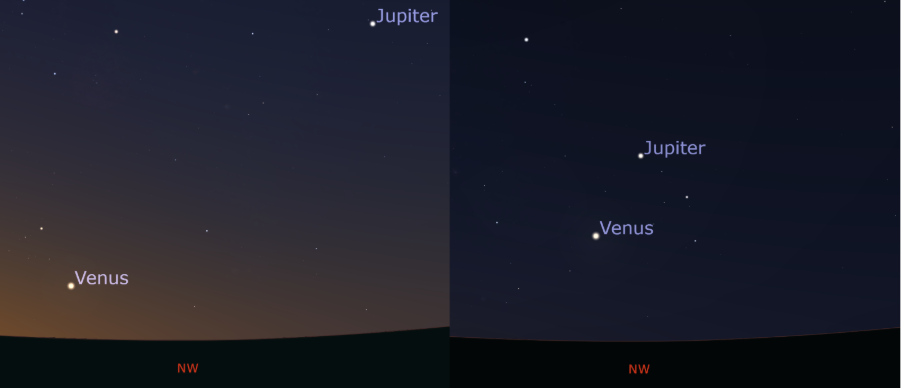
Credit: Stellarium
Mars and Saturn are in the eastern sky before sunrise all May. If you’re deeply intent on seeing Mercury this month, you can catch it in the pre-dawn eastern sky early in the month just before it dips behind the Sun. It then reappears briefly in the post-sunset western sky late in the month.
Constellation of the month
Corvus – The Crow
Corvus is a small but distinctive constellation visible overhead during May evenings. The distinctive flattened diamond pattern of stars, accompanied by a couple of extra stars on either side, is easily recognised and is often interpreted as a crow of some kind.
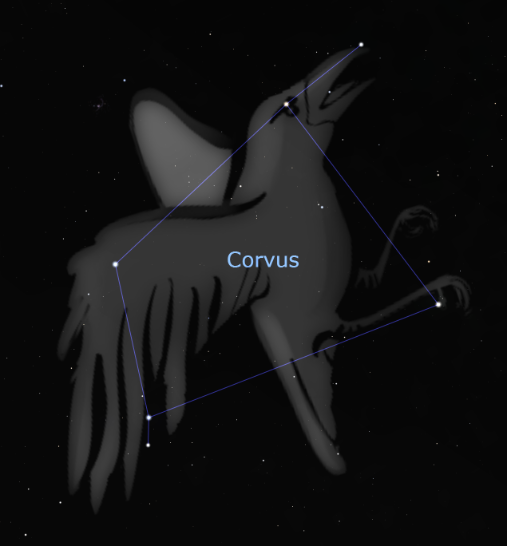
Credit: Stellairium
The story goes that the god Apollo instructed a crow to fill his cup (Crater, described above) with drink. While doing this, the crow got distracted eating figs and so snatched a watersnake (Hydra, described above) from the river, claiming an altercation, to blame for being late fetching the beverage. Apollo saw through the deception so cast them all into the sky in rage.
The most iconic sight inside corvus is the colourful Antennae galaxies, a pair of galaxies in the act of merging.
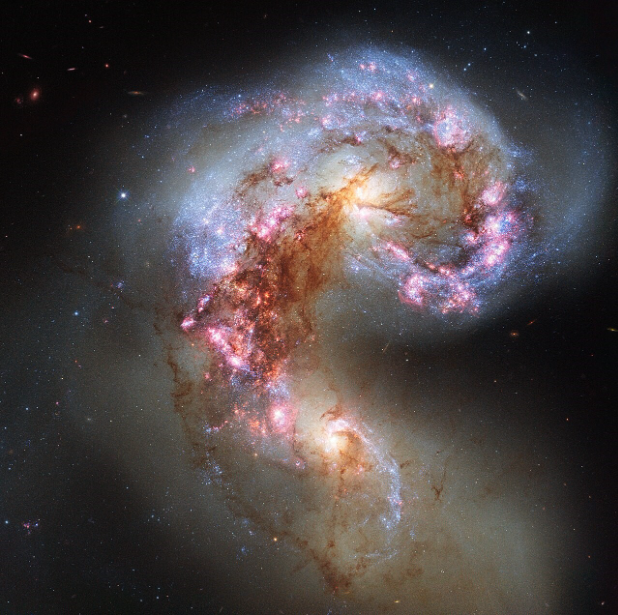
Credit: ESA/Hubble, CC BY 4.0
When galaxies merge, individual stars in each galaxy are still too far apart to collide. Instead, the mutual gravity of the two galaxies tears both them apart, destroying their original shapes completely as they combine into a single, larger structure.
What does collide are the clouds of gas and dust in each galaxy, leading to a huge burst in star formation. Aggressive star formation produces lots of hot blue stars which ionise surrounding hydrogen gas, causing it to glow pink, giving starbust galaxies their unique blue and red hues.
A zoomed out image of the merger reveals long tails of stars trailing from each galaxy, bearing something of a resemblance to insect antennae and providing the namesake for the system.
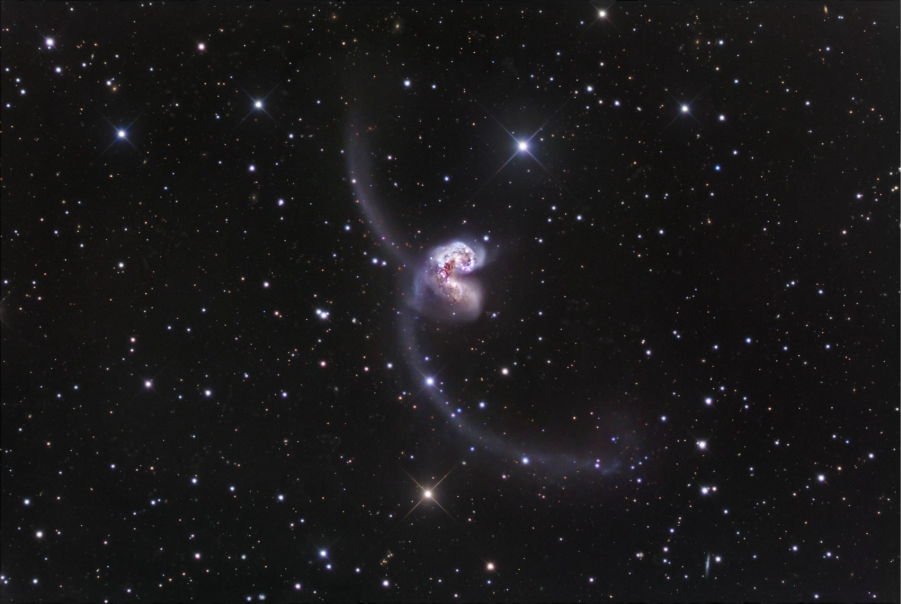
Credit: Robert Gendler