
READ

THE 2026 PREMIER’S SCIENCE AWARDS

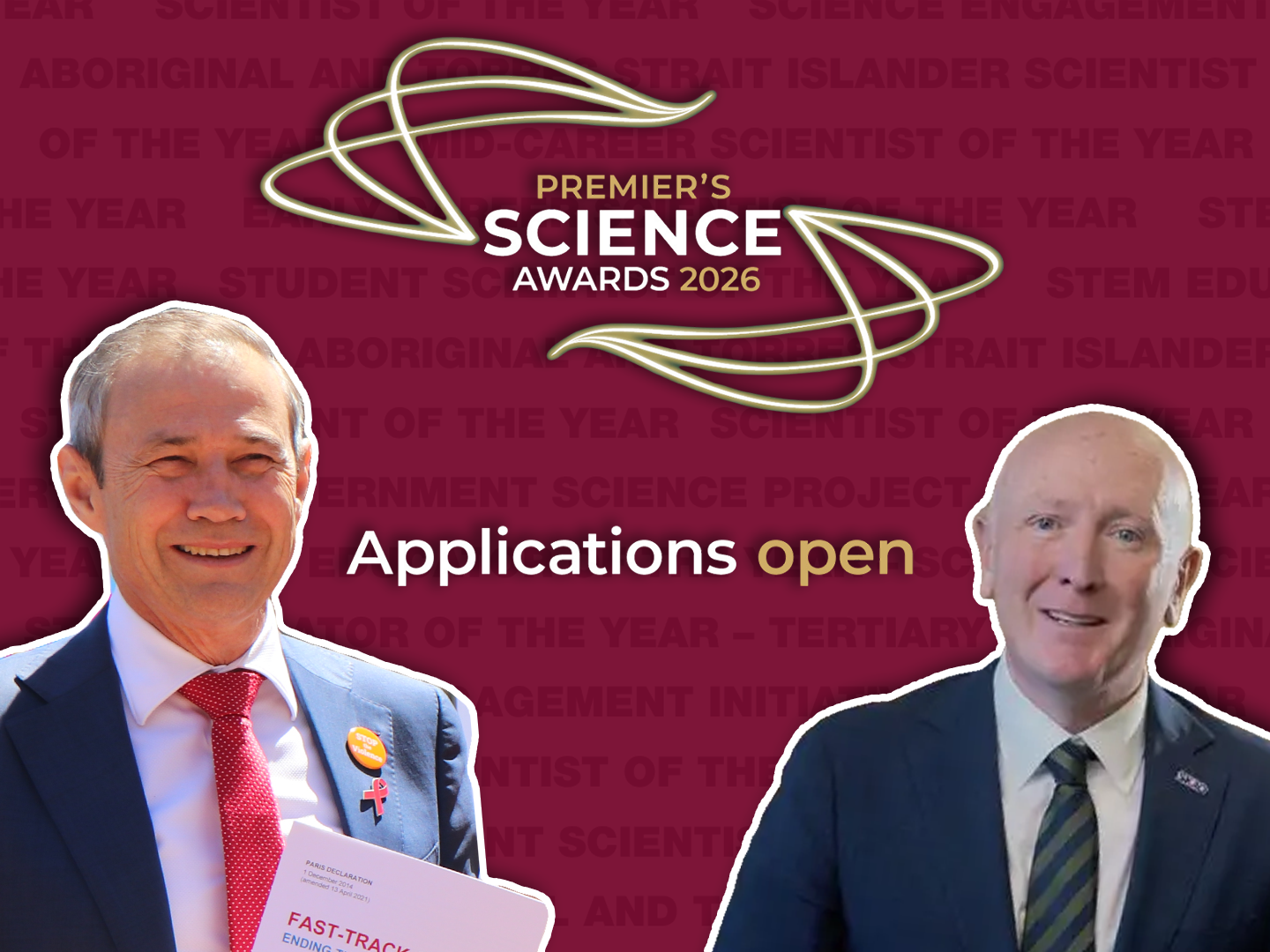
Applications for the 2026 Premier’s Science Awards are now open.
Cat Williams
Cat Williams
Freelance Writer
THE 2026 PREMIER’S SCIENCE AWARDS

Every year, we celebrate the science, scientists and science teachers right here in WA, with the Premier’s Science Awards. They’re back for 2026, which also marks the 25th year of the awards.

They recognise outstanding achievements in Science, Technology, Engineering, and Mathematics (STEM) across 10 categories. This year, the categories are: 

  • Scientist of the Year
  • Aboriginal and Torres Strait Islander Scientist of the Year
  • Mid-Career Scientist of the Year
  • Early Career Scientist of the Year
  • Student Scientist of the Year
  • Aboriginal and Torres Strait Islander STEM Student of the Year
  • Government Science Project of the Year
  • STEM Educator of the Year – Schools
  • STEM Educator of the Year – Tertiary
  • Science Engagement Initiative of the Year

Applications for all categories are now open, as well as nominations for the Western Australian Science Hall of Fame.

The WA Science Hall of Fame recognises those from Western Australia who have made lifelong contributions to STEM, and includes big names such as Barry Marshall, Stephen Hopper, Fiona Stanley, Lyn Beazley and Cheryl Praeger.

To find out more about the Premier’s Science Award visit: WA.gov.au | Premier’s Science Awards

For more information on WA Science Hall of Fame visit: WA.gov.au | WA Science Hall of Fame

Applications and nominations close on Monday 11 May 2026 at 4:00pm AWST.
Cat Williams
About the author
Cat Williams
Cat is a freelance science writer and communicator. Her work has been featured in publications including Cosmos Magazine, the Griffith Review and The Saturday Paper. When not at her writing desk, Cat enjoys travelling and patting every single dog that enters her periphery.
View articles
Cat is a freelance science writer and communicator. Her work has been featured in publications including Cosmos Magazine, the Griffith Review and The Saturday Paper. When not at her writing desk, Cat enjoys travelling and patting every single dog that enters her periphery.
View articles

NEXT ARTICLE

We've got chemistry, let's take it to the next level!

Get the latest WA science news delivered to your inbox, every fortnight.

This field is for validation purposes and should be left unchanged.

Republish

Creative Commons Logo

Republishing our content

We want our stories to be shared and seen by as many people as possible.

Therefore, unless it says otherwise, copyright on the stories on Particle belongs to Scitech and they are published under a Creative Commons Attribution-NoDerivatives 4.0 International License.

This allows you to republish our articles online or in print for free. You just need to credit us and link to us, and you can’t edit our material or sell it separately.

Using the ‘republish’ button on our website is the easiest way to meet our guidelines.

Guidelines

You cannot edit the article.

When republishing, you have to credit our authors, ideally in the byline. You have to credit Particle with a link back to the original publication on Particle.

If you’re republishing online, you must use our pageview counter, link to us and include links from our story. Our page view counter is a small pixel-ping (invisible to the eye) that allows us to know when our content is republished. It’s a condition of our guidelines that you include our counter. If you use the ‘republish’ then you’ll capture our page counter.

If you’re republishing in print, please email us to let us so we know about it (we get very proud to see our work republished) and you must include the Particle logo next to the credits. Download logo here.

If you wish to republish all our stories, please contact us directly to discuss this opportunity.

Images

Most of the images used on Particle are copyright of the photographer who made them.

It is your responsibility to confirm that you’re licensed to republish images in our articles.

Video

All Particle videos can be accessed through YouTube under the Standard YouTube Licence.

The Standard YouTube licence

  1. This licence is ‘All Rights Reserved’, granting provisions for YouTube to display the content, and YouTube’s visitors to stream the content. This means that the content may be streamed from YouTube but specifically forbids downloading, adaptation, and redistribution, except where otherwise licensed. When uploading your content to YouTube it will automatically use the Standard YouTube licence. You can check this by clicking on Advanced Settings and looking at the dropdown box ‘License and rights ownership’.
  2. When a user is uploading a video he has license options that he can choose from. The first option is “standard YouTube License” which means that you grant the broadcasting rights to YouTube. This essentially means that your video can only be accessed from YouTube for watching purpose and cannot be reproduced or distributed in any other form without your consent.

Contact

For more information about using our content, email us: particle@scitech.org.au

Copy this HTML into your CMS
Press Ctrl+C to copy