

READ

Taking a closer look at microscopes

There’s more than meets the eye, when looking at a fly.
Dennis Power
Dennis Power
Freelance Writer
Taking a closer look at microscopes

Microscopes are more than an essential tool for scientific research – they can make the seemingly mundane appear magnificent. 

Take the humble house fly.

An irritating insect that appears as a blur to the naked eye can become fascinating once you add some magnification.

A NEW PERSPECTIVE

The first microscopes had a single lens and were really just glorified magnifying glasses.

In the late 1590s, Zacharias Janssen invented the first compound microscope, providing a new perspective of the world. 

These initial compound microscopes focused light through two precisely ground glass lenses and could achieve an impressive (at the time) 3–30x magnification.

As lens-making technology improved, so did microscopes’ power, and their adoption within the sciences increased.

A new form of scientific enquiry was born.
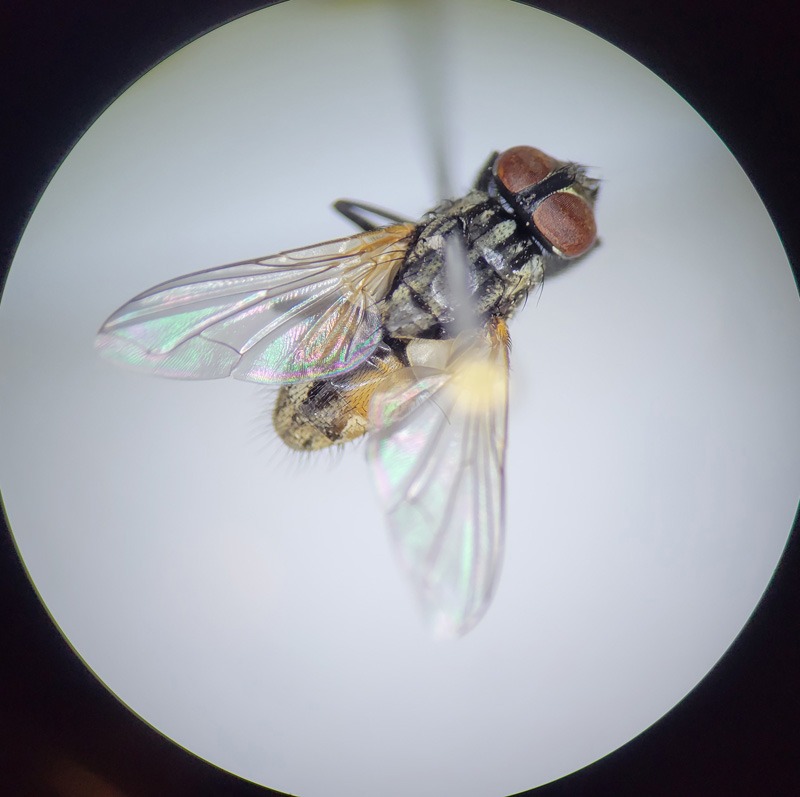
Caption: Looking at the fly, beautiful details come into focus.
Credit: Matt Pelikan

MORE THAN MEETS THE EYE

Modern microscopes can achieve far greater resolution than Janssen’s and have a range of specialities, including viewing living cells, photographing 3D samples and identifying minerals.

We can compare the resolution by taking another look at our house fly.

At 10x magnification, the intricate pattern of a fly’s compound eyes is in focus. At 100x, the hairs upon its pearlescent wings. At 400x, the bacteria coating its proboscis (sucking mouthpart) are visible.

But 400x is child’s play.
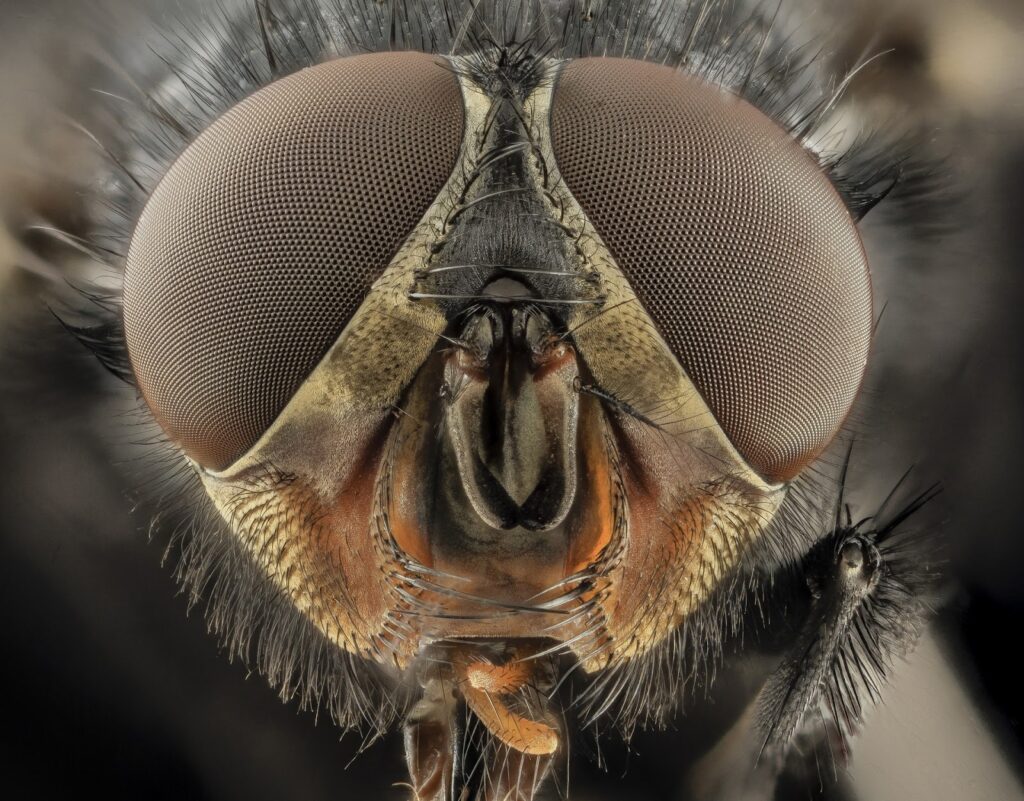
Caption: Wouldn’t want to meet this guy in a dark alley…
Credit: Jean Beaufort

Modern compound microscopes can magnify a sample up to 2000 times. Under this level of magnification, the internal workings of individual cells in the fly’s brain become perceptible.

Another kind of light microscope is the fluorescence microscope.

It uses a high-intensity light source to excite fluorescent compounds, called indicators, which are added to samples.

These indicators can be tailored to highlight points of interest within a cell.

This was a game-changer for biologists, making it easier to understand cell physiology. It also creates striking imagery.
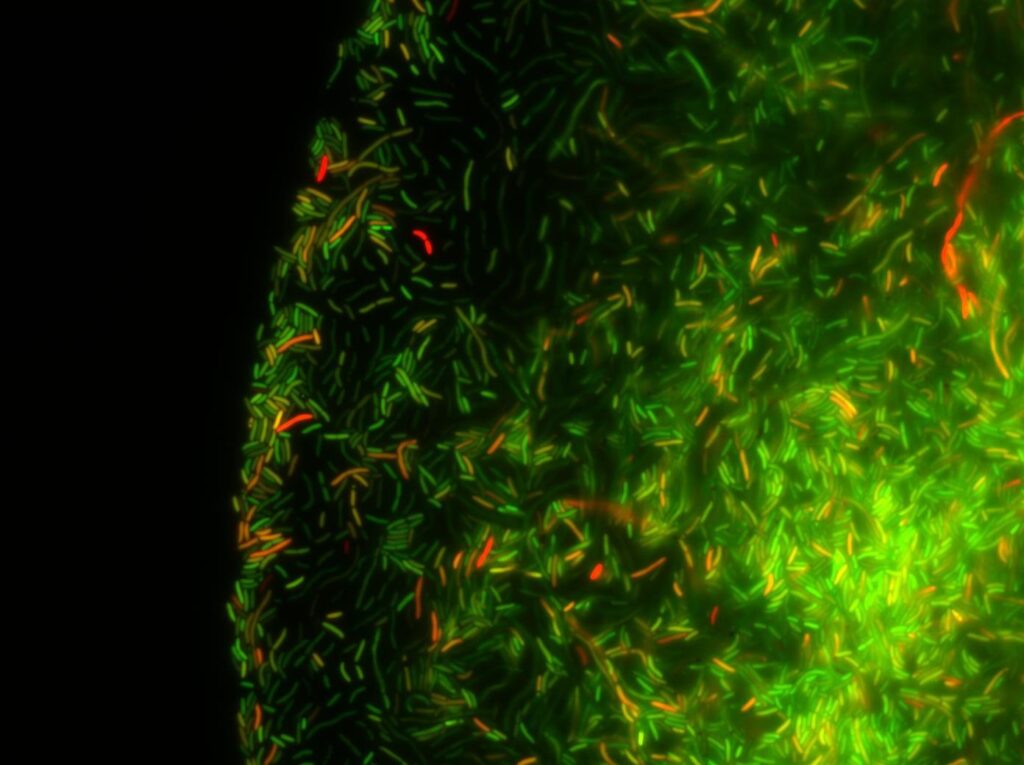
Caption: Fluorescence microscopy of E. coli, a strain of bacteria often spread by flies.
Credit: Pakpoom Subsoontorn, CC BY 4.0

ELECTRON MICROSCOPES

Instead of using light, electron microscopes scan a sample with an electron beam and detect how electrons reflect or pass through a sample to create an image.

This allows scientists to ‘see’ things less than a nanometre in size – like atoms – magnifying structures by up to 50 million times.

There are two main types of electron microscopes: the scanning electron microscope (SEM) and the transmission electron microscope (TEM).

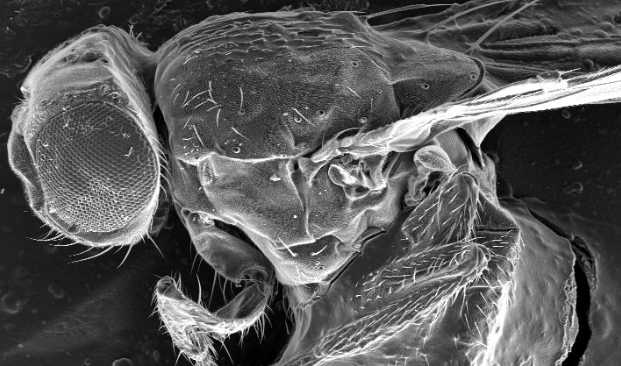
SEMs can show surface textures, like a fly’s face, in intricate and somewhat disturbing detail.
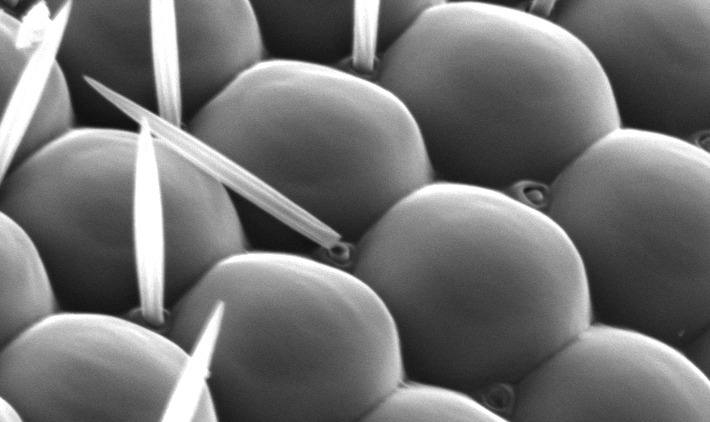
Caption: Image of a fly’s compound eyes under SEM.
Credit: CC BY-SA 2.5

In TEM, electrons interact with a sample as they pass through it on their way to a detector, providing vital information about its fundamental structures.

With TEM, scientists are able to see the molecules and atoms that make a fly a fly.

TOUCHY FEELY MICROSCOPES

Microscope technology isn’t limited to light and electrons.

While not appropriate for all fly analyses, ‘touch’ based microscope technology has advanced areas like materials science.

An atomic force microscope (AFM) provides an image by getting interactive. A very pointy, microscopic metal tip is dragged along a sample, translating the touch into an image.

AFM provides a high-resolution topographic map of a surface. 

The newly developed GelSight microscope delivers magnified data by squishing a gel pad onto the sample. (Probably a bit messy to try with our fly.)

While hundreds of years have passed since the invention of the microscope, the most significant advancements have occurred in recent decades.

There’s no knowing what breakthrough will be next, as microscopes continue to reveal more about the world – and often overlooked insects like the house fly.


Dennis Power
About the author
Dennis Power
They say that curiosity killed the cat, but Dennis knows satisfaction brought it back. Obsessed with asking questions, getting answers, and learning new facts to share with anyone who will listen, science journalism was his logical destination. Dennis loves synthetic chemistry and is a regular contributor to the Chemistry in Australia magazine. He is also the science editor for The Metamorphosis Project Journal. After four years of his PhD he decided he’d rather not handle nasty chemicals every day and built a tiny house on wheels instead.
View articles
They say that curiosity killed the cat, but Dennis knows satisfaction brought it back. Obsessed with asking questions, getting answers, and learning new facts to share with anyone who will listen, science journalism was his logical destination. Dennis loves synthetic chemistry and is a regular contributor to the Chemistry in Australia magazine. He is also the science editor for The Metamorphosis Project Journal. After four years of his PhD he decided he’d rather not handle nasty chemicals every day and built a tiny house on wheels instead.
View articles

NEXT ARTICLE

We've got chemistry, let's take it to the next level!

Get the latest WA science news delivered to your inbox, every fortnight.

This field is for validation purposes and should be left unchanged.

Republish

Creative Commons Logo

Republishing our content

We want our stories to be shared and seen by as many people as possible.

Therefore, unless it says otherwise, copyright on the stories on Particle belongs to Scitech and they are published under a Creative Commons Attribution-NoDerivatives 4.0 International License.

This allows you to republish our articles online or in print for free. You just need to credit us and link to us, and you can’t edit our material or sell it separately.

Using the ‘republish’ button on our website is the easiest way to meet our guidelines.

Guidelines

You cannot edit the article.

When republishing, you have to credit our authors, ideally in the byline. You have to credit Particle with a link back to the original publication on Particle.

If you’re republishing online, you must use our pageview counter, link to us and include links from our story. Our page view counter is a small pixel-ping (invisible to the eye) that allows us to know when our content is republished. It’s a condition of our guidelines that you include our counter. If you use the ‘republish’ then you’ll capture our page counter.

If you’re republishing in print, please email us to let us so we know about it (we get very proud to see our work republished) and you must include the Particle logo next to the credits. Download logo here.

If you wish to republish all our stories, please contact us directly to discuss this opportunity.

Images

Most of the images used on Particle are copyright of the photographer who made them.

It is your responsibility to confirm that you’re licensed to republish images in our articles.

Video

All Particle videos can be accessed through YouTube under the Standard YouTube Licence.

The Standard YouTube licence

  1. This licence is ‘All Rights Reserved’, granting provisions for YouTube to display the content, and YouTube’s visitors to stream the content. This means that the content may be streamed from YouTube but specifically forbids downloading, adaptation, and redistribution, except where otherwise licensed. When uploading your content to YouTube it will automatically use the Standard YouTube licence. You can check this by clicking on Advanced Settings and looking at the dropdown box ‘License and rights ownership’.
  2. When a user is uploading a video he has license options that he can choose from. The first option is “standard YouTube License” which means that you grant the broadcasting rights to YouTube. This essentially means that your video can only be accessed from YouTube for watching purpose and cannot be reproduced or distributed in any other form without your consent.

Contact

For more information about using our content, email us: particle@scitech.org.au

Copy this HTML into your CMS
Press Ctrl+C to copy