

READ

The Sky Tonight: January 2026

The Sky Tonight is a monthly update of the amazing things you can find when looking up from Western Australia. This article was originally published 01.01.2026 on Scitech.org.au titled ‘The Sky Tonight’.
Leon Smith
Leon Smith
Planetarium Coordinator
The Sky Tonight: January 2026

The Casual Observer 

January continues the season of Birak, meaning the hot weather is here to stay. The silver lining is that the night skies are clear and good for stargazing. 

The eastern sky delights us during January evenings with the ‘Orion group of constellations nicely visible. See the hunter accompanied by the dogs Canis Major and Canis Minor confront the mighty bull Taurus. For some reason there’s also a unicorn in there, just to keep things real. 
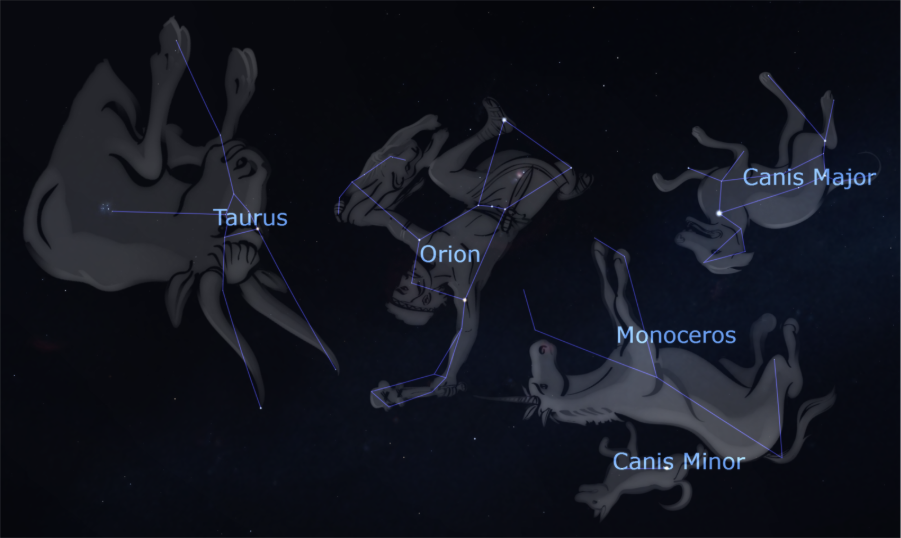
Image: The eastern sky at 9pm during January is full of easy to recognise constellations.
Credit: Stellarium

Jupiter also joins the party in the eastern sky during January evenings. You can find it just under Canis Minor in the constellation of Gemini. The mightiest of planets reaches opposition on 10 January, meaning it is exactly opposite the Sun in the sky. If you point one hand at the Sun and the other at Jupiter you will be pointing in opposite directions. This means that Jupiter rises in the east at the exact same time as the Sun sets in the west, and is visible all night. 
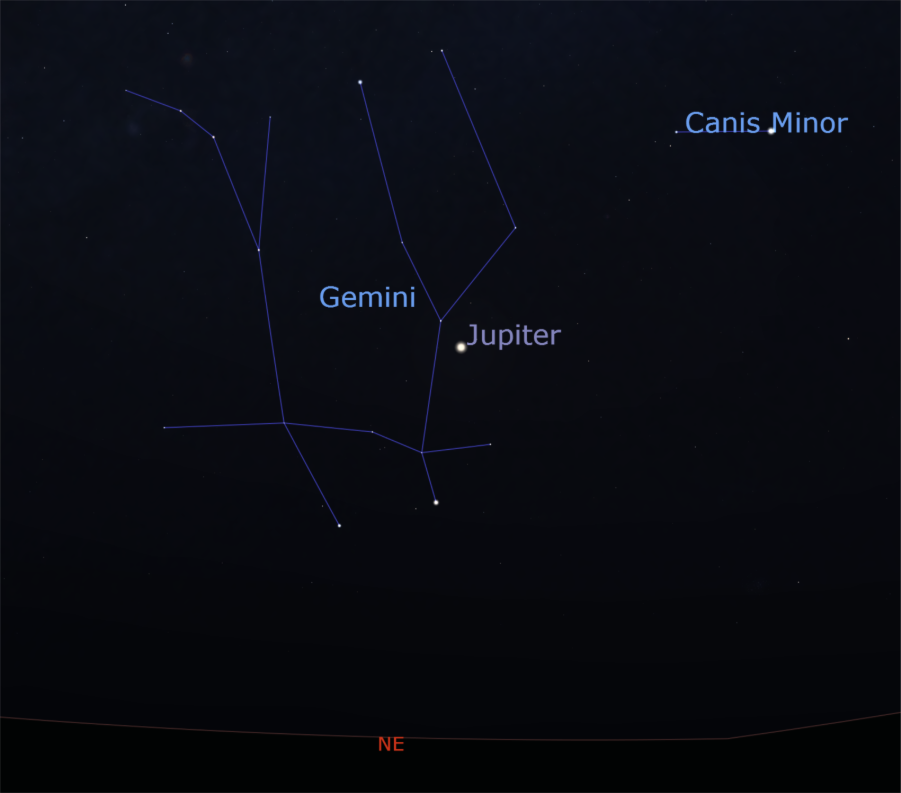
Image: Jupiter’s location in the sky during January.
Credit: Stellarium

Earth reaches perihelion on 4 January, the point on its orbit where we are closest to the Sun. This happens because Earth’s orbit around the Sun is not quite perfectly circular, meaning that the distance to the Sun changes over the year. This places us at a minimum distance (perihelion) of 147 million km during January and a maximum distance (aphelion) of 152 million km during June, and back again over the course of a year. 
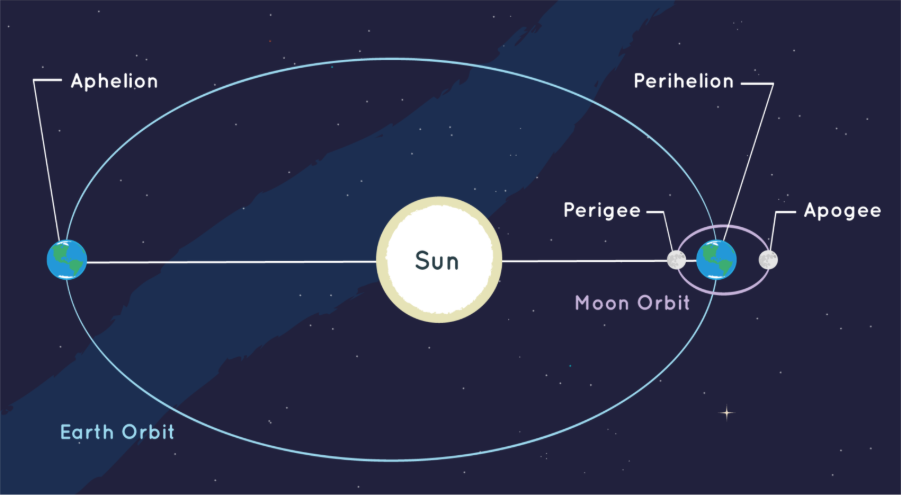
Image: Visualising the perihelion and aphelion, exaggerated for clarity.
Credit: NOAA

It is time for a handy reminder that Earth’s distance from the Sun is not what causes our seasons (remember, it’s winter up north right now!). While it is certainly true that Earth’s variable distance to the Sun does have an effect on temperature, on the scale of Earth’s almost-perfectly-circular orbit, the result is only a few degrees. Earth’s tilted rotation axiswhich is currently pointing the southern hemisphere towards the Sun (and the northern hemisphere away from the Sun) has a much greater effect on temperature, and is the real reason for the seasons. 

Moon phases 

Full Moon: January 3 

Last Quarter: January 10 

New Moon: January 19 

First Quarter: January 26 

Dates of interest 

January 3: Moon close to Jupiter 

January 4: Earth at perihelion 

January 10: Jupiter at opposition 

Planets to look for 

This is a rare month where there is only one planet worth looking at: Jupiter. It dominates the eastern sky during January evenings, so make sure you take the chance to see it. Saturn is visible as a yellowish dot in the northwestern sky during the evenings but is rapidly being left behind by Earth and is setting by 9:30pm by the end of the month.  

What other planets can I easily see in the sky this month?

George Costanza Seinfeld GIF
via GIPHY

Constellation of the month 

Musca – the Fly 

Musca is a small, faint constellation in the southern skies located directly ‘underneath’ the Southern Cross and is usually interpreted as a fly. 
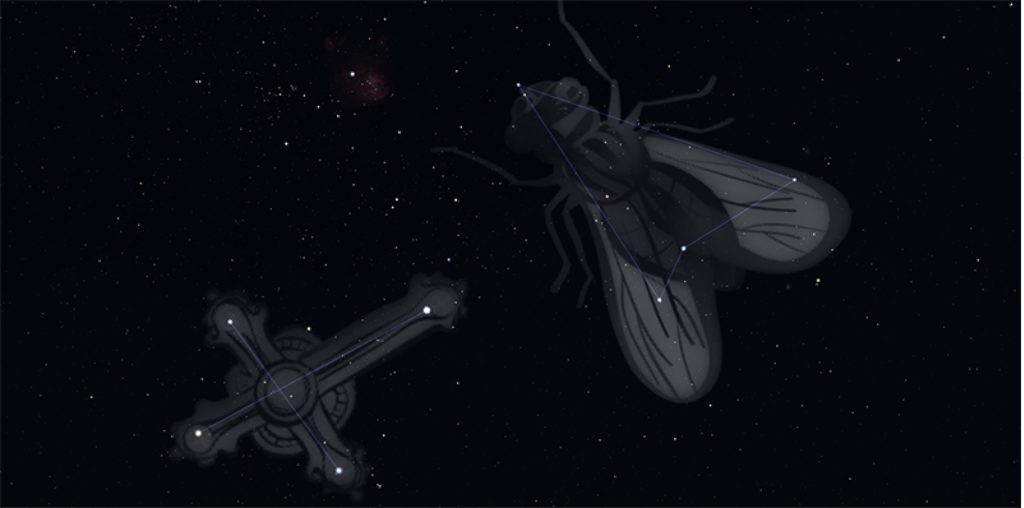
Image: Musca and the Southern Cross.
Credit: Stellarium 

Musca is home to several stars from the Scorpius-Centaurus Association – a loosely bound cluster of stars spreading across the galaxy. Most of the brightest stars you see in Musca are likely members of this group. 

Notably, many stars in the association are of type O or B – extremely hot and bright stars powered by furious consumption of their nuclear fuel. They typically shine with surface temperatures more than 30,000 degrees Celsius, about five times hotter than the surface of the Sun. 

Because they burn so furiously, these types of stars don’t live very long. The fact that we can see them at all means they are very young, cosmologically speaking, and astronomers estimate they are only several million years old. If you wrap Earth’s history into a single 24-hour day, dinosaurs appeared at 10:45pm in the evening and (mostly) disappeared at 11:40pm. These stars appeared at 5 minutes to midnight. 

Objects for the small telescope 

Jupiter – The bringer of jollity 

Point a telescope at it, or use your eyes, it doesn’t matter how you do it. You just must simply look at Jupiter during January.  
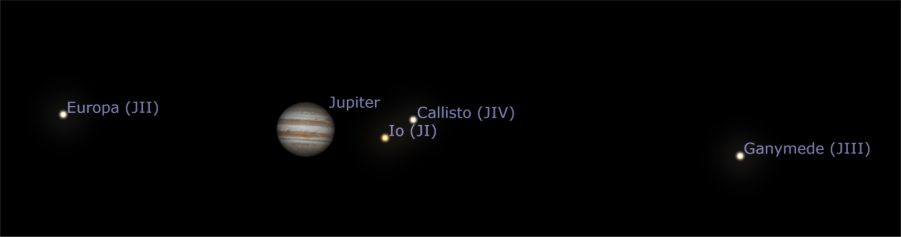
Image: Jupiter and the Galilean moons as they will appear on 26 January.
Credit: Stellarium 


Leon Smith
About the author
Leon Smith
Leon runs the Scitech Planetarium. It's pretty sweet. Theoretical physics is his expertise, science communication is his passion. Tends not to mince words. He stays up too late and drinks too much coffee.
View articles
Leon runs the Scitech Planetarium. It's pretty sweet. Theoretical physics is his expertise, science communication is his passion. Tends not to mince words. He stays up too late and drinks too much coffee.
View articles

NEXT ARTICLE

We've got chemistry, let's take it to the next level!

Get the latest WA science news delivered to your inbox, every fortnight.

This field is for validation purposes and should be left unchanged.

Republish

Creative Commons Logo

Republishing our content

We want our stories to be shared and seen by as many people as possible.

Therefore, unless it says otherwise, copyright on the stories on Particle belongs to Scitech and they are published under a Creative Commons Attribution-NoDerivatives 4.0 International License.

This allows you to republish our articles online or in print for free. You just need to credit us and link to us, and you can’t edit our material or sell it separately.

Using the ‘republish’ button on our website is the easiest way to meet our guidelines.

Guidelines

You cannot edit the article.

When republishing, you have to credit our authors, ideally in the byline. You have to credit Particle with a link back to the original publication on Particle.

If you’re republishing online, you must use our pageview counter, link to us and include links from our story. Our page view counter is a small pixel-ping (invisible to the eye) that allows us to know when our content is republished. It’s a condition of our guidelines that you include our counter. If you use the ‘republish’ then you’ll capture our page counter.

If you’re republishing in print, please email us to let us so we know about it (we get very proud to see our work republished) and you must include the Particle logo next to the credits. Download logo here.

If you wish to republish all our stories, please contact us directly to discuss this opportunity.

Images

Most of the images used on Particle are copyright of the photographer who made them.

It is your responsibility to confirm that you’re licensed to republish images in our articles.

Video

All Particle videos can be accessed through YouTube under the Standard YouTube Licence.

The Standard YouTube licence

  1. This licence is ‘All Rights Reserved’, granting provisions for YouTube to display the content, and YouTube’s visitors to stream the content. This means that the content may be streamed from YouTube but specifically forbids downloading, adaptation, and redistribution, except where otherwise licensed. When uploading your content to YouTube it will automatically use the Standard YouTube licence. You can check this by clicking on Advanced Settings and looking at the dropdown box ‘License and rights ownership’.
  2. When a user is uploading a video he has license options that he can choose from. The first option is “standard YouTube License” which means that you grant the broadcasting rights to YouTube. This essentially means that your video can only be accessed from YouTube for watching purpose and cannot be reproduced or distributed in any other form without your consent.

Contact

For more information about using our content, email us: particle@scitech.org.au

Copy this HTML into your CMS
Press Ctrl+C to copy