


You might be interested


Ciaran O’Hare scribbles symbols using coloured markers across his whiteboard like he’s trying to solve a crime – or perhaps planning one. He bounces around the edges of the board, slowly filling it with sharp angles and curling letters. I watch on, and when he senses I’m losing track, he pauses intermittently, allowing my brain to catch up. Ciaran speaks with an easy to understand British inflection, but the language on the whiteboard might as well be hieroglyphics.
Ciaran’s whiteboard doesn’t lay out a crime, but a mystery in the language of physics. In plain language, the mystery goes like this: everything we can see – with our eyes or elaborate telescopes – makes up only around 5% of the matter in our universe. There’s an invisible something out there that seems to bind the fabric of spacetime together. We don’t know what it is, but we know it’s there because of the force it exerts on the things we can see such as gigantic galaxies. The ‘something’ is a phantom presence that touches our reality.
Scientists call it dark matter.
Finding Phantoms
“We have this beautiful model of particle physics, but at the heart of it, we have this thing – dark matter – which we know has to be there but does not actually have any explanation for why it’s there,” says Ciaran.
For about 2 hours, Ciaran runs me through the specifics of science’s search for the elusive something. He details the possible things dark matter could be – something field-like, similar to magnetism, or something more exotic, even unfathomable, like tiny black holes.
One of the leading theories proposes dark matter might be a hypothetical particle such as a WIMP – a weakly interacting massive particle.
We may be able to find these elusive maybe-particles with specialised detectors buried deep underground around the world. There’s one known as the LUX-ZEPLIN (LZ) attended to by scientists at the end of a tunnel in an old gold mine in Lead, South Dakota. More lie below mighty mountains in Italy, South Korea and China.
These detectors work with extreme patience. The cylindrical chambers, full of liquid xenon, are buried deep beneath the surface of the Earth, where they’re protected from cosmic interference by the mass of rock above. In total darkness and extreme cold, the subatomic particles that make up every atom of xenon in the detector lie in wait, unflinching. If a particle – a something – bumps into one, it emits a flash of light. That light is a flicker the detectors are primed for.
After more than 20 years of observations by detectors around the world, none have definitively discovered the thing we call dark matter. While those negative results seem disappointing, they’re extremely important. They help nail down what dark matter isn’t, so we can get closer to what it is.
Although these detectors are exquisitely tuned to pick up the remarkably faint signals we expect to see from dark matter and they’ve become increasingly sensitive over time, they’re running into a new problem: there are other ghosts in our universe, and they might get in the way.
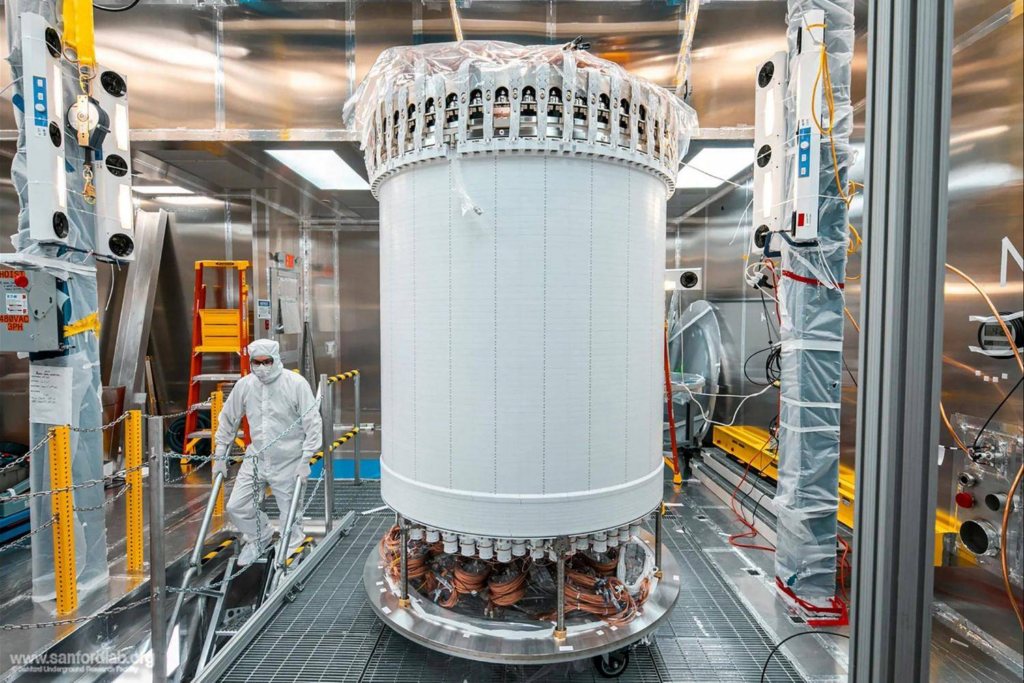
Credit: Sanford Lab
A Haunting Deep Underground
We are all haunted.
As you read this, ghost particles endlessly weave their way around the atoms of your body like downhill skiers. Trillions of them, all at once. Some shoot through your skull and out the soles of your feet, others across your chest or through all the viscera and muscles that hang off your bones. They do not stay long. They journey through you without disruption or damage.
These are friendly ghosts – subatomic particles, almost massless, that barrel across our universe at close to light speed, stopping for very little.
We’ve given the ghost particles a name – neutrinos. Although they are elusive, just as scientists have built ingenious devices to attempt to detect dark matter, they have also built devices that can capture a neutrino.
Just like dark matter detectors, these devices are out of sight. Some rest under a kilometre of Antarctic ice. Others are buried below sweeping Japanese mountains or tethered to the bottom of the Mediterranean Sea.
Unlike dark matter, scientists have detected neutrinos. We know where they come from – within the heart of our Sun, when cosmic rays crash into our atmosphere, during the explosion at the end of a star’s life or from human sources like nuclear reactors.
In 1956, researchers working on Project Poltergeist detected a neutrino at Savannah River in the United States. It was humanity’s first observation of neutrinos, and one of the scientists behind it won the Nobel Prize in Physics some 40 years later.
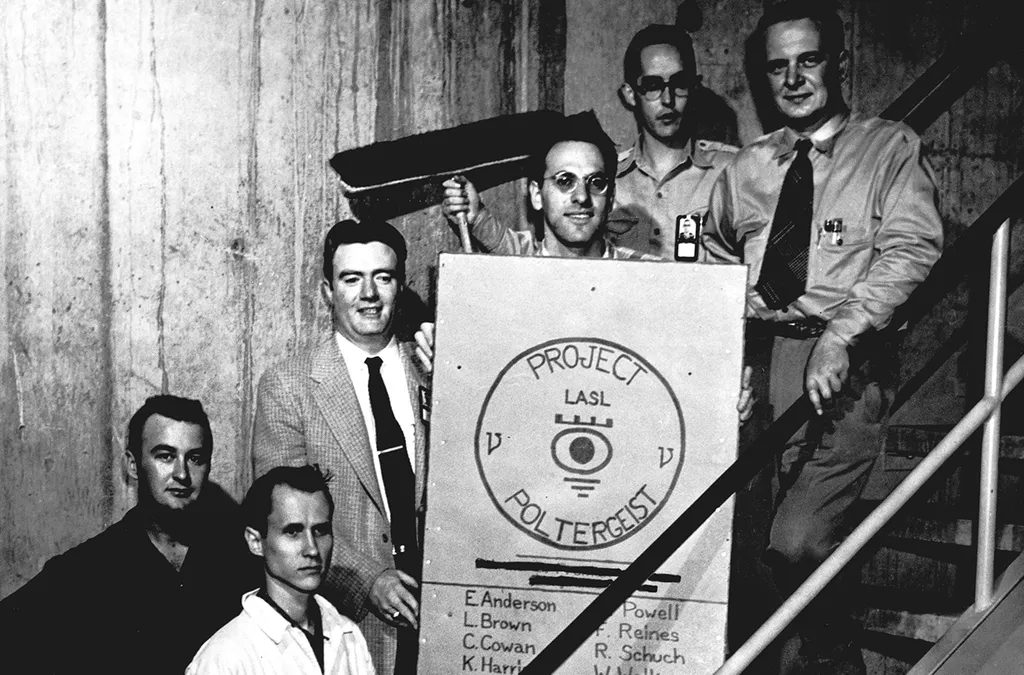
Credit: Los Alamos National Laboratory
Neutrinos have long intrigued physicists. Very early on, there was even an idea that massive neutrinos might be a form of dark matter.
“When people were thinking about what dark matter is, neutrinos were one of the candidates, because many of the properties neutrinos have could be very similar to a dark matter particle,” says Theresa Fruth, an astroparticle physicist at the University of Sydney, who currently works on the LZ dark matter experiment in South Dakota.
“But neutrinos don’t have enough mass. We now know that they’re really light, so they couldn’t constitute dark matter.”
What this all means is that, when we go searching for dark matter in underground detectors, ghost particles will look to the detectors much like dark matter would look.
“This is the background, which basically looks like the dark matter signal,” says Ciaran. The ghost particles leave an imprint on them, just as a Victorian-era ghost might lurk in a sepia-toned photograph and obscure a face.
This background has been dubbed the neutrino fog. And we’ve recently reached it.
WHO YOU GONNA CALL?
In 2024, two of the world’s major dark matter detectors, PandaX-4T at the China Jinping Underground Laboratory and XENONnT at the Gran Sasso National Laboratory in Italy, glimpsed the fog for the first time.
The detectors, full of tonnes of liquid xenon, detected multiple occasions where a neutrino from the Sun – a specific type known as a boron-8 solar neutrino – bounced off the nucleus of an atom.
“This is the first detection of any of the neutrino background in these experiments,” says Ciaran.
The PandaX-4T experiment captured 75 neutrino events, while XENONnT captured 11. The signals were detected with a high-but-not-extremely-high level of statistical significance, just under 3σ (3-sigma) for both. That’s about a 0.3% probability the detections were by chance. Typically, physicists like to hold themselves to the significance of 5σ. At this standard, there’s a vanishingly small probability – just 0.00006% – that you detect it by chance.
Yet, “the chance that both results are fluked is remote,” says Fei Gao, a physicist at Tsinghua University who works in Italy’s XENONnT collaboration. “It has all the features you would expect from a [neutrino] signal.”
In December 2025, the detector in South Dakota, LZ, also detected neutrinos from the Sun, with a significance of 4.5σ, for the first time. That puts our major dark matter observatories smack in the middle of the fog. Is that a problem?
“It starts to become a problem,” says Robert James, a dark matter physicist at the University of Melbourne and member of the LZ team.

Credit: Riccardo De Luca/Getty Images
Into The Fog
Just like driving in a fog at night, these neutrino events make it hard to see signals clearly. This fog can’t be penetrated – it will always be there as part of the “irreducible background” in our experiments.
Fortunately, we’re only at the border of the fog and only for this specific type of potential dark matter particle. Even if dark matter is a WIMP, there’s still a lot more experimental space for scientists to plunder.
“Everywhere else, it’s not limiting our dark matter search,” says Theresa. It will be some time before scientists are fully immersed in it and the next-generation detectors will be big enough and run for long enough that they’re likely to start seeing the impact of neutrinos that crash through our atmosphere from across the universe, not just from the Sun. That will present an even bigger challenge.
It also presents an opportunity. Now that dark matter detectors can detect neutrinos originating from within the Sun’s core, scientists have the ability to study the fusion reactions taking place within.
“That’s what makes it so exciting that now we’ve made these detectors which are so powerful in their discrimination, in their low background, in their sensitivity, that we can see other things and we can do other science with that,” says Theresa.
Ghost Stories
During a cool spring day in 2022, I visited the Stawell Underground Physics Laboratory (SUPL) in Stawell, Western Victoria. The detector at SUPL is a little different to those full of liquid xenon in South Dakota, China or Italy – and it will not have to concern itself with the neutrino fog. Instead, Australia’s dark matter experiment will attempt to replicate results obtained by Italian scientists some 20 years ago. The experiment, known as SABRE South, is scheduled to begin later this year.
After acquiring an orange hard hat, vest and knee-high boots and completing the safety checks, I jumped into the back seat of a Toyota Hilux, sandwiching myself between researchers and staff. The slow drive down winding, dark passages ended at an opening where a metal frame is set back into the rock, with a simple A4 sign. This is it: Australia’s underground laboratory.

Credit: Jackson Ryan
During my visit, it’s a gigantic empty space. Orange wiring tracks around the chamber walls. There are fire extinguishers. My guide, University of Melbourne particle physicist Elisabetta Barberio, points to the spaces on the floor where the experiment will eventually be set up in years to come.
But outside, one of the mine staff tells me a tale – and I’m unsure how to take it. It’s almost mythical. A kilometre below the surface, one of his colleagues had toiled away in low light. He heard noises, like footsteps, and turned to look, his headlamp illuminating the empty space. Nothing there. Then, more footsteps.
Again he swung around, the headlamp illuminating puddles of water on the ground. Undisturbed. Nothing there. It’s this story I can’t get out of my head as we emerge from the tunnel that afternoon, back into the light. It’s that story I can’t get out of my head 4 years later.
We are all haunted.
We become obsessed with things we cannot see and cannot explain and devise clever tricks and techniques in an attempt to reveal their nature. We don’t have any evidence that ghosts linger on Earth long after their physical bodies have died. That’s not what I’m talking about here. But when you start to sink into the muck of particle physics, the similarities crystallise.
That is the space where science thrives. The search for dark matter is a series of constant exclusions. As we pursue what dark matter is not, we edge closer to the something it is.
I’ve often wondered how scientists think about this – this pursuit of the invisible, of the unknown. They’re spinning around in a dark cave or lost in a deep fog, checking the puddles of water for footprints, shining their headlamps into the fractures and crevices in the rock. Ghosts are hard to catch. That’s the point.
“It’s only by doing hard things that you reap the rewards,” says Robert. “Even if all you do is exclude something, that still helps inform what you’re going to build next, what you’re going to try next.”