


You might be interested


On 13 November, the Escape and Plasma Acceleration and Dynamic Explorers (EscaPADE) mission launched to space on the New Glenn rocket provided by Blue Origin.
That’s quite a sentence so let’s unpack it.
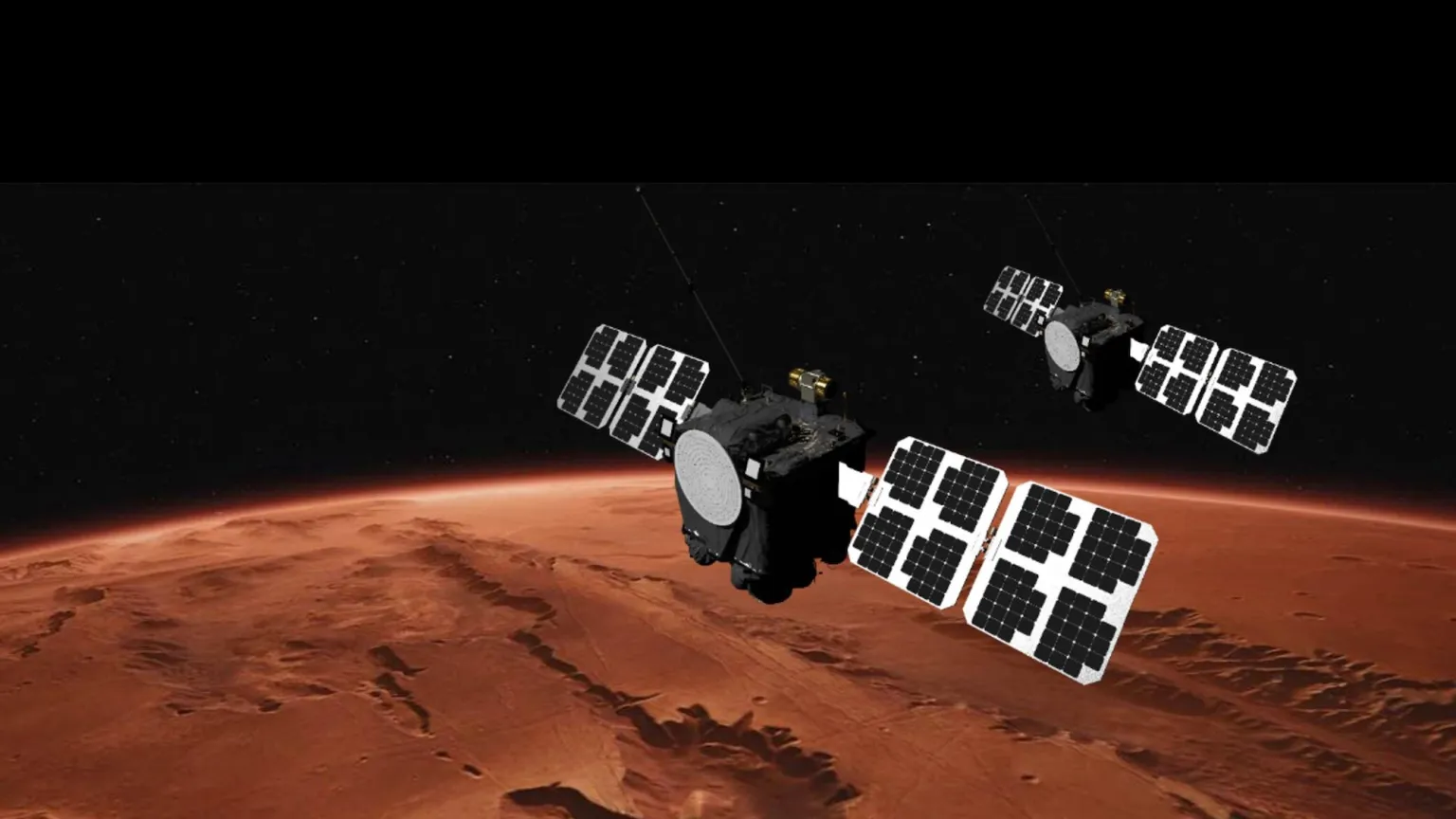
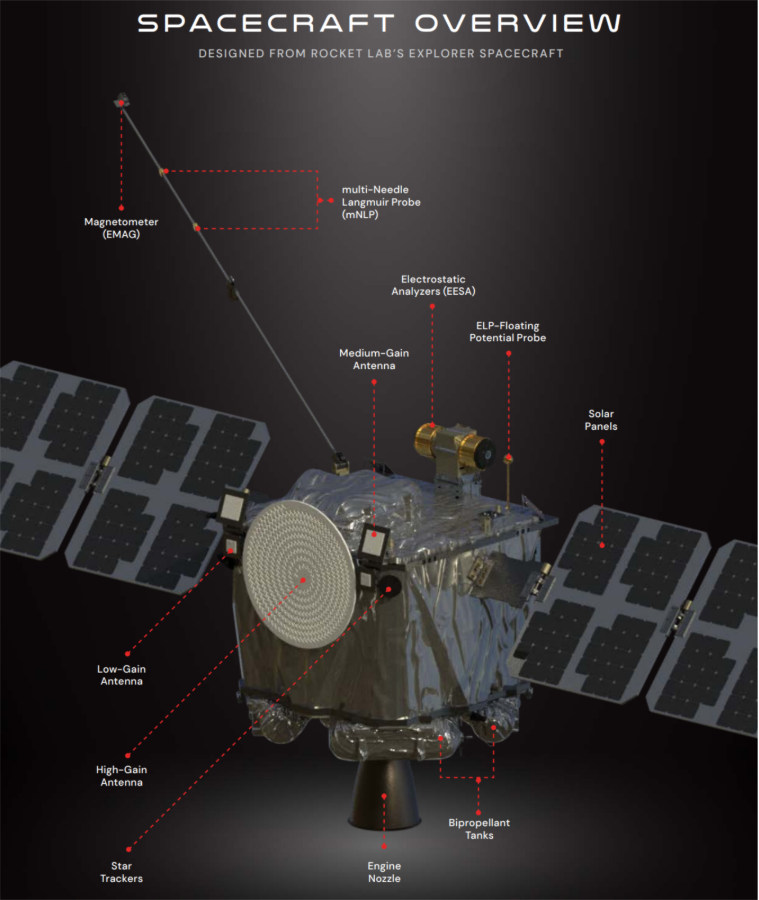
EscaPADE is a NASA mission consisting of two identical spacecraft, about a metre in size, named Blue and Gold, whose purpose is to study the magnetic and plasma environment around Mars.
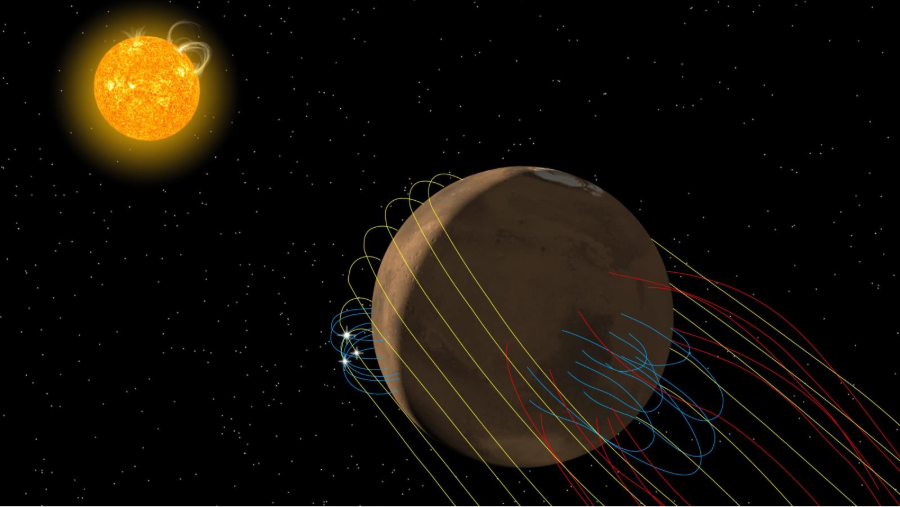
Scientists want to know how Mars’s magnetic field interacts with the solar wind – the constant stream of high energy charged particles that emanates from the Sun – and how this interaction affects Mars’s atmosphere.
Unlike on Earth, where our planet’s strong magnetic field comfortably deflects most of the solar wind safely around us, the weak and inconsistent Martian magnetic field is nowhere near as effective, allowing the solar wind to interact much more strongly with the atmosphere of Mars and, over millions of years, strip it away from the planet.
Ultimately, the mission’s goal is to understand more about the puzzling history of Mars and its water.
Credit: NASA’s Scientific Visualization Studio, overlay courtesy of Anil Rao/University of Colorado/MAVEN/NASA GSFC
A TENUOUS ATMOSPHERE
As a result of billions of years of exposure to the solar wind, Mars as we know it today has an extremely tenuous atmosphere, 150 times thinner than Earth. Consequently, the air pressure is so low that liquid water can’t exist on the surface of the planet – it just immediately evaporates away or freezes, or both.
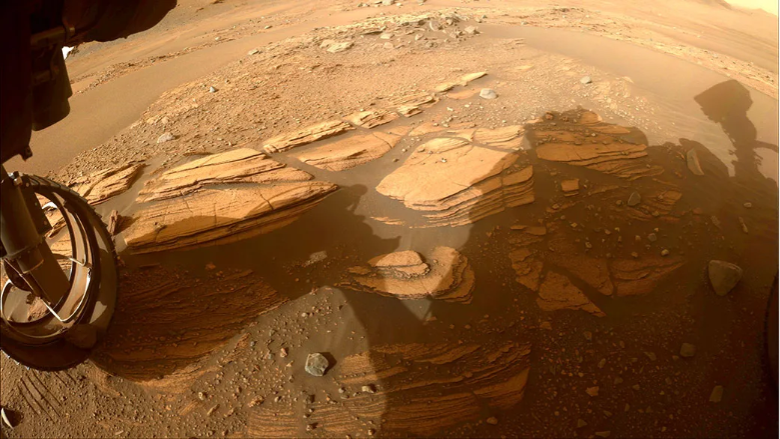
There are no rivers or lakes on Mars today. However, the extensive presence of sedimentary rocks and clay minerals – things that can only form in bodies of liquid water – tells us the planet used to have great bodies of water on its surface.
This means the atmosphere of Mars in the distant past was once much thicker and at a high enough pressure to be able to support liquid water. Thus, the need to understand how Mars lost its atmosphere.
Credit: NASA/JPL-Caltech
MEASURING MAGNETIC FIELDS
Blue and Gold are both equipped with magnetometers to measure the magnetic field strength around Mars, as well as instruments that measure the energy and density of ions and plasma around the planet.
After an 11-month flight to Mars, the two spacecraft will operate a year-long science mission collecting data around the planet.
Cleverly, the spacecraft will spend six months orbiting Mars in the same orbit, allowing them both to collect measurements from the same part of the magnetosphere.
Then, they will each shift to different orbits, allowing for measurements of different and distant parts of the magnetosphere at the same time.
Credit: Rocket Lab
PLAN A, B OR C
That’s the plan anyway. The spacecraft were supposed to be launched in October 2024 but were delayed by the late development of the New Glenn rocket – the rocket responsible for launching the EscaPADE spacecraft.
Because Earth and Mars are always moving, there are only certain times of year you can launch a spacecraft directly between them – known as a launch window.
November 2025 is not an open launch window between Earth and Mars, but the looming threat of budget cuts potentially cancelling the program encouraged NASA to try a creative launch trajectory.
Instead of Blue and Gold launching directly to Mars, they will hang around at a point about 1.5 million km from Earth called L2 until late 2026. When the window to Mars opens, they will swing back past Earth and be on their way to the Red Planet.
NEW GLENN IS HEFTY
The flight was exciting as the second test flight of the shiny new New Glenn rocket from Blue Origin.
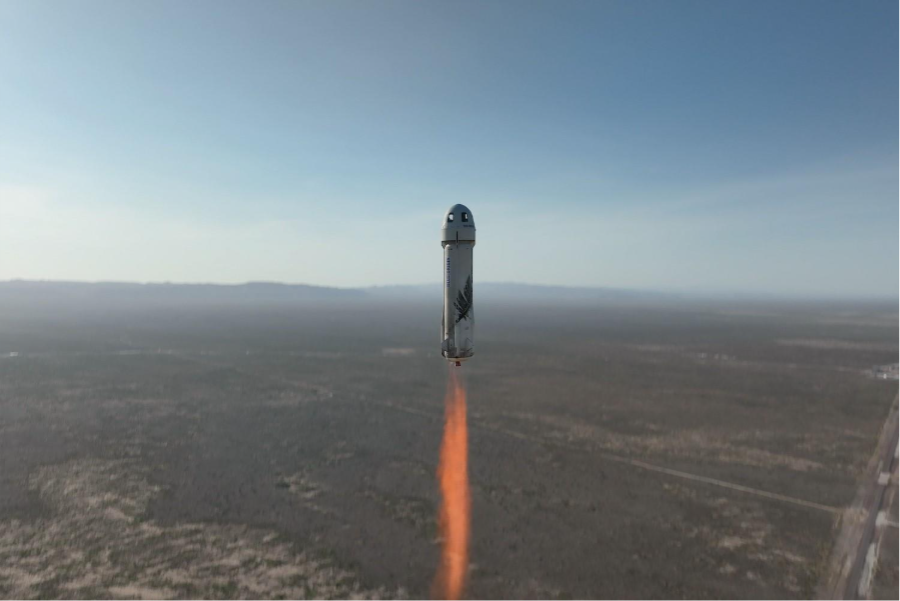
Blue Origin – owned by Jeff Bezos – is an aerospace company mostly known for their space tourism flights on the New Shepard rocket. You know, the one that is shaped like an aubergine.
Credit: Blue Origin
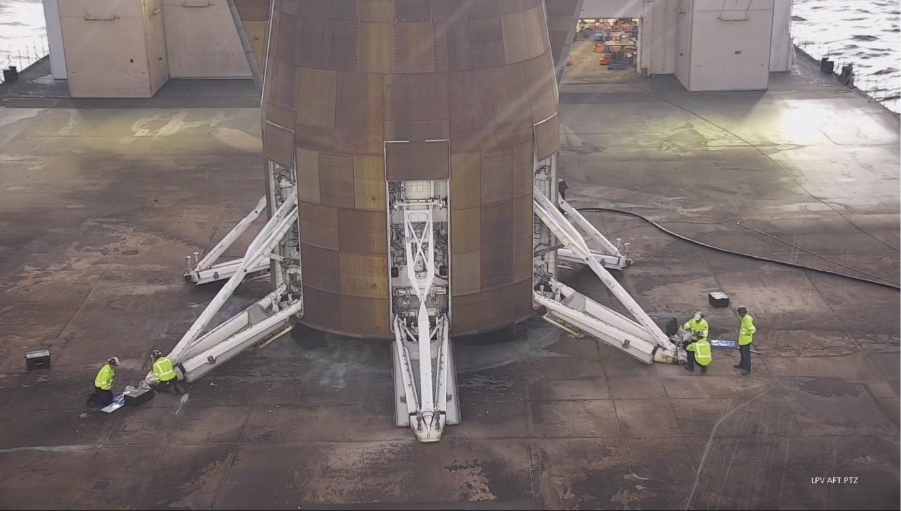
For the past decade or so, they have quietly (and somewhat secretively) been developing the New Glenn – a 100-metre-tall heavy lift vehicle designed to haul satellites and spacecraft into Earth’s orbit and beyond.
At seven metres in diameter and capable of launching 45 tonnes of cargo into Low Earth Orbit, New Glenn was comically overpowered for the 2 x 500kg spacecraft of EscaPADE.
To truly get a scale for how big this thing is, here’s some people for comparison:
Credit: Jeff Bezos/Blue Origin
The successful landing, and eventually, reuse of the New Glenn booster will allow Blue Origin to be more competitive in the commercial satellite launch market, a market currently dominated by SpaceX.
In case you’re wondering…
The New Shepard and New Glenn get their namesakes from American astronauts. Alan Shepard was the first US citizen to go to space. His flight on the Freedom 7 spacecraft launched straight up and down, just like the New Shepard does today. John Glenn was the first US citizen to orbit Earth on the Friendship 7 spacecraft, as New Glenn is designed to do.