

READ

Is My Charizard Real?

Gotta catch all those counterfeits.
Jackson Ryan
Jackson Ryan
Freelance Writer
Is My Charizard Real?

Somewhere in my Mum’s back shed lies a blue folder, faded and covered in a film of dust. Inside lies my small fortune – a collection of Pokémon cards from the mid-1990s.

Pokémon cards have enjoyed a public resurgence over the past 6 years, largely thanks to the eye-watering sums of money exchanged for some of the trading card game’s rarest finds.

In February, disgraced influencer turned WWE star Logan Paul sold a card, featuring the titular character holding a paintbrush, for almost AU$25 million (US$16.5 million).

With cards attracting so much attention and money, there seem to be an increasing number of scams, fakes and frauds sneaking into circulation. 

How can you know what’s real and what isn’t?

Spotting fakes

Kenji Misino, who runs Perth’s K2 Collectibles, has seen plenty of fake Pokémon cards – and the disappointment that comes when trying to trade or sell them.

“We’ve had a number of situations where people came to showcase their shiny, gold Pokémon cards purchased elsewhere for a couple of dollars, only to be told by my team that they are fake cards,” says Kenji.

For those new to the trading card game, it can be difficult to spot a fake, he notes. 

He comes across two types of fakes often: cards that don’t exist in real sets, and cards that have incorrect texture or colouring. 

In both cases, a physical assessment is the first way to tell if something is off.

There are often tell-tale signs that cards are not legitimate – for instance, spelling errors or use of the word ‘Pokemon’ without its accented ‘e’. 

You might also notice washed-out colours, misaligned logos or the hit points and attack power are massive such as in the Charizard card below.
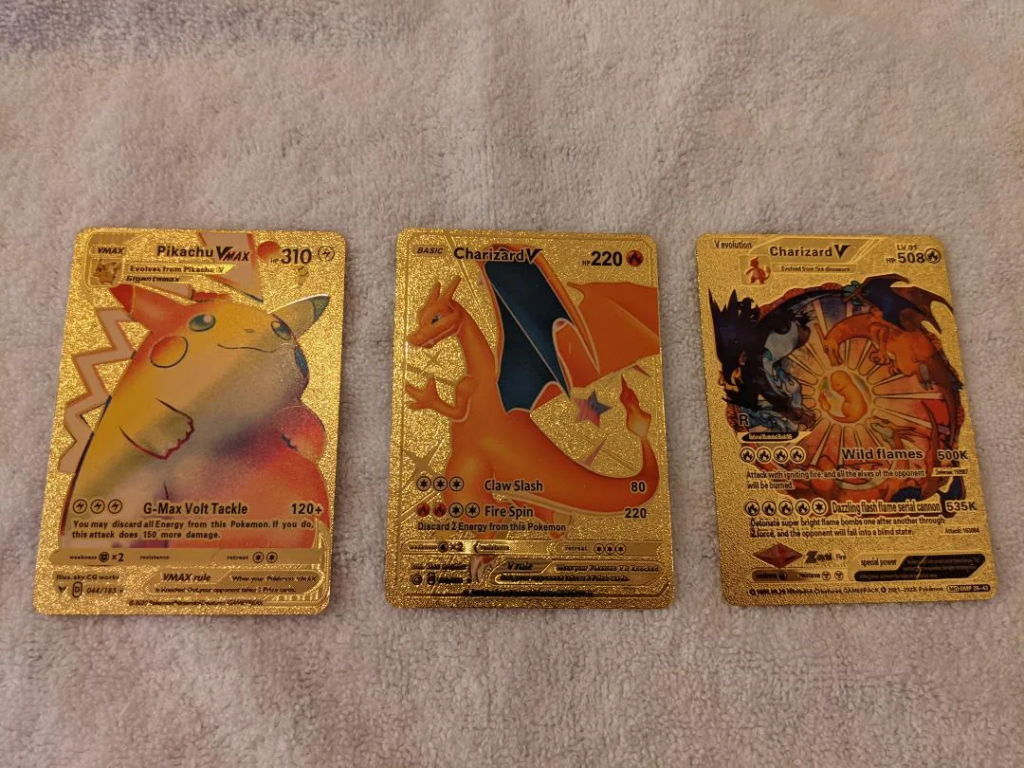
Caption: Kenji Misino says there are a few different ways to tell if cards are the real deal or not.
Credit: rahulabon in r/PokemonTCG via Reddit

Comparisons can be extremely useful too. When buying or trading cards, it’s a good idea to access databases such as the Pokemon.com official database or even a reputable community website like PkmnCards

The above gold cards feature on neither – another sign they’re fakes.

Let it rip

Kenji has one, somewhat frightening, example of detecting fakery. He was recently gifted a holographic Raichu from the base set of cards, first released in 1999. 

The most pristine copies of this card can sell for upwards of AU$3,000.

The weight of the card was much heavier than he was used to. He was fortunate to have another card to compare it to, detecting slight differences between the pair. 

So he conducted the most brutal of all counterfeiting detection techniques the Rip Test.

Tearing the card in two, he discovered with relief, proved it was a fake. True Pokémon cards have specific cardboard layering. The Rip Test showed this Raichu did not. Even so, he recommends it only as a very last resort.

2.B.A Counterfeit Master

There’s no absolute method to determine a card’s legitimacy prior to purchasing, especially if you’re trading and selling online, says Kenji. 

There are even instances where graded cards – those sealed in a validated enclosure – have been carefully extracted from their enclosure and replaced. 

“Our advice is to always inspect the cards you’d like to purchase in person and ask for second opinions if you’re unsure,” says Kenji.

“The community, both at physical events and in various online groups, has an invested interest in keeping the good eggs from leaving the hobby and ousting those with bad intentions. 

“Their insight can be quite helpful in preventing scams from occurring.”

 

Jackson Ryan
About the author
Jackson Ryan
Jackson Ryan is an award-winning freelance science journalist and President of the Science Journalists Association of Australia. He is co-editor of the 2024 Best Australian Science Writing Anthology, which you should absolutely buy.
View articles
Jackson Ryan is an award-winning freelance science journalist and President of the Science Journalists Association of Australia. He is co-editor of the 2024 Best Australian Science Writing Anthology, which you should absolutely buy.
View articles

NEXT ARTICLE

We've got chemistry, let's take it to the next level!

Get the latest WA science news delivered to your inbox, every fortnight.

This field is for validation purposes and should be left unchanged.

Republish

Creative Commons Logo

Republishing our content

We want our stories to be shared and seen by as many people as possible.

Therefore, unless it says otherwise, copyright on the stories on Particle belongs to Scitech and they are published under a Creative Commons Attribution-NoDerivatives 4.0 International License.

This allows you to republish our articles online or in print for free. You just need to credit us and link to us, and you can’t edit our material or sell it separately.

Using the ‘republish’ button on our website is the easiest way to meet our guidelines.

Guidelines

You cannot edit the article.

When republishing, you have to credit our authors, ideally in the byline. You have to credit Particle with a link back to the original publication on Particle.

If you’re republishing online, you must use our pageview counter, link to us and include links from our story. Our page view counter is a small pixel-ping (invisible to the eye) that allows us to know when our content is republished. It’s a condition of our guidelines that you include our counter. If you use the ‘republish’ then you’ll capture our page counter.

If you’re republishing in print, please email us to let us so we know about it (we get very proud to see our work republished) and you must include the Particle logo next to the credits. Download logo here.

If you wish to republish all our stories, please contact us directly to discuss this opportunity.

Images

Most of the images used on Particle are copyright of the photographer who made them.

It is your responsibility to confirm that you’re licensed to republish images in our articles.

Video

All Particle videos can be accessed through YouTube under the Standard YouTube Licence.

The Standard YouTube licence

  1. This licence is ‘All Rights Reserved’, granting provisions for YouTube to display the content, and YouTube’s visitors to stream the content. This means that the content may be streamed from YouTube but specifically forbids downloading, adaptation, and redistribution, except where otherwise licensed. When uploading your content to YouTube it will automatically use the Standard YouTube licence. You can check this by clicking on Advanced Settings and looking at the dropdown box ‘License and rights ownership’.
  2. When a user is uploading a video he has license options that he can choose from. The first option is “standard YouTube License” which means that you grant the broadcasting rights to YouTube. This essentially means that your video can only be accessed from YouTube for watching purpose and cannot be reproduced or distributed in any other form without your consent.

Contact

For more information about using our content, email us: particle@scitech.org.au

Copy this HTML into your CMS
Press Ctrl+C to copy