


READ

Particle 101: Taste Buds

From flavour explosions to muted meals – why our taste changes as we age.
Libby Klopper
Libby Klopper
Freelance Writer
Particle 101: Taste Buds

Ever bitten into a hot pie, yelped “Hothothot!” then had your taste buds go on strike for the next week? Taste buds are a sensitive bunch. 

Taste buds are clusters of tiny sensory cells. They detect the five basic tastes: sweet, salty, sour, bitter and umami. 

The visible bumps on your tongue, called papillae, house between 2,000 and 10,000 taste buds. 

Each taste bud is made up of 10–50 specialised taste receptor cells that regenerate every 10–14 days.

This ensures your sense of taste is always in top form. But how do we actually ‘taste’?

The flavour journey

Chewing and saliva break down the chemicals in food. These chemical messages are detected by taste receptors and transported to your brain.

The experience of taste is very much a team effort. 

It involves smell receptors, texture sensing, temperature and mouth feel. 

This is why a blocked nose dramatically dulls your sense of taste.
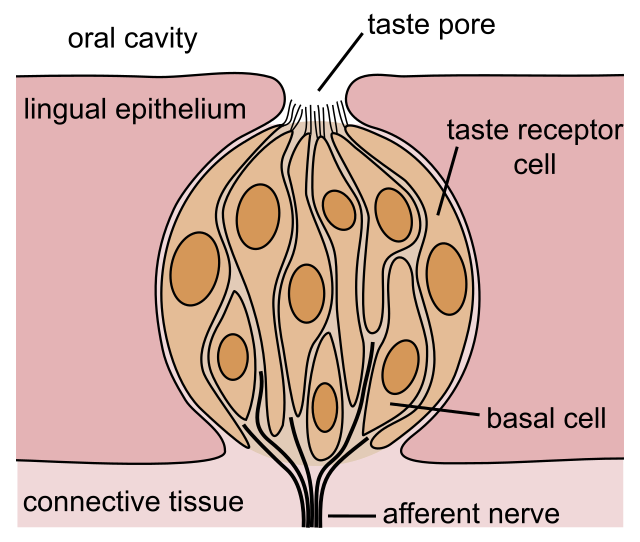
Caption: Illustration of the anatomy of a taste bud.
Credit: NEUROtiker/Wikimedia Commons CC-BY-SA-3.0

The bitter truth

It was once believed that different regions of the tongue detected specific tastes. 

Now, research shows all tastes can be sensed across the tongue. Except bitter receptors – they’re particularly concentrated at the back of the tongue. 

This heightened sensitivity likely evolved as a defence against ingesting something that might kill you. 

Not what they used to be

Our sense of taste evolves over time. Taste is most intense in childhood.

We’re born with around 10,000 taste buds, which is why kids often find bold or bitter foods overwhelming. If you hated olives when you were younger but now can’t get enough of them, you’re not alone. 

As we get older, our taste buds become less sensitive and die off, making strong or bitter flavours more enjoyable.

But it’s not just age that changes how we taste. Medication, illness, stress, diabetes and hormonal changes, including pregnancy, can all mess with your sense of taste.

Burnt tongues and broken buds

While uncomfortable, burning your tongue won’t permanently damage your taste buds. 

Caption: Burning your tongue doesn’t kill your taste buds, just like a minor burn doesn’t kill your skin.
Credit: Vladimir Floyd/Getty Images

However, chronic factors such as smoking, drug use, poor oral hygiene or infections can cause lasting impairment, permanently altering taste perception.

So the next time you’re too impatient to let your pie cool down, think about your taste buds and maybe blow on it.


Libby Klopper
About the author
Libby Klopper
Libby is a freelance writer with a background in zoology and conservation biology. When not working in the Pilbara, she enjoys in depth research sessions and travelling.
View articles
Libby is a freelance writer with a background in zoology and conservation biology. When not working in the Pilbara, she enjoys in depth research sessions and travelling.
View articles

NEXT ARTICLE

We've got chemistry, let's take it to the next level!

Get the latest WA science news delivered to your inbox, every fortnight.

This field is for validation purposes and should be left unchanged.

Republish

Creative Commons Logo

Republishing our content

We want our stories to be shared and seen by as many people as possible.

Therefore, unless it says otherwise, copyright on the stories on Particle belongs to Scitech and they are published under a Creative Commons Attribution-NoDerivatives 4.0 International License.

This allows you to republish our articles online or in print for free. You just need to credit us and link to us, and you can’t edit our material or sell it separately.

Using the ‘republish’ button on our website is the easiest way to meet our guidelines.

Guidelines

You cannot edit the article.

When republishing, you have to credit our authors, ideally in the byline. You have to credit Particle with a link back to the original publication on Particle.

If you’re republishing online, you must use our pageview counter, link to us and include links from our story. Our page view counter is a small pixel-ping (invisible to the eye) that allows us to know when our content is republished. It’s a condition of our guidelines that you include our counter. If you use the ‘republish’ then you’ll capture our page counter.

If you’re republishing in print, please email us to let us so we know about it (we get very proud to see our work republished) and you must include the Particle logo next to the credits. Download logo here.

If you wish to republish all our stories, please contact us directly to discuss this opportunity.

Images

Most of the images used on Particle are copyright of the photographer who made them.

It is your responsibility to confirm that you’re licensed to republish images in our articles.

Video

All Particle videos can be accessed through YouTube under the Standard YouTube Licence.

The Standard YouTube licence

  1. This licence is ‘All Rights Reserved’, granting provisions for YouTube to display the content, and YouTube’s visitors to stream the content. This means that the content may be streamed from YouTube but specifically forbids downloading, adaptation, and redistribution, except where otherwise licensed. When uploading your content to YouTube it will automatically use the Standard YouTube licence. You can check this by clicking on Advanced Settings and looking at the dropdown box ‘License and rights ownership’.
  2. When a user is uploading a video he has license options that he can choose from. The first option is “standard YouTube License” which means that you grant the broadcasting rights to YouTube. This essentially means that your video can only be accessed from YouTube for watching purpose and cannot be reproduced or distributed in any other form without your consent.

Contact

For more information about using our content, email us: particle@scitech.org.au

Copy this HTML into your CMS
Press Ctrl+C to copy