

READ

Particle 101: Off-Grid Living

The benefits of a low-impact lifestyle.
Dennis Power
Dennis Power
Freelance Writer
Particle 101: Off-Grid Living

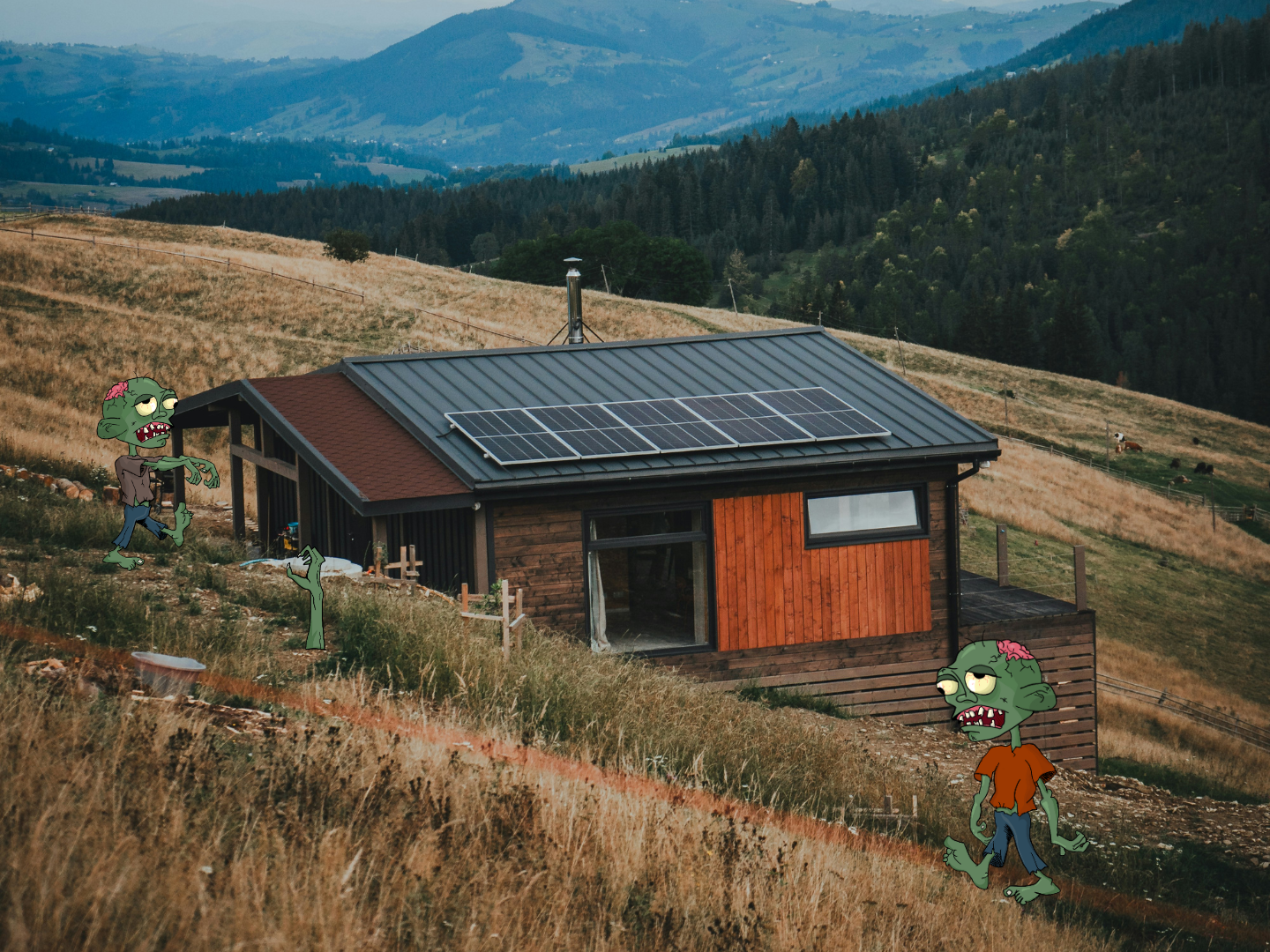
In the event of a zombie apocalypse, going off-grid can be the answer to survival. You’ll need to build a life non-reliant on mains power, water and deep sewerage.

Forget the Bear Grylls Survival Kit – your home can become your greatest asset.

It may sound idyllic: a homestead in the bush, veggie patch out the front and frolicking naked among nature. But living off-grid requires some serious planning and problem solving.

Power and waste management, water collection and purification, and heating and cooling are just a few barriers on the road to survival.

GOTTA CATCH THEM RAYS

Harnessing the power of the Sun with solar panels is the tried-and-true method for meeting off-grid electricity demand in Australia.

Provided the Sun doesn’t get blocked out by nuclear fallout (wrong apocalypse), abundant sunshine can keep batteries nicely charged.

Caption: Batteries, baby!
Credit: Nischaporn/stock.adobe.com

It’s critical to closely monitor your power consumption during the winter months when there’s less sunlight.

Alas, just say goodbye to your zombie-proof electric fence.

FRESH WATER FROM THE SKY

Survival is thirsty work, so you’ll need plenty of rainwater. Collect it straight off the roof and it’s good to drink, provided your roof isn’t dirty.

It’d be wise to also have a dam – kind of like a battery but for water.

That way, you can still get a drink during a drought. However, it will need to be purified.

Drinking unclean water can be dangerous, so you’ll need to remove any unwanted nasties, using particle and UV lamp filters.

BE COOL, STAY HOT

Many off-grid homes take advantage of the natural environment to achieve climate control.

Construct your shelter using insulative materials facing north to the Sun and you’ll achieve passive heating and cooling.

Caption: The direction of your shelter and solar panels is crucial.
Credit: Carl Attard – Public domain CC0

Now you have power, water and climate control, what about dealing with your waste?

A composting toilet is a great alternative to deep sewerage.

In its simplest form, it’s a bucket with sawdust but they can get far more advanced with urine separators and exhaust fans. Apocalyptic luxury!

If your toilet is outdoors, the classic ‘Aussie bush loo’ or long drop works too – just make sure it’s nowhere near your water supply.

BE PREPARED

You don’t have to be facing a zombie apocalypse to go off-grid.

Plenty of people have disconnected their homes in the suburbs to be self-sufficient and lower their environmental impact and utility bills.


Dennis Power
About the author
Dennis Power
They say that curiosity killed the cat, but Dennis knows satisfaction brought it back. Obsessed with asking questions, getting answers, and learning new facts to share with anyone who will listen, science journalism was his logical destination. Dennis loves synthetic chemistry and is a regular contributor to the Chemistry in Australia magazine. He is also the science editor for The Metamorphosis Project Journal. After four years of his PhD he decided he’d rather not handle nasty chemicals every day and built a tiny house on wheels instead.
View articles
They say that curiosity killed the cat, but Dennis knows satisfaction brought it back. Obsessed with asking questions, getting answers, and learning new facts to share with anyone who will listen, science journalism was his logical destination. Dennis loves synthetic chemistry and is a regular contributor to the Chemistry in Australia magazine. He is also the science editor for The Metamorphosis Project Journal. After four years of his PhD he decided he’d rather not handle nasty chemicals every day and built a tiny house on wheels instead.
View articles

NEXT ARTICLE

We've got chemistry, let's take it to the next level!

Get the latest WA science news delivered to your inbox, every fortnight.

This field is for validation purposes and should be left unchanged.

Republish

Creative Commons Logo

Republishing our content

We want our stories to be shared and seen by as many people as possible.

Therefore, unless it says otherwise, copyright on the stories on Particle belongs to Scitech and they are published under a Creative Commons Attribution-NoDerivatives 4.0 International License.

This allows you to republish our articles online or in print for free. You just need to credit us and link to us, and you can’t edit our material or sell it separately.

Using the ‘republish’ button on our website is the easiest way to meet our guidelines.

Guidelines

You cannot edit the article.

When republishing, you have to credit our authors, ideally in the byline. You have to credit Particle with a link back to the original publication on Particle.

If you’re republishing online, you must use our pageview counter, link to us and include links from our story. Our page view counter is a small pixel-ping (invisible to the eye) that allows us to know when our content is republished. It’s a condition of our guidelines that you include our counter. If you use the ‘republish’ then you’ll capture our page counter.

If you’re republishing in print, please email us to let us so we know about it (we get very proud to see our work republished) and you must include the Particle logo next to the credits. Download logo here.

If you wish to republish all our stories, please contact us directly to discuss this opportunity.

Images

Most of the images used on Particle are copyright of the photographer who made them.

It is your responsibility to confirm that you’re licensed to republish images in our articles.

Video

All Particle videos can be accessed through YouTube under the Standard YouTube Licence.

The Standard YouTube licence

  1. This licence is ‘All Rights Reserved’, granting provisions for YouTube to display the content, and YouTube’s visitors to stream the content. This means that the content may be streamed from YouTube but specifically forbids downloading, adaptation, and redistribution, except where otherwise licensed. When uploading your content to YouTube it will automatically use the Standard YouTube licence. You can check this by clicking on Advanced Settings and looking at the dropdown box ‘License and rights ownership’.
  2. When a user is uploading a video he has license options that he can choose from. The first option is “standard YouTube License” which means that you grant the broadcasting rights to YouTube. This essentially means that your video can only be accessed from YouTube for watching purpose and cannot be reproduced or distributed in any other form without your consent.

Contact

For more information about using our content, email us: particle@scitech.org.au

Copy this HTML into your CMS
Press Ctrl+C to copy