

READ

DR JESSICA KRETZMANN IS MAKING DNA ORIGAMI

A young research scientist at UWA is changing how we approach gene therapy.
Cat Williams
Cat Williams
Freelance Writer
DR JESSICA KRETZMANN IS MAKING DNA ORIGAMI

Growing up, Jessica Kretzmann didn’t expect to become a scientist. 

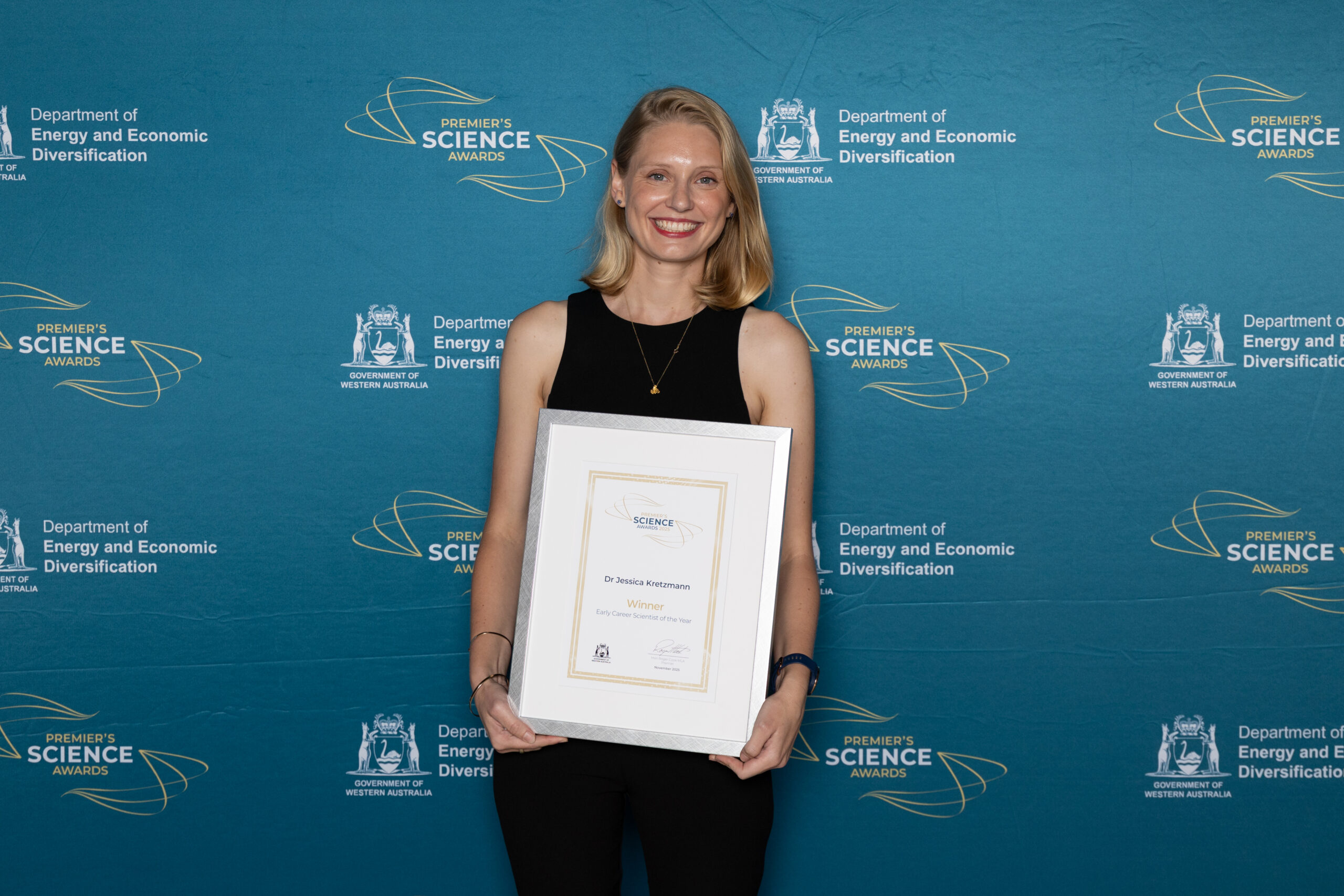
She certainly didn’t expect to be honoured as the Early Career Scientist of the Year at the recent Premier’s Science Awards. 

“I’m speechless about it to be honest,” says Jessica. 

“It’s a bit mind-blowing.”

CONNECTING THE DOTS

Jessica grew up in Karratha.

“We didn’t really have much of a science program, especially in primary school,” says Jessica.

But a few pivotal moments shaped how she thought about science – including a visit from Scitech. 

“You’re sitting there, 300 people in an undercover area, and it’s hot and there’s flies,” says Jessica.

“But you’re totally enamoured by liquid nitrogen which hasn’t evaporated yet.”

After moving to Perth for high school, Jessica realised all her interests led to science. 

“From there, I started connecting the dots a little bit more,” she says. 
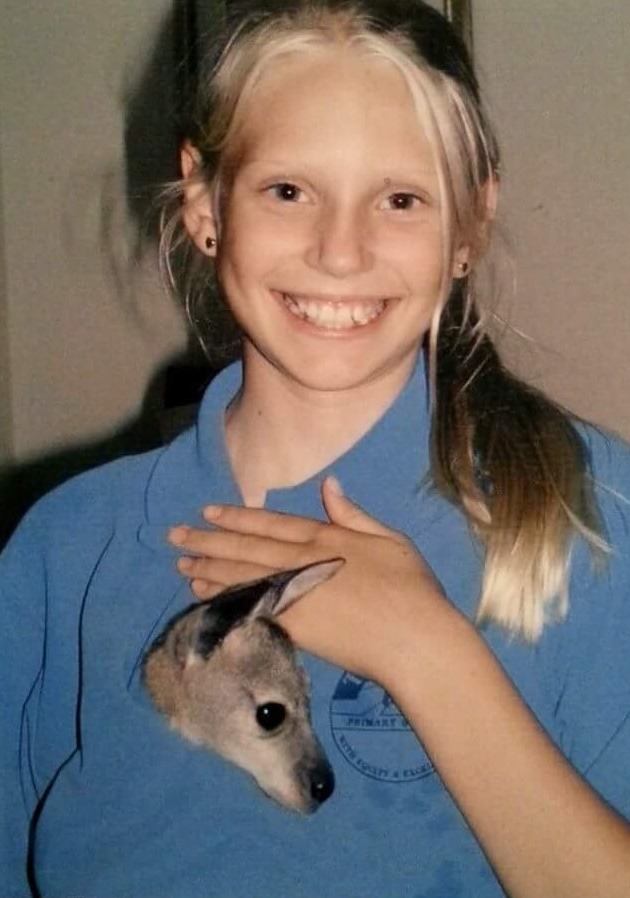
Caption: Jessica’s family has always loved the outdoors, and even raised a kangaroo joey they rescued from the side of the road.
Credit: Supplied Jessica Kretzmann

CHECK(POINT) IT OUT

Now, Jessica is using nanotechnology to better understand how we can deliver gene therapies. 

Gene therapy is a type of medical treatment for genetic disorders – including cancers, multiple sclerosis or blood diseases.

It involves delivering altered or edited genes into someone’s body. 

“There’s potential to completely revolutionise the way that we treat diseases or cure them or even prevent them,” says Jessica. 

“My research has been looking at ways to deliver gene therapeutics.

“One of the very difficult things to do is deliver it safely and efficiently to cells.”

Jessica says this is because “your cells have evolved to try and resist something else giving it genetic instructions”.

This means gene therapies must bypass the cell’s security checkpoint and avoid detection by your immune system.

They also need to be targeted. If a gene therapy is helping someone with a blood disorder, it’s not much use if it ends up in their hair cells. 

“We need to understand those cellular checkpoints and understand how we can design materials around them,” says Jessica.

DNA ORIGAMI

Researchers are trying various ways to get gene therapies past cell checkpoints. 

There are CAR T-cell therapies, which Jessica says “reprogram your T cells” to launch an immune response. 

“The mRNA COVID-19 vaccine was [another] way of doing gene delivery,” she says. 

But Jessica is working on another method: DNA origami

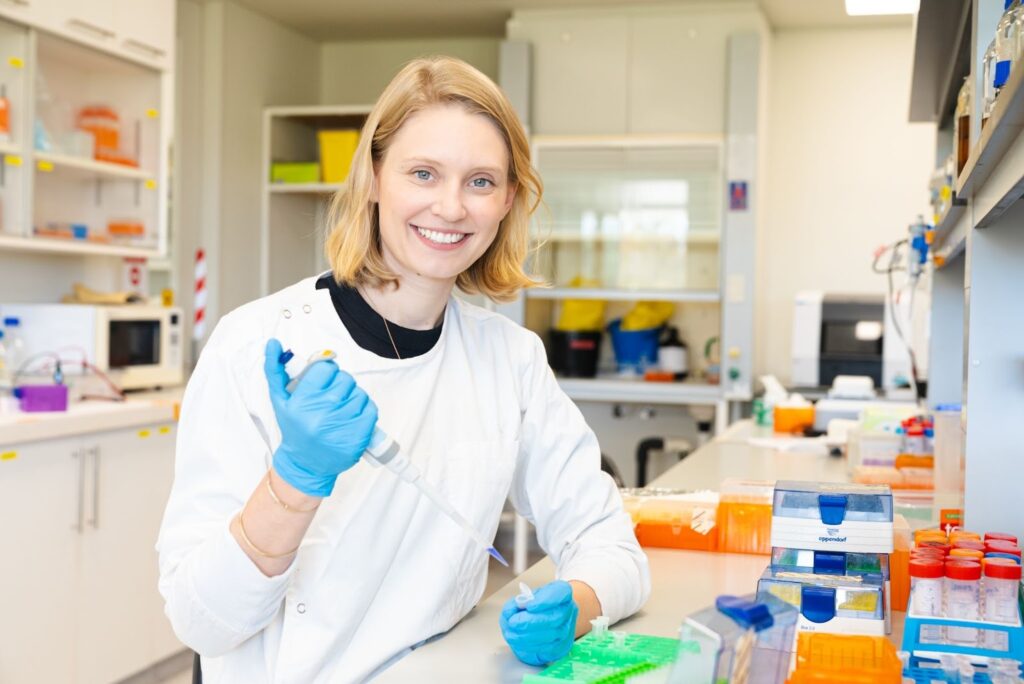
Caption: Jessica in her lab. 
Credit: Supplied Jessica Kretzmann

“DNA origami is a technique or tool where you take any piece of synthetic known DNA and fold it into any two- or three-dimensional shape,” she says.

Researchers have tested the potential of DNA origami to make useful and interesting shapes, but the DNA couldn’t be read or interpreted by a cell.

In Jessica’s groundbreaking research, she was able to encode a gene into her origami structure that could deliver a readable message to a cell.

“You have his intricate folded 3D structure … and gene therapy in one, so you don’t need any extra carrier,” she says.

Like a peach, a DNA origami gene therapy comes with its own perfect packaging.

WE’RE JUST GETTING STARTED

As WA’s leading expert on DNA origami, Jessica is expanding her team.

“This year, I’ve had my first PhD students,” says Jessica proudly.

She’s currently working with three PhD students and, “at any one stage, two or three master’s students”. 

“When you do an experiment for a moment you’re the first person in the world to know that result.”

Jessica loves to “see [her students] have these moments and get really excited.” 

In the future, she would love to see more people using DNA origami as a tool in their own research. 

“There is a huge benefit [in gene therapy],” says Jessica. 

“But we haven’t reached its full potential.”

Cat Williams
About the author
Cat Williams
Cat is a freelance science writer and communicator. Her work has been featured in publications including Cosmos Magazine, the Griffith Review and The Saturday Paper. When not at her writing desk, Cat enjoys travelling and patting every single dog that enters her periphery.
View articles
Cat is a freelance science writer and communicator. Her work has been featured in publications including Cosmos Magazine, the Griffith Review and The Saturday Paper. When not at her writing desk, Cat enjoys travelling and patting every single dog that enters her periphery.
View articles

NEXT ARTICLE

We've got chemistry, let's take it to the next level!

Get the latest WA science news delivered to your inbox, every fortnight.

This field is for validation purposes and should be left unchanged.

Republish

Creative Commons Logo

Republishing our content

We want our stories to be shared and seen by as many people as possible.

Therefore, unless it says otherwise, copyright on the stories on Particle belongs to Scitech and they are published under a Creative Commons Attribution-NoDerivatives 4.0 International License.

This allows you to republish our articles online or in print for free. You just need to credit us and link to us, and you can’t edit our material or sell it separately.

Using the ‘republish’ button on our website is the easiest way to meet our guidelines.

Guidelines

You cannot edit the article.

When republishing, you have to credit our authors, ideally in the byline. You have to credit Particle with a link back to the original publication on Particle.

If you’re republishing online, you must use our pageview counter, link to us and include links from our story. Our page view counter is a small pixel-ping (invisible to the eye) that allows us to know when our content is republished. It’s a condition of our guidelines that you include our counter. If you use the ‘republish’ then you’ll capture our page counter.

If you’re republishing in print, please email us to let us so we know about it (we get very proud to see our work republished) and you must include the Particle logo next to the credits. Download logo here.

If you wish to republish all our stories, please contact us directly to discuss this opportunity.

Images

Most of the images used on Particle are copyright of the photographer who made them.

It is your responsibility to confirm that you’re licensed to republish images in our articles.

Video

All Particle videos can be accessed through YouTube under the Standard YouTube Licence.

The Standard YouTube licence

  1. This licence is ‘All Rights Reserved’, granting provisions for YouTube to display the content, and YouTube’s visitors to stream the content. This means that the content may be streamed from YouTube but specifically forbids downloading, adaptation, and redistribution, except where otherwise licensed. When uploading your content to YouTube it will automatically use the Standard YouTube licence. You can check this by clicking on Advanced Settings and looking at the dropdown box ‘License and rights ownership’.
  2. When a user is uploading a video he has license options that he can choose from. The first option is “standard YouTube License” which means that you grant the broadcasting rights to YouTube. This essentially means that your video can only be accessed from YouTube for watching purpose and cannot be reproduced or distributed in any other form without your consent.

Contact

For more information about using our content, email us: particle@scitech.org.au

Copy this HTML into your CMS
Press Ctrl+C to copy