


READ

Science says size really does matter

A big penis is evolutionarily advantageous.
Cat Williams
Cat Williams
Freelance Writer
Science says size really does matter

Since the dawn of the fragile male ego, a simple phrase was born alongside it – ‘size doesn’t matter’.

But this may be untrue.

A new study from UWA has found that penis size does matter, with females rating larger penises as more attractive and males considering men with larger penises more intimidating or sexually competitive. 

So why does it matter and what sort of an experiment can tell us this?

DAR-WINNERS AND LOSERS

Before we get into how the experiment was conducted, it’s important to understand why this research was done in the first place – and it’s all to do with evolution. 

Evolution has ensured that our bodies are built to survive and outlast. We have colour vision to detect visual threats and opposable thumbs to hold things. 

But compared to other primates, humans have a big penis to body size ratio, which made evolutionary biologists curious.

Caption: Compared to other primates such as the chimpanzee, humans have the largest penis to body size ratio.
Credit: Dan Kitwood/Getty Images

Sexual selection has been a leading theory. But given some ethical research boundaries and enormous variety in human bodies, coming up with an experimental design to test this idea wasn’t easy. 

BIG D*CK ENERGY

To overcome what researchers call ‘natural covariation among traits’ (otherwise known as ‘no two penises are the same’), they computer-generated images of males. Then they manipulated penis size, height and body shape. 

343 images were shown to over 800 heterosexual study participants, who rated the figures based on one of three questions. 

Females were asked to rate how sexually attractive the figure was. Males were asked to rate how jealous they would feel if the figure was talking to their partner or how threatened they would feel if the figure picked a fight with them. 

For all questions, figures that were taller and had a V-shaped body and large penis were selected.
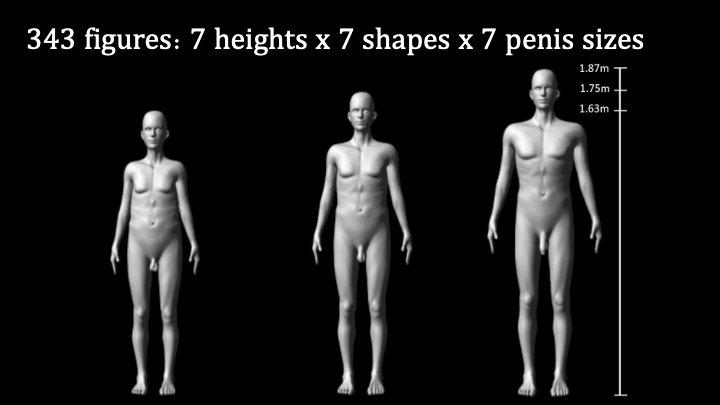
Caption: Figures with varying height, penis size and body shape were tested in this study.
Credit: Aich et al., 2025, PLOS Biology

This research finds that both female choice and competition between males is a strong theory for humans having large penises compared to other primates. 

A PEACOCK EQUIVALENT

While it seems an odd thing to study, understanding what drives human evolution has fascinated us for years. 

While the main function of a penis is sperm transfer, it appears our ancestors needed a larger penis to attract a female mate. A large penis in humans is apparently the peacock equivalent of a massive, feathered tail. 

For anyone with a penis who might be feeling a little blue after reading this, just remember, we wear clothes now.

Cat Williams
About the author
Cat Williams
Cat is a freelance science writer and communicator. Her work has been featured in publications including Cosmos Magazine, the Griffith Review and The Saturday Paper. When not at her writing desk, Cat enjoys travelling and patting every single dog that enters her periphery.
View articles
Cat is a freelance science writer and communicator. Her work has been featured in publications including Cosmos Magazine, the Griffith Review and The Saturday Paper. When not at her writing desk, Cat enjoys travelling and patting every single dog that enters her periphery.
View articles

NEXT ARTICLE

We've got chemistry, let's take it to the next level!

Get the latest WA science news delivered to your inbox, every fortnight.

This field is for validation purposes and should be left unchanged.

Republish

Creative Commons Logo

Republishing our content

We want our stories to be shared and seen by as many people as possible.

Therefore, unless it says otherwise, copyright on the stories on Particle belongs to Scitech and they are published under a Creative Commons Attribution-NoDerivatives 4.0 International License.

This allows you to republish our articles online or in print for free. You just need to credit us and link to us, and you can’t edit our material or sell it separately.

Using the ‘republish’ button on our website is the easiest way to meet our guidelines.

Guidelines

You cannot edit the article.

When republishing, you have to credit our authors, ideally in the byline. You have to credit Particle with a link back to the original publication on Particle.

If you’re republishing online, you must use our pageview counter, link to us and include links from our story. Our page view counter is a small pixel-ping (invisible to the eye) that allows us to know when our content is republished. It’s a condition of our guidelines that you include our counter. If you use the ‘republish’ then you’ll capture our page counter.

If you’re republishing in print, please email us to let us so we know about it (we get very proud to see our work republished) and you must include the Particle logo next to the credits. Download logo here.

If you wish to republish all our stories, please contact us directly to discuss this opportunity.

Images

Most of the images used on Particle are copyright of the photographer who made them.

It is your responsibility to confirm that you’re licensed to republish images in our articles.

Video

All Particle videos can be accessed through YouTube under the Standard YouTube Licence.

The Standard YouTube licence

  1. This licence is ‘All Rights Reserved’, granting provisions for YouTube to display the content, and YouTube’s visitors to stream the content. This means that the content may be streamed from YouTube but specifically forbids downloading, adaptation, and redistribution, except where otherwise licensed. When uploading your content to YouTube it will automatically use the Standard YouTube licence. You can check this by clicking on Advanced Settings and looking at the dropdown box ‘License and rights ownership’.
  2. When a user is uploading a video he has license options that he can choose from. The first option is “standard YouTube License” which means that you grant the broadcasting rights to YouTube. This essentially means that your video can only be accessed from YouTube for watching purpose and cannot be reproduced or distributed in any other form without your consent.

Contact

For more information about using our content, email us: particle@scitech.org.au

Copy this HTML into your CMS
Press Ctrl+C to copy