


READ

PARTICLE 101: BLOOD TYPES

They are more than just a label.
Dr Laura Masters
Dr Laura Masters
PARTICLE 101: BLOOD TYPES

A single drop of blood contains thousands of white blood cells, millions of platelets and many millions of red blood cells.

These cells make up about 45% of your blood. The remaining content is a substance called plasma.

But it’s your red blood cells that determine your blood type. 

WHAT’S YOUR TYPE?

There are eight main blood types: A+, A-, B+, B-, AB+, AB-, O+ and O-. 

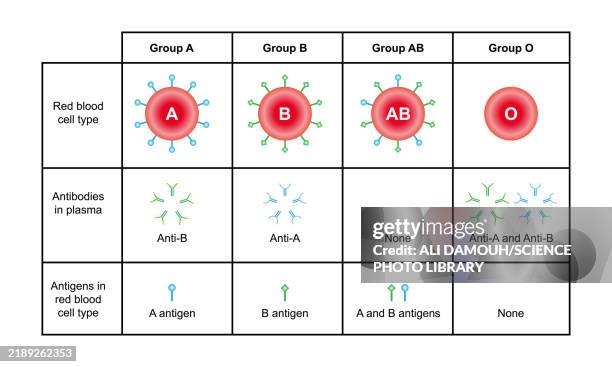
Red blood cells have molecules called antigens on their cell surface. The most well-known blood types are determined by the A, B and Rh factor D antigen (the + or – next to your letter).  

A person’s red blood cells can have A antigens, B antigens, both A and B antigens or neither!

If your red blood cells have the D antigen on them, you’re assigned the + symbol. If you don’t, your blood type will end in the – symbol. 
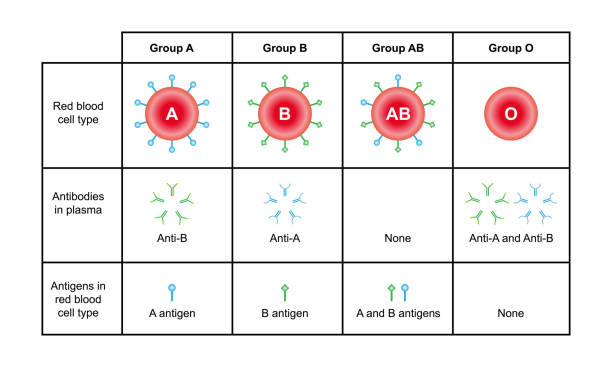
Caption: Different antigens present on your red blood cells help determine your blood type.
Credit: Ali Damouh/Science Photo Library/Getty Images

ANTIGEN ALERT!

White blood cells are another type of cell present in your blood. While there are only around 10,000 of these in a single drop of blood, they pack a punch!

White blood cells are part of your immune system. They keep you safe from the invaders that could make you sick. 

White blood cells can see antigens on these invading pathogens and make antibodies to neutralise the threat. The trouble is that, to a white blood cell, any foreign antigen looks threatening. 

While white blood cells won’t make antibodies against the antigens on your own red blood cells, they will make antibodies against the other red blood cell antigens.

For example, white blood cells in a person with B blood type won’t fight B antigens, but they will fight A antigens.

This is why blood transfusions and blood donations are so carefully managed. If you receive the wrong type, your white blood cell antibodies will target those donor red blood cells for destruction. A disaster!

A DIFFERENT INHERITANCE

Your blood type is inherited from your parents – one set of genes from each. Because of this, the most common blood type varies by population.

If you’re one of the 7% of Aussies who have O- blood, you are pretty special! Your red blood cells can be donated to anyone because there are no antigens on your red blood cells, so it won’t react badly with the recipient’s own blood.  
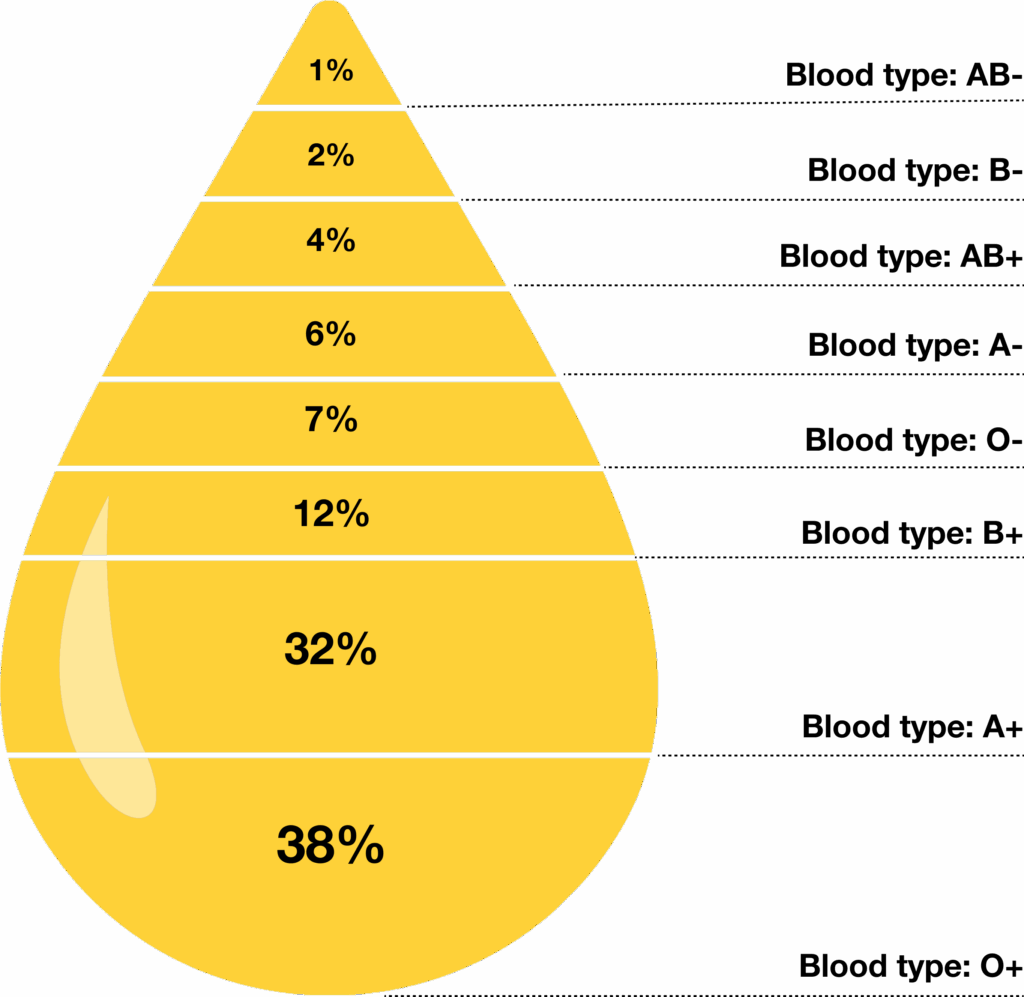
Caption: The proportion of different blood types in Australia is heavily skewed toward O+ and A+.
Credit: Drew Kendell

The good news is that Australians are generous with their blood, no matter their type.

Each year, Lifeblood collects around 1.6 million blood donations – that’s equivalent to over 750,000 litres.

But while nearly 60% of us are eligible to donate blood, only 3% do. 

If you like the idea of rolling up your sleeve and becoming a lifesaver, consider becoming a blood donor.


Dr Laura Masters
About the author
Dr Laura Masters
Laura is research microbiologist with an interest in viruses, particularly those that are important in pregnancy and early life. She's always been fascinated by science, and willing to share her passion with anyone who will listen.
View articles
Laura is research microbiologist with an interest in viruses, particularly those that are important in pregnancy and early life. She's always been fascinated by science, and willing to share her passion with anyone who will listen.
View articles

NEXT ARTICLE

We've got chemistry, let's take it to the next level!

Get the latest WA science news delivered to your inbox, every fortnight.

This field is for validation purposes and should be left unchanged.

Republish

Creative Commons Logo

Republishing our content

We want our stories to be shared and seen by as many people as possible.

Therefore, unless it says otherwise, copyright on the stories on Particle belongs to Scitech and they are published under a Creative Commons Attribution-NoDerivatives 4.0 International License.

This allows you to republish our articles online or in print for free. You just need to credit us and link to us, and you can’t edit our material or sell it separately.

Using the ‘republish’ button on our website is the easiest way to meet our guidelines.

Guidelines

You cannot edit the article.

When republishing, you have to credit our authors, ideally in the byline. You have to credit Particle with a link back to the original publication on Particle.

If you’re republishing online, you must use our pageview counter, link to us and include links from our story. Our page view counter is a small pixel-ping (invisible to the eye) that allows us to know when our content is republished. It’s a condition of our guidelines that you include our counter. If you use the ‘republish’ then you’ll capture our page counter.

If you’re republishing in print, please email us to let us so we know about it (we get very proud to see our work republished) and you must include the Particle logo next to the credits. Download logo here.

If you wish to republish all our stories, please contact us directly to discuss this opportunity.

Images

Most of the images used on Particle are copyright of the photographer who made them.

It is your responsibility to confirm that you’re licensed to republish images in our articles.

Video

All Particle videos can be accessed through YouTube under the Standard YouTube Licence.

The Standard YouTube licence

  1. This licence is ‘All Rights Reserved’, granting provisions for YouTube to display the content, and YouTube’s visitors to stream the content. This means that the content may be streamed from YouTube but specifically forbids downloading, adaptation, and redistribution, except where otherwise licensed. When uploading your content to YouTube it will automatically use the Standard YouTube licence. You can check this by clicking on Advanced Settings and looking at the dropdown box ‘License and rights ownership’.
  2. When a user is uploading a video he has license options that he can choose from. The first option is “standard YouTube License” which means that you grant the broadcasting rights to YouTube. This essentially means that your video can only be accessed from YouTube for watching purpose and cannot be reproduced or distributed in any other form without your consent.

Contact

For more information about using our content, email us: particle@scitech.org.au

Copy this HTML into your CMS
Press Ctrl+C to copy