


You might be interested

The Casual Observer
April brings us into the season of Djeran, and finally the weather should start to cool. Orion and its neighbouring constellations are now dominating the northwestern sky in the evenings. The easy familiarity of this part of the sky makes for a great opportunity to practice looking for satellites.
To spot a satellite you need to be outside just after sunset. Face to the northwest and make a mental note of all the obvious stars in Orion and around there. Now wait a minute. And look again. Has something appeared that wasn’t there before? Is it moving silently and determinedly across the sky? Is it a steady solid light? Congratulations, you’ve spotted a satellite! On a clear night you should have no trouble spotting a satellite every few minutes.
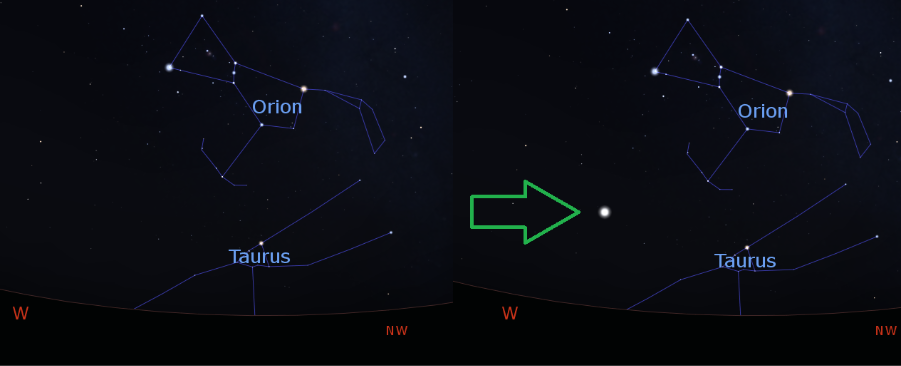
Credit: Stellarium, markup by Smith/Scitech.
April is a transitional time of the year, where you can go out in the early evenings and watch Orion set in the west, and turn around and watch Scorpius rise in the east, the hunter and the hunted forever chasing each other across the sky,
On the morning of 7 April, the Moon passes very close to Antares in the eastern sky. Sometimes the Moon passes directly in front of it, called an occultation, but this time is just a near miss.
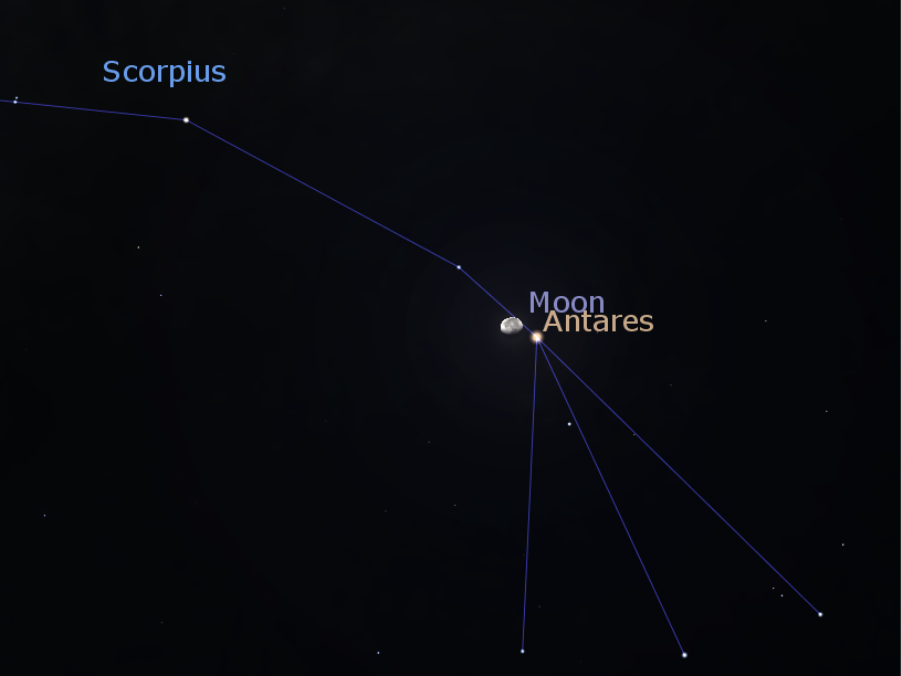
Credit: Stellarium
Venus has reappeared in the western sky just after sunset. Because of Venus’s awkward position on its orbit at the moment, it just kind of looms there low in the sky chasing the Sun over the horizon. In subsequent months it will get higher in the sky.
The morning of 16 April sees Mercury, Mars, Saturn and the Moon in the eastern sky before sunrise. (Note, you will need a telescope to see Neptune.) There’s a few days either side of this date where the planets are very close together in the sky, but the Moon is only here on this day.
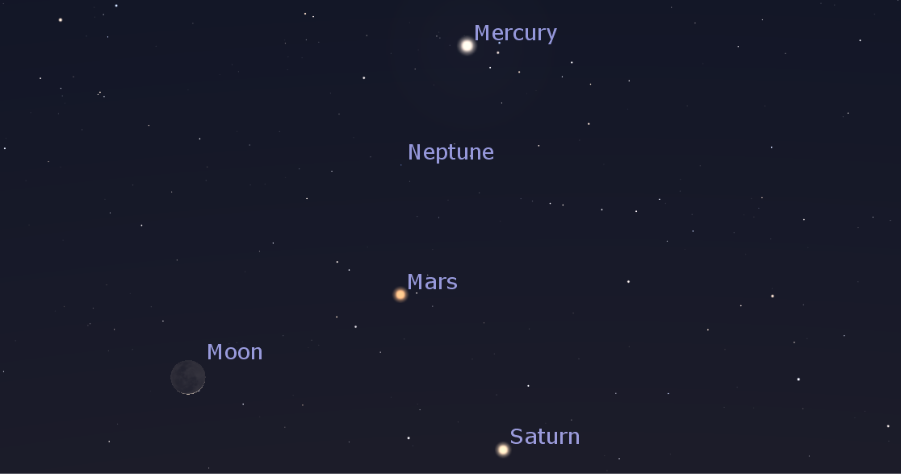
Credit: Stellarium
NASA will again try launching the Artemis II mission to the Moon, with several potential dates lined up for early April. Read more about it here.
There are two dates of symoblic importance this month. The International Day of Human Spaceflight takes place on 12 April, with 2026 commemorating 65 years since Yuri Gagarin became the first human to travel to space. Earth Day takes place on 22 April and is a symbolic birthday of sorts for Earth, with the purpose to raise awareness of environmental concerns and protections.
1 April holds a special place in the astronomical calendar, this year marking the 50th anniversary since astronomers figured out where the Sun goes at night.
ISS sightings from Perth
The International Space Station passes overhead multiple times a day. Most of these passes are too faint to see but a couple of notable sightings* are:
| Date, time | Appears | Max Height | Disappears | Magnitude | Duration |
| 5 April 05:35 AM | 10° above SW | 88° | 10° above NE | -3.8 | 6 min |
| 6 April 04:40 AM | 46° above SSE | 47° | 10° above ENE | -2.9 | 3.5 min |
Source: Heavens above, Spot the Station
*Note: These predictions are only accurate a few days in advance. Check the sources linked for more precise predictions on the day of your observations.
Moon phases
Full Moon: 2 April
Last Quarter: 10 April
New Moon: 17 April
First Quarter: 24 April
Dates of interest
1 April: 50th anniversary of discovering where the Sun goes at night
2 April: Potential launch of Artemis 2.
5 April: Long flyover of International Space Station
7 April: Moon near Antares
12 April: International Day of Human Spaceflight
16 April: Mercury, Mars, Saturn, Neptune and Moon in the eastern morning sky.
22 April: Earth Day
Planets to look for
Venus hugs the western horizon all month just after sunset and shares the evening sky with Jupiter. Technically Uranus is there too, but you’ll need a telescope to see it.
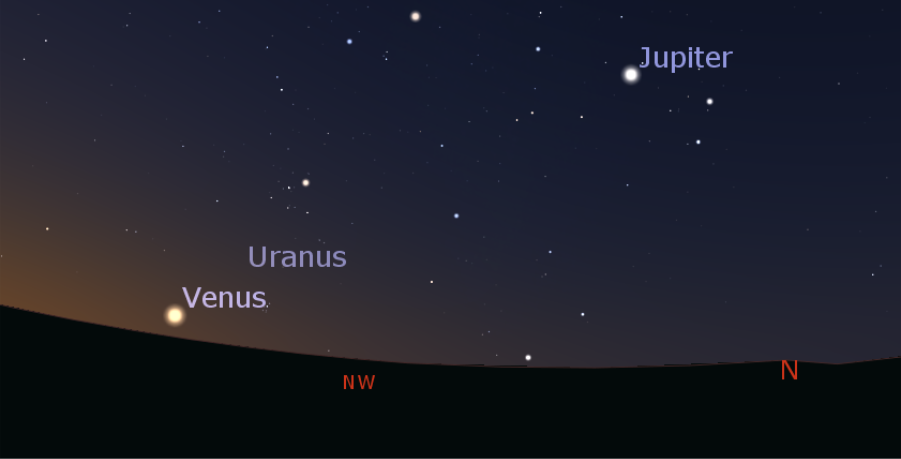
Credit: Stellarium
Meanwhile, on the other side of the sky and the opposite time of day, Mercury, Mars, Saturn and Neptune are visible in the east before sunrise. They’re closest together on 20-21 April, and the Moon joins them on 16 April, but any time around then is a good time to look. (Note, you can’t see Neptune without a telescope.)
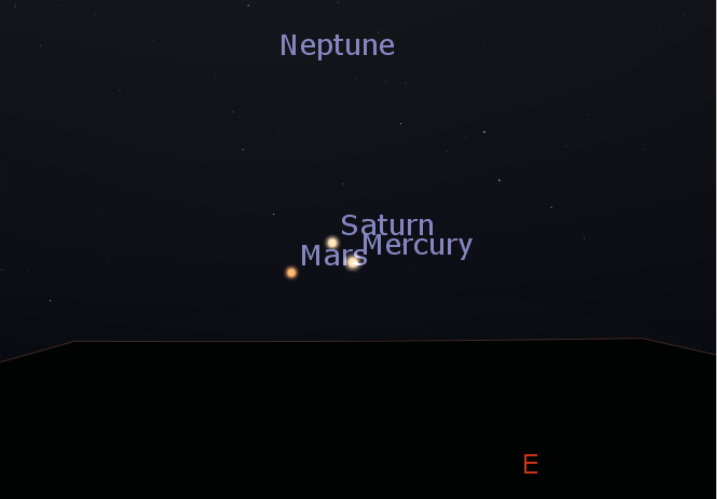
Credit: Stellarium
Constellation of the month
Libra the Scales
Libra is a medium sized constellation visible in the eastern sky during April evenings. A zodiacal constellation, the orbits of the planets and the Moon pass through this part of the sky, as does the apparent motion of the Sun.
Libra was originally associated with Scorpius, as an extension of the stinging arachnid in the form of its claws.
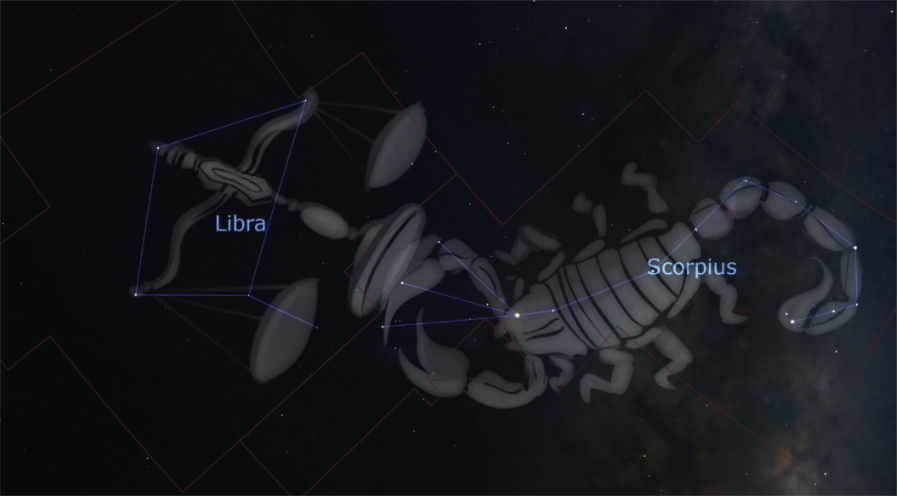
Credit: Stellarium
This association with Scorpius is manifest in the constellation’s three brightest stars Alpha Librae, Beta Librae and Gamma Librae, respectively known in Arabic as Zubenelgenubi (the Southern Claw), Zubeneschamali (the Northern Claw) and Zubenelhakrabi (the Scorpion’s Claw).
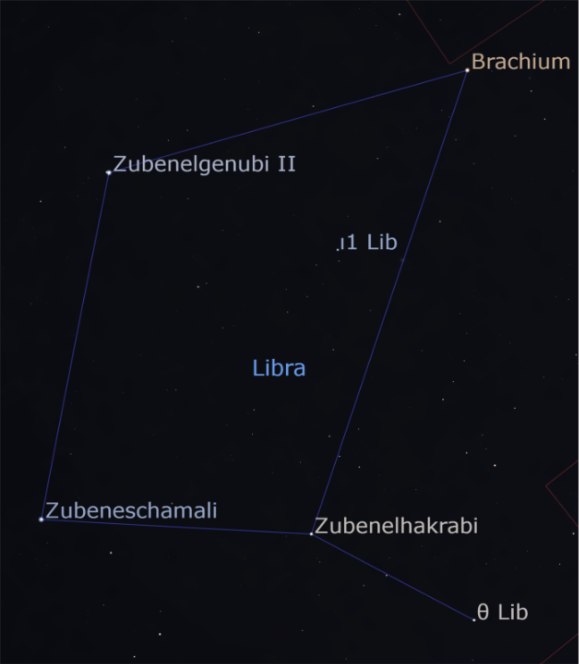
Credit: Stellarium
During the times of ancient Greece and Rome this pattern of stars was interpreted as the scales of Astraea, the goddess of justice. This interpretation as balancing scales is the one we are familiar with today.
Libra is home to the extensively studied exoplanet system Gliese 581. This system is about 20 light years away and consists of a red dwarf star surrounded by at least three planets, with some disputed suggestions of more.
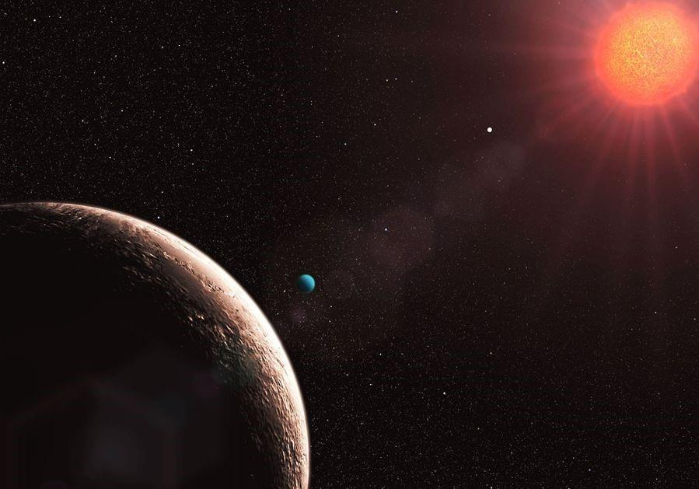
Credit: ESO/L. Calcada
As it is currently understood, the three confirmed planets Gliese 581 e, b and c are inside the warm edge of the star’s habitable zone and are expected to be tidally locked, always facing the same side towards the parent star. These parameters suggest it is unlikely these planets are hospitable to life.
In 2008, a radio signal was beamed towards the Gliese 581 system containing 501 digitised messages. If anybody is listening at the other end, we can expect a reply in 2050.